INDEX
ABOUT
FAQ
GLOSSARY
MBTI TYPINGS
MBTI RELATIONS
DISCORD
PHOTOS
STORIES
GENERAL
DIFFERENCES
TYPING
FUNCTIONS
TABLES
LISTS
WORKS
VARIOUS
NAMES
MORE
➤ Disclaimer
➤ Factors
➤ Relations
➤ Quadrants
➤ Closeness
➤ Curiosities
➤ Circles
➤ Descriptions
My intention with this page is to offer a general layout to explore and refer to the 16 type-relations. It's not about how relationships between different types "should be". In many cases what's described here might be completely absent or even contrary to the actual interactions between real people, because a) every type can take very different "forms/versions/paths" (and I just can't imagine all of them), and b) outside the general ideas there are lots of factors that come into play and influence how things go.
1. Please be aware that what's written here can only be relevant if people's types are correctly identified. If they aren't, and you're not open to the extremely common possibility of mistype[s], then it's all going to be very confusing and eventually counterproductive. Some descriptions can be useful for identifying some of those mistypes, or perhaps for getting a few indications if you're simply trying to type someone and have taken your time to make sure at least one person who's closely related to him/her is correctly typed with a clear understanding of what dichotomies and functions truly mean, not taking tests, and NOT with the "functions" that most people take for granted, because those famous "eiei/ieie" function "stacks" are all incorrect, and they only make things worse for everybody (the real functions of the types are included in the table below). So, please, be careful with all this. It's been decades of widespread misconceptions, and this typology is definitely not like most blogs/sites explain it.
2. Sometimes it can be a few years before you finally identify a person's true type. In fact, for most people the subject of relations needs a big red sign at the door which says: "whoa" and then another one with "you are just getting ridiculously ahead of yourself" (capital letters everywhere). The most important thing in all this is not being mistyped. That's where the attention should be. For several years. And then some more. Because, chances are, lots of people are mistaken about their type and the types of those around them. They think they are something they are not ("introvert" and "intuitive" being among the most misused words here), and that's precisely what needs to be corrected, for everyone's sake. If it's not, the relations will be just more problems. So another red sign for the door: "come back in five years".
3. Don't take anything in this page (or the blog, or life in general) as "proof" or justification for feeling "superior" or "inferior" to anyone. This is especially important regarding asymmetric relations (Convex-Concave and Accent-Fade). Don't think that these unequal positions give you "authority" or some kind of "power" over anyone, or that being nice/helpful to others means the person is some sort of "subordinate" type so you/others have the "right" to treat them as such. Don't do that. Don't make hierarchies. Pay attention to your conceptual assumptions and remember that type relations are always a circular thing: whatever you think about a supposedly "lesser" type, you are always in that same position from the point of view of another type, so maybe you can imagine what it would be like if they thought that of you.
The moment we start looking at interactions between two or more people everything comes into play, not just the types involved.
You have, for example, age. Age has a great effect, not only in terms of gaps and how long the individuals have known each other, but also because any type can go through different levels of function differentiation, which modify some of the crucial contents that a person has in his/her mind. A particular ISTJ, for example (or someone with any other type), can hold certain opinions/beliefs when [s]he's young, but [very] different ones when [s]he's older, so for people with similar or opposing beliefs, the specific moment/stage in which the encounter takes place is definitely more important than the person being an ISTJ.
There are other [more or less] variable factors that affect relationships in similar ways. Instead of beliefs you can think about economic means, education/profession, tastes and hobbies, interests and plans for the future, etc. Other components tend to be quite static in comparison, for example kinship (it's not the same having an ESTJ as a younger cousin than as a father), social/cultural/religious divisions (of individuals but also of their families and friends), any kind of subordination (boss-employee, etc), physical attraction (or lack of), etc. All that diminishes and sometimes overrides the relevance of the particular types.
It's important to notice that not all relations are the same, even if they are equivalent. That is: even though ESTJ-INFJ is conceptually the same as ISTJ-ENFJ, the actual [visible and internal] "result" of those relations is not the same, and different pairs always constitute different "combos", with different resulting essences, possibilities of interaction, external contributions, etc. They don't look the same, they don't work the same, and they don't feel the same (that's why, in reality, we should be talking about 11x8 + 3x16 = 136 relations). One of the main factors for this is the different temperaments of the types, which follow a pattern that doesn't match the cognitive functions. In the previous example, ISTJ-ENFJ don't share temperament components at all, but ESTJ-INFJ both have the melancholic element, so they are already much more similar than the other pair.
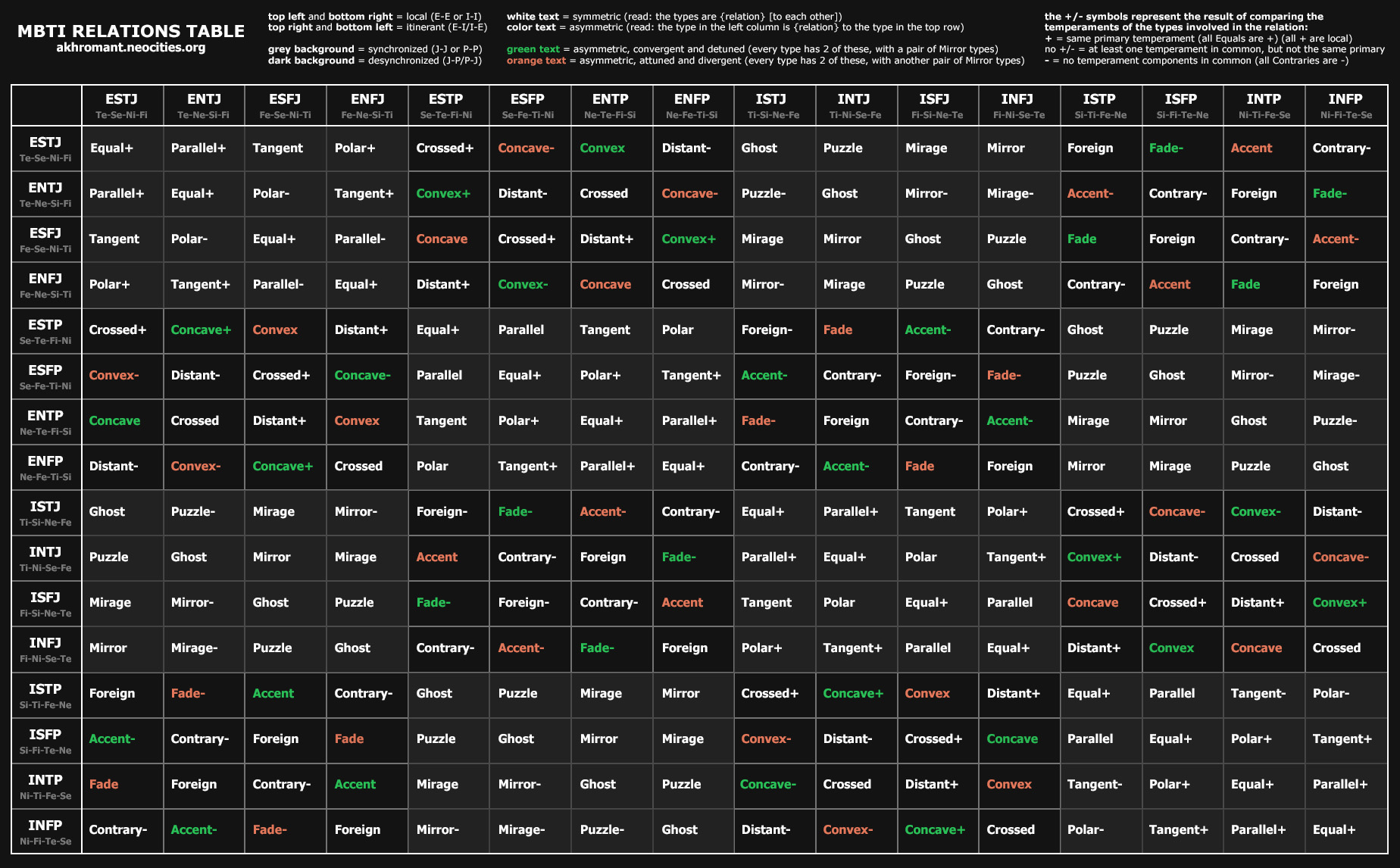
The names of the relations are based mostly on how the dichotomies and functions of the two types compare (remember that this is purely schematic: actual relationships are obviously not reducible to a word). I tried to make them both general and neutral, because there are always new aspects to be discovered, and implying constant problems or relational "superiorities" and "inferiorities" is just wrong. Each line below includes first the name of the relation (which can be used to refer to the other type, too), then the other type's proper functions (X1-X2-X3-X4) written with those of the type in question (often your type), and then the way the letters change between them.
Equal (X1-X2-X3-X4): your type.
Parallel (X1-G3-G2-X4): your SJ↔NJ or TP↔FP counterpart.
Mirror (X4-X3-X2-X1): the type that only shares your J/P.
Mirage (X4-G2-G3-X1): the type that only shares your SJ, NJ, TP or FP.
Crossed (X2-X1-X4-X3): your J↔P counterpart.
Contrary (X3-X4-X1-X2): the type with all the letters that you don't have.
Concave (G3-X1-X4-G2): the previous type in your local circle (see below).
Convex (X2-G4-G1-X3): the next type in your local circle (see below).
Accent (G2-X4-X1-G3): the previous type in your itinerant circle (see below).
Fade (X3-G1-G4-X2): the next type in your itinerant circle (see below).
Distant (G3-G4-G1-G2): the type that only shares your E/I.
Foreign (G2-G1-G4-G3): the type that only shares your ST, SF, NT or NF.
Tangent (G4-X2-X3-G1): your TJ↔FJ or SP↔NP counterpart.
Polar (G4-G3-G2-G1): the type that only shares your EJ, IJ, EP or IP.
Puzzle (G1-X3-X2-G4): the type that only shares your TJ, FJ, SP or NP.
Ghost (G1-G2-G3-G4): your E↔I counterpart.
The following 5 pairs of terms can be used to describe certain aspects that different relations have in common. For example: Polar is a symmetric, local, synchronized, divergent and detuned relation, and it is like that for everybody. Some relations vary in the last two points for different pairs of types.
➤ A symmetric relation is one in which the movement or transformation of the functions from one type to the other is the same in both directions. In asymmetric relations it's not the same. (Each type has 12 symmetric relations (white text) and 4 asymmetric relations (color text)).
➤ If the types have the same Attitude (E-E or I-I) then the relation is local. If they have different Attitudes (E-I/I-E) it's itinerant. (Each type has 8 local relations and 8 itinerant relations). Itinerant relations can have a kind of rescue motif going on inside them, with the extravert doing the outer saving, and the introvert doing the internal one. This can be seen for example between Contraries (Howl and Sophie in Howl's Moving Castle), Mirrors (Neo and Trinity in The Matrix), etc.
➤ If both types have the same Rhythm (J-J or P-P) the relation is synchronized. If they have different Rhythms (J-P/P-J) it's desynchronized. (Each type has 8 synchronized relations and 8 desynchronized relations).
➤ Same Judgment (TiFe or FiTe in both types): convergent. Different Judgments: divergent. (Each type has 8 convergent relations and 8 divergent relations).
➤ Same Perception (SiNe or NiSe in both types): attuned. Different Perceptions: detuned. (Each type has 8 attuned relations and 8 detuned relations).
Each group of 4 types with the same proper functions is called a "quadrant". There are 4 quadrants, of course. I use the cardinal directions to name them, taking the classic elements of each group as reference: North and South are air+water (like the poles), while East and West are earth+fire (like the deserts). A fitting result is that Polar, Distant, Foreign and Ghost types are all in opposite groups/directions, and the four asymmetric relations involve adjacent ones:
North = ESFJ, ESFP, INTJ, INTP (they all have TiFe and NiSe) (only SF+NT = Water+Air)
East = ESTJ, ESTP, INFJ, INFP (they all have FiTe and NiSe) (only ST+NF = Earth+Fire)
South = ENTJ, ENTP, ISFJ, ISFP (they all have FiTe and SiNe) (only NT+SF = Air+Water)
West = ENFJ, ENFP, ISTJ, ISTP (they all have TiFe and SiNe) (only NF+ST = Fire+Earth)
As a very general rule, you are often more interested, involved and/or comfortable around people of your same quadrant, because sharing all the functions makes interpersonal links more real, more grounded in something true (see post #24.4), even if it's unexpected, displaced or a bit chaotic. With people from adjacent quadrants there's a mix of true and false connections, and in the case of those from the opposite quadrant everything is somehow unreal. It doesn't mean you can't be on good terms with them, this is something more subtle and indefinite than that, and sometimes ghostly elements feel better than too-real ones. Also, shared letters tend to have a kind of "smoothing" effect, so for example it's very common to find good friends who are Ghosts, or totally incompatible Mirrors.
The +/- symbols after the name of the relation are a general indication of its relative (and theoretical) "softness" or "easiness". They come from comparing the temperaments of the types involved: a plus sign "+" means that both types share their primary temperament, a minus sign "-" means that the types don't share temperament components, and no +/- means that the types share at least one temperament component, but not the primary.
There are other factors that can add + or - to actual relations (temperament is just one that can be determined right away for all of them). These are some ideas (all cumulative):
✸ One - for subordination or different generations (boss-employee, parents-children, etc).
✸ One + for relatives/friends at the same "level" and generation (siblings, classmates, etc).
✸ One - for completely unrelated past experiences (culture, life events, conditions/lifestyle, etc).
✸ One + for shared/identical past experiences (culture, life events, conditions/lifestyle, etc).
✸ One - for completely unrelated interests, beliefs and plans for the future.
✸ One + for shared/identical interests, beliefs and plans for the future.
For couples (the last two are about social pressure):
✸ One + if both partners find each other attractive.
✸ One + if the man is T and the woman is F.
✸ One - if the man is F and the woman is T.
The signs are computed mathematically, so maybe after taking several elements into account a given relation can go from Contrary- to Contrary++.
I think the most likely conflict seems to appear in asymmetric relations, especially the itinerant ones (Accent and Fade), and also the Contrary, Mirror and Mirage, sometimes (but these can be [really] good friends and couples, too). One source of dispute is other people pointing out, showing, demanding, carrying too far or just "intruding" in things that resonate with someone's unconscious. The Wheelwright couple were Mirror types (ENFP-ISTP) (they are listed in the typings page) but, even though they obviously benefited from Jung's help (and they share the sanguine component), they were together for a long time. Sometimes there's a complementariness between the types that might bring good things, but it's hidden because other elements stand in the way, especially egos, prejudices and low self-awareness. The idea is that people can work to improve their interactions, but of course this can be extremely complicated, because it's never just one person in any of them.
The most peaceful interactions are, in theory, between those who share a lot of things, but you still have to remember all the elements that I mentioned before (which can bring problems to anyone), and also that just because they are peaceful doesn't mean they are all-purpose.
1. All types have 4 + and 4 - relations, except the pure-temperament types (ENTJ, ESFP, ISTJ and INFP), with 9 - relations.
2. All + are local (E-E or I-I).
3. All Equals are +.
4. All Contraries are -.
5. There are no - in Equal, Crossed or Ghost.
6. There are no + in Mirror, Mirage, Foreign, Puzzle or Contrary.
7. The only Parallel- is ESFJ-ENFJ.
8. The only Tangent- is ISTP-INTP.
9. The only Foreign- are ISTJ-ESTP and ISFJ-ESFP.
10. There are no orange+ (orange = asymmetric, divergent and attuned).
11. There are lots of mistypes between green+ (green = asymmetric, convergent and detuned).
12. Ghost, Foreign, Polar and Distant are all divergent and detuned (these are the 4 types of your opposite quadrant).
13. Equal, Crossed, Mirror and Contrary are all convergent and attuned (these are the 4 types in your same quadrant).
14. If your Concave is divergent+attuned then your Convex is convergent+detuned (this happens to all Ps), and vice versa (all Js).
15. If your Fade is divergent+attuned then your Accent is convergent+detuned (this happens to all Js), and vice versa (all Ps).
The circles below are a good way to visualize and think about the 16 types, because they make it easier to deduce and keep in mind some of the relations between them (especially the asymmetric ones). All circles follow these two basic sequences: ↔SJ↔SP↔NJ↔NP↔ and ↔TJ↔FP↔FJ↔TP↔. The arrows don't have a predetermined meaning, they are just a reminder of the two kinds of asymmetry and the fact that the two types involved don't see each other in the same way.
The best idea is to focus on the 4 local circles: the ones consisting only of extraverts or introverts. If you memorize them, then in order to obtain the itinerant ones (those who alternate extraverts and introverts) you only need to change the attitude (E↔I) of the types at the sides (the Js or the Ps, depending on your preferred point of view), and remember that the arrows don't mean the same as the previous ones, of course.

In the local circles, the types opposite each other (ESTJ-ENFJ, for example) are Polar types. If you go around looking from the outside at the center of the circles, the type on the right of any given type is its Concave (or the "previous" one, if you follow the arrows), and the one on the left is its Convex (the "next" one). The type in the same position of the up↔down circle is its Ghost. Your Ghost has your Fade on its right, and your Accent on its left. The Polar of your Ghost is your Mirror type. If you take those two circles and switch all Ts↔Fs you get the other two circles on the other side. The relations there can't be determined with simple visual rules like the previous ones, but we already have half of the total, so it's not that bad.

In the 4 itinerant circles the arrows have a different color because the relations are different: the "previous" type is now the Fade, and the "next" one is the Accent.
The next pair of images combine the quadrants and the circles:


These are just some preliminary notes. I still have a lot of work to do, and large portions of the following might change [radically] later on.
✸ Equal
local, symmetric, synchronized, attuned, convergent
This is the relation of each type with people of the same type. The idea is that, putting aside differences in talent, means and discipline (the fact that you might not be able to do it or explain it), you are in the best position to understand the ultimate source and intention of your Equal's actions and creations ("work"). Everything in them that's meaningful in the deepest sense is inside your "cognitive scope".
It's important to remember two things here. One is that "work" includes virtually everything people do, not only what's related to an "occupation" or "profession". The other is that you can admire and love the work of any type, so you can't just interpret "I like his/her work a lot" as a sign of someone having your type, or dislike as an indication of different types. Not everything in an Equal's work is going to be good: sometimes it feels extremely mistaken, unnecessary, ridiculous, etc.
Certain reactions of internal discomfort or "embarrassment", especially if we have already tried and discarded that kind of work, might come from the fact that we are too familiar with the subject, the process and/or the approach, so it might feel too naive, needlessly revealing, incomplete or repetitive. (It's funny because it's only our type that sees that, not the others). It can also make you think that you can do it "better", of course. And some things we don't even need to try to know that we would never do them, even if we are sure they come from an Equal.
✸ Concave → X → Convex
local, asymmetric, desynchronized
→ENTP→ESTJ→ESFP→ENFJ→
→ENFP→ESFJ→ESTP→ENTJ→
→INTP→ISTJ→ISFP→INFJ→
→INFP→ISFJ→ISTP→INTJ→
(In each of the four lines of types the last arrow is the same as the first). These are two asymmetric relations (like Accent and Fade) because you don't see each other at the same level: you see one type as Convex, but it sees you as Concave, and you see another type as Concave, but it sees you as Convex.
The names try to convey mainly two things:
a) The slight inclination that occurs between people with these types: the Convex person tends to be somehow "available" to his/her Concave, especially in terms of closeness, attention, help, or support. Sometimes it's just "being there", listening, for example. People of other types can do the same thing, of course, but the key between these two is that there's always an inequality. The relation to your Concave is a bit like a student listening to the words of a teacher who can explain interesting things, useful things, and also perhaps that which the student already does instinctively (= can't help but do/be), while at the same time seeing the teacher's struggles and limitations in the way someone could see a wounded animal, for example. (You might need to replace "words" with some other quality or activity of the Concave, of course). Following this analogy, sometimes the Concave realizes [s]he can't really teach anything [new] to the Convex: [s]he's definitely living things through additional or extended senses ("beyond").
b) The ideas that go from you to your Convex are more likely to generate some kind of conclusion in him/her (intellectual, active, etc), like the way light rays can be made to concentrate in a point when they pass through a convex lens. This is not necessarily about obedience, it can be about the Convex person taking the information to another level, a different psychological "realm", a different field/audience (for example spreading it), etc. In the other direction the effect is the opposite: the Concave can't make full use of what the Convex says (the ideas spread, so they only get a few rays). Still, the Concave can benefit from the kind of activity, knowledge, etc, that certain Convex people can offer.
The general function-reasoning would be like this: Concave has Convex's dominant as auxiliary, so there's always something more important for an ISTJ (Ti-Si-Ne-Fe) than what ISFP (Si-Fi-Te-Ne) brings as "final result", for example. ISFP is busy and happy simply with useful things, but ISTJ demands some kind of conceptual purity from that work. On the other hand, ISFP sees that ISTJ doesn't have Fi/Te, and also that there's some kind of limitation inside the person that obstructs the awareness of Si in all its splendor. You can replace these two types with others and see what might be the transference in the different combinations.
On average, and with everything else being equal, you tend to prefer your Concave to your Fade, and your Convex to your Accent. That is: local asymmetry feels better than the itinerant one. The difference is not as strong as the one between Contrary and Distant, but it's there.
✸ Polar
local, symmetric, synchronized, detuned, divergent
ESTJ-ENFJ, ENTJ-ESFJ, ESTP-ENFP, ESFP-ENTP
ISTJ-INFJ, INTJ-ISFJ, ISTP-INFP, ISFP-INTP
I call this relation Polar because this type is at the other side of your 2 proper circles, and it doesn't have anything in common with you, except the "legend" age (IP/IJ/EP/EJ). There's some kind of communication here, some kind of flow between both types, and sometimes it's interesting, but it's usually quite bumpy, as if the types were actually opposed poles in a planet and the ideas needed to cross water, valleys, mountains and abrupt terrains, and arrived in bad shape. It's not automatically uncomfortable, but it can be, and sometimes the shock is too much.
You can admire the work of a Polar person, and sometimes there is a certain "alignment" and you really like what one of them does. Other times, and regarding the closest aspects of the relation in general, some kind of effort is probably required, some "learning" or "getting used to", because those things are definitely not natural for you.
✸ Parallel
local, symmetric, synchronized, detuned+convergent for Js, attuned+divergent for Ps
ESTJ-ENTJ, ESFJ-ENFJ, ESTP-ESFP, ENTP-ENFP
ISTJ-INTJ, ISFJ-INFJ, ISTP-ISFP, INTP-INFP
Parallels probably understand where the other person is coming from, but disagree or don't really get their final conclusions or applications. They might need to translate too often what they mean. I think they don't tend to be in direct opposition, and they can be quite close, but in comparison with Tangents, for example, they probably keep a certain distance.
✸ Distant
local, symmetric, desynchronized, detuned, divergent
ESTJ-ENFP, ENTJ-ESFP, ESFJ-ENTP, ENFJ-ESTP
ISTJ-INFP, INTJ-ISFP, ISFJ-INTP, INFJ-ISTP
With your Distant you know you don't have anything in common, but the conversation seems to build itself quite easily. You adopt an interested but evidently cold and formal attitude, like discovering a completely new point of view that adds unexpected sides without removing or replacing anything. It feels like business. The sense of conflict is almost nonexistent, but there's also no special attachment either, no emotion involved, and no need for more (in fact it can be too much if it goes for too long). There's no interest in the other person's private life, no worry if you never speak with them again, etc. (I think you can even feel like they are not actually "needed" in any sense). The person has his/her weird things, but is almost completely respectable, in a neutral way, and you probably won't even feel like giving them advice, asking them for help or trying to cooperate explicitly in anything.
I called that Distant because that's how it really feels. Sometimes there's the intention of trying to "get closer" to your Distant with some kind of gesture, but it ends up feeling like an intrusion. The response seems to indicate that they don't actually need you [to do that]. (It actually feels very symmetric: if you pay attention, they probably [are] do[ing] the same from their side). Their work might be interesting or not.
✸ Tangent
local, symmetric, synchronized, attuned+divergent for Js, detuned+convergent for Ps
ESTJ-ESFJ, ENTJ-ENFJ, ESTP-ENTP, ESFP-ENFP
ISTJ-ISFJ, INTJ-INFJ, ISTP-INTP, ISFP-INFP
Sometimes, especially at first, there might be a kind of (foolish) sibling-like rivalry between Tangents, if they spend enough time in the same circle[s], at similar levels. They are both trying to compete or achieve the same thing but coming from different sides. The thing is that Tangents are usually very good friends, and they can also form a couple. There can be a great deal of admiration for the work of some of your Tangents.
In the long run, and following its name, people in this relation tend to drift apart, and sometimes there's a very noticeable break between them. This is what happened between Freud and Jung, for example (INFJ/INTJ).
✸ Crossed
local, symmetric, desynchronized, attuned, convergent
ESTJ-ESTP, ENTJ-ENTP, ESFJ-ESFP, ENFJ-ENFP
ISTJ-ISTP, INTJ-INTP, ISFJ-ISFP, INFJ-INFP
Crossed types share everything except their rhythm (J/P). This might seem inconsequential, but it's actually very important and, ultimately, crucial. It reverses the interrelation of the functions both in the conscious and the unconscious side, so in a way the result looks like the same sphere but inside-out (although from the other's perspective it might feel more like wrong-side-out). I don't know if this manifests more often as a problem, a curiosity, or something useful.
Each Crossed probably sees the other as something that can be improved, although I don't think they try to do that directly, or at all. Perhaps there's a sense that "it just can't be helped". In their interactions, and with everything else being equal, the judger proposes focus, decisions, consequences, commitments, goals, construction, organization, and/or some kind of [self-]regulation, while the perceiver suggests opening things up, browsing, drifting, experimentation, detours, playing, slacking, and/or some form of [self-]indulgence. I think this can be seen quite clearly in certain fictional pairs, for example Frodo and Sam from The Lord Of The Rings (ISFJ/ISFP), Cyclops and Wolverine from X-Men (ESTJ/ESTP), or Nicholas and Conrad from The Game (ENTJ/ENTP).
✸ Ghost
itinerant, symmetric, synchronized, detuned, divergent
ESTJ-ISTJ, ENTJ-INTJ, ESFJ-ISFJ, ENFJ-INFJ
ESTP-ISTP, ESFP-ISFP, ENTP-INTP, ENFP-INFP
The relationship with your Ghost can be fantastic: all-day-long interesting, funny, non-confrontational, etc, at most "levels" of interaction, especially if there are shared hobbies, of course. It's only what could be called each other's "ultimate worldview" that doesn't fit at all. Their deepest awareness/evaluation of things doesn't have any real common foundation: it's all a phantasm. Maybe you can sense this during your interactions, and stop before getting in trouble, but this might be easier for some people, and perhaps unavoidable for others (there are probably more Ps in the former group, and more Js in the latter). A classic example of this relation would be the one between Plato (ISTJ) and Aristotle (ESTJ).
It's quite common that in the interaction between two Ghost friends/partners the extravert seems to be somehow "taking out" and "carrying" the introvert around, taking him/her to places, introducing him/her to other people and activities, etc (this can also happen in other itinerant relations, of course).
✸ Fade → X → Accent
itinerant, asymmetric, desynchronized
→ENTP→ISTJ→ESFP→INFJ→
→ENFP→ISFJ→ESTP→INTJ→
→INTP→ESTJ→ISFP→ENFJ→
→INFP→ESFJ→ISTP→ENTJ→
(In each of those four lines of types the last arrow is the same as the first). These are two asymmetric relations (like Concave and Convex) because you don't see each other at the same level: you see one type as Accent, but it sees you as Fade, and you see another type as Fade, but it sees you as Accent.
One of the things that these two names try to reflect is how the initial situation might look to someone who finds/joins a group of people that includes both their Accent and their Fade: they probably see too much focus, attention or importance placed on the Accent person, and too little on the Fade one. This might be just a subjective impression, and some people might want to reverse it or balance it in some way, following the fact that their Accent's dominant function is eclipsed by their Fade's: G2-X3. The names of the relations also describe this new situation: your Accent focuses his/her/the attention on you, and your Fade does the opposite.
I think we tend to see the potential problems and conflicts with our Accent quite early in comparison (maybe even before any interaction, in some cases), but with our Fade it can take longer. (In fact, that's also part of the point of the relations' names). The asymmetry might get to a point where the initial "focus displacement" reaches a limit and we'd actually prefer if our Fade stopped doing something that they do. This is partly related to how their X1 is our X3, we are interested in it but we want to limit it somehow, and partly to the way they might go against our X1, or reinterpret it in terms of our G4.
As a general rule, when an Accent and its corresponding Fade are in the same place, or working on the same thing, the focus and the [public] attention tend to be on the Accent, while the Fade stays somehow in the background (or "behind the scenes"). This is more directly noticeable when the Accent is an extravert, of course. In those cases the Fade's influence is mostly personal, artistic, etc. As examples you can think of Yoko Ono (INFJ) and her effect on John Lennon (ENTP), or Michel Gondry (INFP) and the videos that he made for Björk (ESFJ). When the Accent is an introvert the Fade is usually working for or directing some kind of event, movement, organization or industry. Sometimes, if the Accent introvert starts getting too famous or powerful, the Fade extravert might try turning the focus [back] to him/her. Here you have, for example, when space flight was just starting, the Russian ESTJ supervisors and engineers that prepared everything for Yuri Gagarin (ISFP), the first human to travel into space.
✸ Mirror
itinerant, symmetric, synchronized, attuned, convergent
ESTJ-INFJ, ENTJ-ISFJ, ESFJ-INTJ, ENFJ-ISTJ
ESTP-INFP, ESFP-INTP, ENTP-ISFP, ENFP-ISTP
I think this relation can be a question of extremes: you either match perfectly with your Mirror, or you mostly can't stand him/her. This effect is clearly related to the all-or-nothing quality of the inferior function, and it might apply to the same individual, alternating from one moment to the next. I don't know which situation is more common, but I'd say the clashing one is more frequent when the Mirror is of the sex that you don't feel attracted to. Still, you can find examples of Mirror friends, like Lennon and McCartney (ENTP-ISFP).
Knowing the difference between your proper and ghost functions is very useful (it's not about ignoring the ghosts, but realizing what they are and why they are that way). In that context, one of the main differences between Contrary and Mirror is that your Contrary can help you distinguish between your X3 and your G3 right from the start (it's their X1 and G1), which also helps with your X2//G2 (their X4 and G4), because those two proper functions run very close together (they are a kind of internal engine in your mind). A Mirror needs to be more "advanced" in his/her own self-knowledge to be helpful in that way, and in any case the combination is never the same, of course.
✸ Puzzle
itinerant, symmetric, synchronized, attuned+divergent for Js, detuned+convergent for Ps
ESTJ-INTJ, ENTJ-ISTJ, ESFJ-INFJ, ENFJ-ISFJ
ESTP-ISFP, ESFP-ISTP, ENTP-INFP, ENFP-INTP
It's very common to admire the work of certain people with our Puzzle type, especially when we are young, to the point of being absolute fans, completely absorbed by it (like someone in front of a jigsaw puzzle), and believing we share with them much more than we actually do. That's because we have the same X2-X3 pair, but inverted, so we can keep each other "running", and we also share 2 letters and a general dominant essence. That's the foundation for the abundance of Puzzle couples out there, and for the multitude of mistypes between Puzzles, too. In the last case there's the additional fact that the actual functions of the extraverted type are a rearrangement of the introvert's in the false eiei/ieie order. All those are the reasons behind so many ENFPs (Ne-Fe-Ti-Si) believing they are "INTPs", so many ESFJs (Fe-Se-Ni-Ti) mistyping as "INFJs", lots of ESTPs (Se-Te-Fi-Ni) thinking they are "ISFPs", etc.
✸ Contrary
itinerant, symmetric, desynchronized, attuned, convergent
ESTJ-INFP, ENTJ-ISFP, ESFJ-INTP, ENFJ-ISTP
ESTP-INFJ, ESFP-INTJ, ENTP-ISFJ, ENFP-ISTJ
There's an almost automatic and completely honest admiration of your Contrary's work, and the conversation is probably about that, not about an intermediate thing (which was Distant's case). Their weird things and problems are not neutral, they carry some kind of emotion for you (sorrow, for example), and you might try to help, and/or feel better asking for help than in Distant's case. The person is usually more interesting than the Distant. You might share "deeper" jokes with your Contrary, for example. There's also a [slight] sense of danger coming from that person, but not actually towards you, it's weird.
I think a difference between Mirror and Contrary is that the Contrary might seem like a "magician" or a "miracle worker" a bit more than the Mirror who, in a sense, can be slightly more "understandable" from your point of view, even if still impressive, of course. (This is probably limited to particular cases, not a rule about the type). Your Contrary has your G4 and X4 closely linked (as G2 and X2, respectively), so they can see and act on the connection between them, especially in the X2←G2 direction, which corresponds to something almost magical in you: G4→X4, and they can do it better than any other type. Your Accent has the same X2←X3, but they have it inside a ghost dimension (your G2-G3), so the result tends to feel somehow inadequate or "lost".
✸ Mirage
itinerant, symmetric, synchronized, detuned+convergent for Js, attuned+divergent for Ps
ESTJ-ISFJ, ENTJ-INFJ, ESFJ-ISTJ, ENFJ-INTJ
ESTP-INTP, ESFP-INFP, ENTP-ISTP, ENFP-ISFP
The name here tries to convey the idea of an imperfect mirror, of something that seems to be there but it's elusive, partly because, even when there's no friction, the apparent results of communication tend to vanish in the air, or be relocated to a farther position that you never seem to reach.
I think Mirage doesn't tend to be a very smooth or solid relation in comparison. I haven't found any famous Mirage couples, and only a pair of famous Mirage friendships (coworkers). I think they also tend to have very different lifestyles. They can be acquaintances, of course, and there might be many more cases of Mirage partners that I don't know of, but it seems that, in general, it works better from a distance, because this relation shares a slightly less intense version of the Mirror's love/hate extremes: when it works it's less great than the Mirror, but when it doesn't it's not so bad. When they are actually close, the idea is that Mirages often intrude in each other's unconscious (X4), and that can be uncomfortable. Maybe some people like that, perhaps under specific conditions, so there might be exceptions here, but it's not immediately obvious.
✸ Foreign
itinerant, symmetric, desynchronized, detuned, divergent
ESTJ-ISTP, ENTJ-INTP, ESFJ-ISFP, ENFJ-INFP
ESTP-ISTJ, ESFP-ISFJ, ENTP-INTJ, ENFP-INFJ
The word Foreign points to someone from another continent, another century, or another planet. You can't do what they do at all, but you might recognize the general kind of "energy source" that moves the other person (Foreign types share classic element: ST = earth, SF = water, NT = air, NF = fire), and its potential "good intention" or "side", so there's some kind of resonance there, even though you probably think the other person is somehow wrong in the way [s]he applies that energy.
The nonexistent "eiei/ieie" order causes a mistype tendency between many of the Foreign pairs, especially from extravert to "introvert" (and even more from EF to "IF"), because people see their true auxiliary+tertiary but mistake the attitude of their dominant+inferior. Many ESFJs (Se2-Ni3) mistype and are mistyped as "ISFPs", ENFJs (Ne2-Si3) as "INFPs", ESFPs (Fe2-Ti3) as "ISFJs" and ENFPs (Fe2-Ti3) as "INFJs". There are also some ENTPs (Te2-Fi3) mistyped as "INTJs", etc. Some people mistype a very clear INTP, Friedrich Nietzsche, as "ENTJ", too. And there are probably many other examples.