INDEX
ABOUT
FAQ
GLOSSARY
MBTI TYPINGS
MBTI RELATIONS
DISCORD
PHOTOS
STORIES
GENERAL
DIFFERENCES
TYPING
FUNCTIONS
TABLES
LISTS
WORKS
VARIOUS
NAMES
MORE
✸ → Types #1X
1.1) ALL THE FUNCTIONS FOR THE INTROVERTS ARE WRONG
It seems nobody can spot the difference between the introverted functions that Jung described and the current absurd mythologies that get attached to them. Because everything that you can read online about those "functions" (and most of the extraverted too) is wrong. And it seems nobody can recognize the actual correspondence between the introverted types in real life, the people that we supposedly know, and the ones that appear in Psychological Types.
I don't know what's the cause of this, but it might be that somebody read the descriptions and didn't like what Jung had to say about some types, probably the introverted rational ones. Some people started thinking about themselves and/or talking about those types as if they were some of the perceivers, because of their less threatening nature, perhaps. Introverted feelers say, for instance, that they are "dreamy", or "misunderstood", or something like that. Introverted thinkers may say they "love history", lament that others don't take their advice, etc. They are all "attuned to their senses" or "their intuition", etc. I'm sorry, but that's only the self-marketing language speaking, not a psychological analysis. It's all costumes and masks, in some kind of parade where everybody wants to be "special" (that is: marketable). At this point the language is so twisted up, that those words, and the types themselves, can mean anything.
Now, just for the sake of trying once more:
Do you really think INTJs/INFJs are the kind of people that a serious psychologist (not a Shakespeare) would describe as the artistic dreamers, misfits or cranks of society? Are they the "great men gone wrong", whose arguments tend to lack conviction and nobody understands, among all others? Are ISTJs/ISFJs indifferent to their surroundings and passive? Do they allow themselves to be abused? Do you really think their inner essence could be described as "calm"? Would a psychologist say ISFPs/INFPs' reactions to the object have a negative character? Is it really so that they don't join others' emotions, but instead try to cool them down? Do you really see those types as driven, and sometimes a bit paranoid? Are INTPs/ISTPs really the most "scrupulous"? Do they show a tendency to complicate themselves, and do they actually pay that much attention to detail? Do they give the impression of surrounding themselves with psychological minefields?
No. Jung wasn't writing his first impressions about a bunch of random people. He wasn't doing a "first thing that comes to your mind" exercise. His depictions were the result of years of professional practice on all kinds of people, and the evaluations he used were placed in their right positions along a wide spectrum. So it's the most scrupulous that gets called that, not the one that might be a little bit scrupulous from time to time, or someone that's trying to market himself as scrupulous in a job interview.
It's the INTPs/INFPs (Ni1) that get lost in useless fantasies. They are the weird ones. But not the weird ones on television or the media. That's not a faithful reflection of the spectrum of real people. They are the real weird ones, not the famous [extraverted] "lunatics". This is so obvious that I don't know how anybody can read Jung and think otherwise. It's almost as if nobody actually reads what he wrote. It's the ISFJs/INFJs (Fi1) that have unreachable visions, the ones that develop hidden intense feelings and sometimes imagine what others are thinking. They are the ones with a "mysterious power", the ones of sudden and heroic gestures. The scrupulous ones are the ISTJs/INTJs (Ti1), the ones that complicate themselves, and often others. They are the ones with the uneasy amiability, the ones that really seem to be worried about any lack of control. And the calm ones are the ISTPs/ISFPs (Si1), the ones that take their time to tinker and get lost in their own perception of things.
1.2) THE AUXILIARY IS WRONG FOR EVERYBODY
One of the main points in Jung's work was that consciousness is one-sided: either introverted or extraverted. You can't be "rational inside and irrational outside", like Myers said. That's not how it works. Your primary functions (conscious and unconscious) are one of those, and that's your J/P, which applies to both the inside and the outside. So you are always rational or irrational, everywhere, as a default state or "natural essence", and you seek the assistance of the other in particular moments/things/tasks/ideas, to help your true foundation, which is at all times "running in the background". You can also picture this as one inside the other.
The most important thing in Jung's work is the opposition between introversion and extraversion. If you really want to understand what he was trying to say here is another picture for you: those two attitudes as opposed points of attraction, and the contents of the mind starting at the center and then sliding and placing themselves more to one side than to the other, in pairs of interrelated but opposing elements. The first things to move from the center are the conscious of the person, that goes to one side, and the unconscious, that goes to the other. If the conscious goes to the extraverted end we have an extraverted person, if it went to the introverted one, we'd had an introvert.
The degree of self-clarity between the contents and workings of the mind (along this imaginary line between those two points of attraction) is what Jung called "differentiation". At this moment the main form of the conscious/unconscious are two functions. These can be Thinking/Feeling or Sensation/Intuition, either in that order or backwards. The conscious one (let's say it's Feeling) is indistinguishable from the way the subject "experiences" life/himself, making it harder to be identified than what's usually thought. This is what's called the "dominant function". The unconscious one, in this particular case, would be Thinking, and it could be called "unconscious dominant" (Jung called it "inferior"). One is introverted and the other extraverted. Always.
In his book Jung described these "pure" types in detail, but noted that differentiation always leads to a second element getting caught in the attraction of one side, sending its opposite to the other. These are two more functions, called "auxiliary" because they help the dominant ones. In order to be helpful they must be the pair that didn't move in the previous stage. In the case of our Feeling type they are Sensation and Intuition: one would go help the conscious Feeling and the other the unconscious Thinking (two possible combinations, then). The "poles of gravity" in the mind are introversion/extraversion, not conscious/unconscious, so the second function appears with the same attitude as the one that's already in place on each side. This means that if you are an introvert everything that slides to your conscious mind will be introverted, and if you are an extravert it will be extraverted. Your unconscious gets the other part.
This is actually one of the most amazing things that Jung discovered. Introversion and extraversion are basically two different worlds, and we live consciously in one and unconsciously in the other.
The extraverted types have always had two rightly defined functions whenever people talk about those MBTI types through them: the dominant ones (conscious and unconscious). But their auxiliaries are wrong in the minds of lots of people. So, in comparison with the introverts, they have been only half-mistreated. This means that the extraverted functions should be slightly better understood, but nobody is getting the introverted ones right at all, so I think their extraverted counterparts might be getting some backlash from all that misunderstanding.
1.3) ALL DESCRIPTIONS BASED ON THOSE "FUNCTIONS" ARE WRONG
I have to leave here a big thank you to reckful (aka reddshoes) for his great explanations about MBTI and typology (especially this one) (he doesn't like anything "functional" at all, to be clear). It was reading those lines when something made click and I finally understood what was wrong with the usual "stack model" that everybody seems to repeat over and over. It's all wrong, people. It's aaaaaaaaall wrong. Those who took the "stack" and started making sites, and descriptions of the types, and selling books, and typing people only with that (saying the "functions" were "cool" and "advanced"), only made the "types" even more meaningless, mixing people with all kinds of real types together. Then you have those absurd ideas about "grips" and "loops", that only magnify the seal of ignorance. Now there are so many contradictory and plainly imaginary things mixed up together in each type that currently those four-letter combinations amount to little more than amorphous collections of made-up "facts", clichés and misunderstandings.
There are patterns of mistakes in lots of typology-related texts out there. This one, for example, is one of the most common:
Their descriptions of "Te" are actually about TJs, not about Te as a function (because, for example, ITJs are Ti1).
Their descriptions of "Ti" are actually about TPs, not about Ti as a function (because, for example, ETPs are Te2).
Their descriptions of "Fe" are actually about FJs, not about Fe as a function (because, for example, IFJs are Fi1).
Their descriptions of "Fi" are actually about FPs, not about Fi as a function (because, for example, EFPs are Fe2).
Their descriptions of "Se" are actually about SPs, not about Se as a function (because, for example, ISPs are Si1).
Their descriptions of "Si" are actually about SJs, not about Si as a function (because, for example, ESJs are Se2).
Their descriptions of "Ne" are acually about NPs, not about Ne as a function (because, for example, INPs are Ni1).
Their descriptions of "Ni" are actually about NJs, not about Ni as a function (because, for example, ENJs are Ne2).
Again: it's all wrong. It's such a next-level kind of wrong that it was one of the main reasons for me to start publishing here. The thousands of books, pages, forums and blogs, the most famous and linked descriptions on the internet, the millions of posts about typing celebrities and characters and the different kinds of bricks and flavours of ice-cream. All backwards and twisted and wrong. ("But what about...?" Yes, that one too). All wrong, and basically useless. Only good for making ignorance look like complexity (as if that was some kind of guarantee), and not helping people at all. Yeah. There's a lot of things that "work" just like that.
OK. RIGHT. SO. WHAT CAN WE DO?
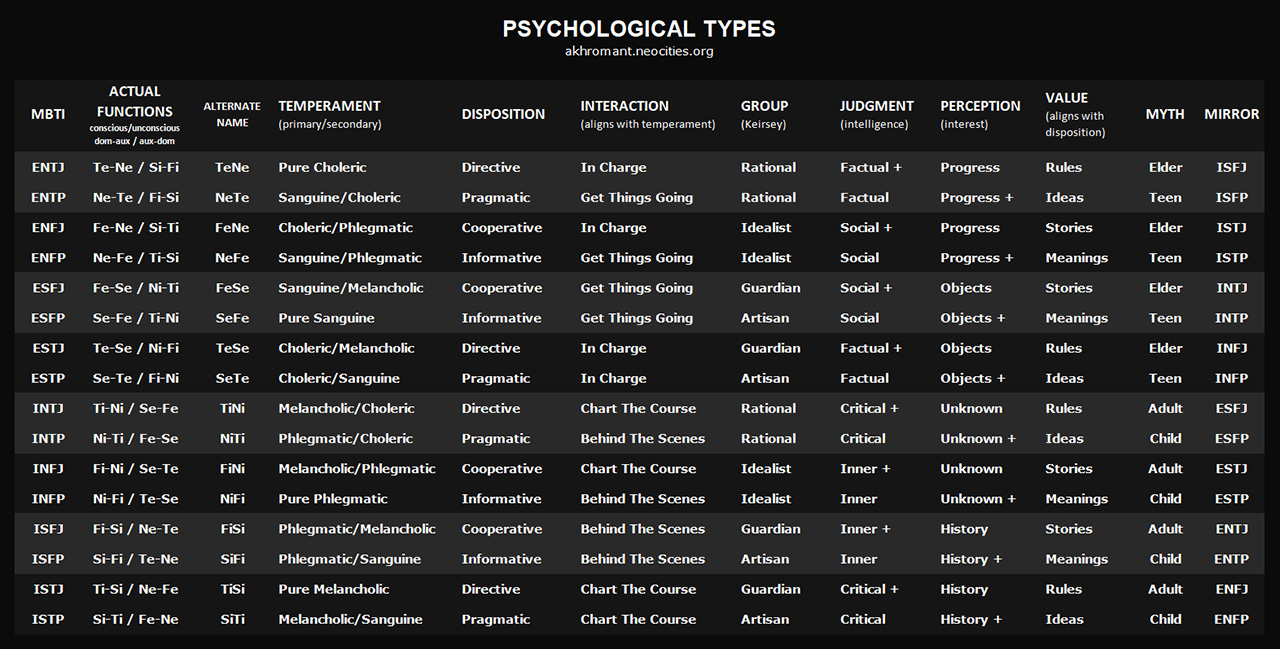
The real Jungian functions of each type are those that appear in this table that I've made. That's the way everything makes sense. The table includes some of the categories and terms that I've found to be the most meaningful in almost 10 years of reading and trying and thinking and collecting information and starting all over again, on this topic of psychological types. There are lots of things that could be there as well, but I think this selection works as a good starting point.
I tried to put words that could be used together in sentences, with a little tweaking, going from one column to another, in order to find new ways of exploring the types, their similarities and their differences. Some combinations don't work at all, I know, but others might go "click", and open doors. Some good examples could be: J types "want to find [perception][value] for [judgment]", and P types "want to find [judgment][value] in [perception]". The + sign marks the main standpoint of the type, what takes precedence over everything else. It should appear (or be understood) only as the most important source AND destination.
2.1) TEMPERAMENT
I find the temperament associations (taken from the links here) very meaningful because they seem to capture almost perfectly that kind of "vibe" or "air" that comes from the people of each type. They are colorful and give the types a more tangible aspect. (I made some images trying to show this: {1} {2} {3} {4} {5}).
One interesting thing is that we have a type with a "pure" temperament for each Keirsey group, intelligence, interest and myth (see 2.3 below). That's pretty neat. And the same can be said if we look at Berens' "interaction styles", because they all match perfectly.
And we also have matching descriptions if we take a look at Jung's Psychological Types. About the introverted feeling people he said: "not infrequently their temperament is melancholic." Check. On the extraverted thinker he used words such as "cruel tyrant" and "his expression and tone frequently becomes sharp, pointed, aggressive", which could easily be how someone would describe a choleric temperament. And about the introverted thinker he writes "emotivity and susceptibility", "bitterness", "isolation", "feelings of inferiority" and a certain tendency to victimhood (these last two are about both rational introverts), which are a good mix of melancholy and choleric things.
2.2) JUDGMENT AND PERCEPTION
The words "intelligence" and "interest" here are just a guide, like the rest of the words in the table. You know they are not "scientific", "final" or "exclusive" in any sense. That's not how I write. Ok.
We just needed to put the right functions in the table to discover this correlation:
Conscious Te = Factual Intelligence (ET = cTe)
Conscious Fe = Social Intelligence (EF = cFe)
Conscious Se = Interest in Objects (ES = cSe)
Conscious Ne = Interest in Progress (EN = cNe)
Conscious Ti = Critical Intelligence (IT = cTi)
Conscious Fi = Inner Intelligence (IF = cFi)
Conscious Si = Interest in History (IS = cSi)
Conscious Ni = Interest in Unknown (IN = cNi)
So, yes, your conscious includes both combinations of your second and third letters with your first letter. If you are a J their order is reversed (X1 = 3rd+1st, X2 = 2nd+1st), but with a P you already have them in order (X1 = 2nd+1st, X2 = 3rd+1st). There's a lot more to say about the functions, but those two-word descriptions are actually pretty good. We can make an experiment right now to see how the order matters a lot: ESFPs "would use their social intelligence to help their interest in objects", whereas ESFJs "would use their interest in objects to help their social intelligence".
Ok, just one more thing for now: "History" in the table means [personal] history (and things related to that), so it's not necessarily "world history" (whatever that is), or anything in a mere narrative sense. Conscious Si implies a more internal aspect of the perception of things, essentially "the known", in contrast to "the unknown" (which is the realm of Ni, as the two are mutually exclusive).
2.3) MYTH
We can arrange the 16 psychological types in all sorts of ways. One of them is using the first and last letters: EJ / EP / IJ / IP, which results in four groups of four. To me these are incredibly meaningful groups (in fact, it's the main classification in Jung's book). If you think about the types in each one you get a sense that they could be considered representations of four main archetypical roles that characters embody in legends and classic tales: the Child, the Teen (or Young), the Adult and the Elder. It's not about the actual age of anybody, of course. It's about the mythical qualities that their minds would probably acquire if they were characters in some kind of fairy tale. This arrangement matches the 16 court cards of the tarot perfectly, so you could say these 16 archetypes have been known for centuries.
The Child is the innocent bearer of strange and unmapped new treasures. He is the playful explorer that wanders and wonders at things, known or unknown. But the treasures he finds need somebody else to be recognized and applied, because the Child can only imply their existence, and he's actually somehow aware that they can be abused or misused, so he usually doesn't announce or lend them. The Child is often dependent in some important way (physical, emotional, economical, directional, etc). Sometimes they can be also suddenly original, weird, insolent or irreverent, because they don't recognize customs or authority. IPs are the eternal Children. (Si1/Ni1). All Children have some kind of phlegmatic temperament, except ISTPs, the more "mature" among them, and probably the less likely to be dependent.
The Teen is the one who thinks he knows everything. He's the one without restraint, daring and bold but also loud, reckless and dangerous. He "believes", goes out there and tries to prove himself. The Teen likes competition and anything that he hasn't done before. He likes change for change's sake. The groups or partnerships that he might be part of are usually just fleeting gatherings of separate individuals, not actual established institutions. And he joins whatever satisfies him, without thinking about responsibility. He wants everything, and doesn't understand the concept of incompatibility. The Teen takes games too seriously and work too leisurely. When something that should be mere routine goes amazingly well or terribly wrong is often because of them. EPs are the eternal Teenagers. (Se1/Ne1). All Teens have some kind of sanguine temperament. People that don't really understand typology tend to think of [famous] Teens as being Child types.
The Adult is the dutiful one, running things at a private scale, usually in small groups, like a team or a family. It's often an Adult that's in charge of Teens and Children. He is always working, and making things right. Everything is a serious matter for him, he has responsibilities. The Adult is a little worried that things might go wrong, and sometimes puts up with too much. He doesn't want anything to go to waste, or become a liability. The Adult might find it difficult to relax, but he is a solid foundation. He likes protection, involvement and development. He is ambitious in a common-sense kind of way. His results are localized, serving as a bridge to more work. IJs are the eternal Adults. (Ti1/Fi1). All Adults have some kind of melancholic temperament.
The Elder is the one running things in a public way, and he's usually somewhat alone in his position. He is a known leader, often consulted regarding important decisions in all kinds of matters. The Elder tends to work at his own pace (not necessarily slower than the rest, so he can be impatient with others), and gets global results. He's not actually worried, but more like resigned, or maybe somehow "possessed". He knows a lot that can be useful, but tries to focus on some principle that he has found and considers more valuable than knowledge. It's those principles that can "possess" some of them. EJs are the eternal Elders. (Te1/Fe1). All Elders have some kind of choleric temperament, except ESFJs, the more "child-like" and probably the most likely to be closer to younger people. I think there's also a tendency in this case, for people that don't really understand typology, to think of [famous] Elders as being Adult types.
This is something that I've been thinking about a lot lately. I like this kind of things :)
2.4) MIRROR
This would be the actual "dual" of each type, the one with the same functions in the opposite place. I don't know anything about how they "get along", and I'm still trying to figure out what kind of "switch" takes place between each pair, or how to explain it, but this was another problem with the usual "function stack", another thing that didn't make sense at all. This way it might start to do so.
—
Ok. I'd say that's enough for now.
Look at the table. Then go away. And think about it.
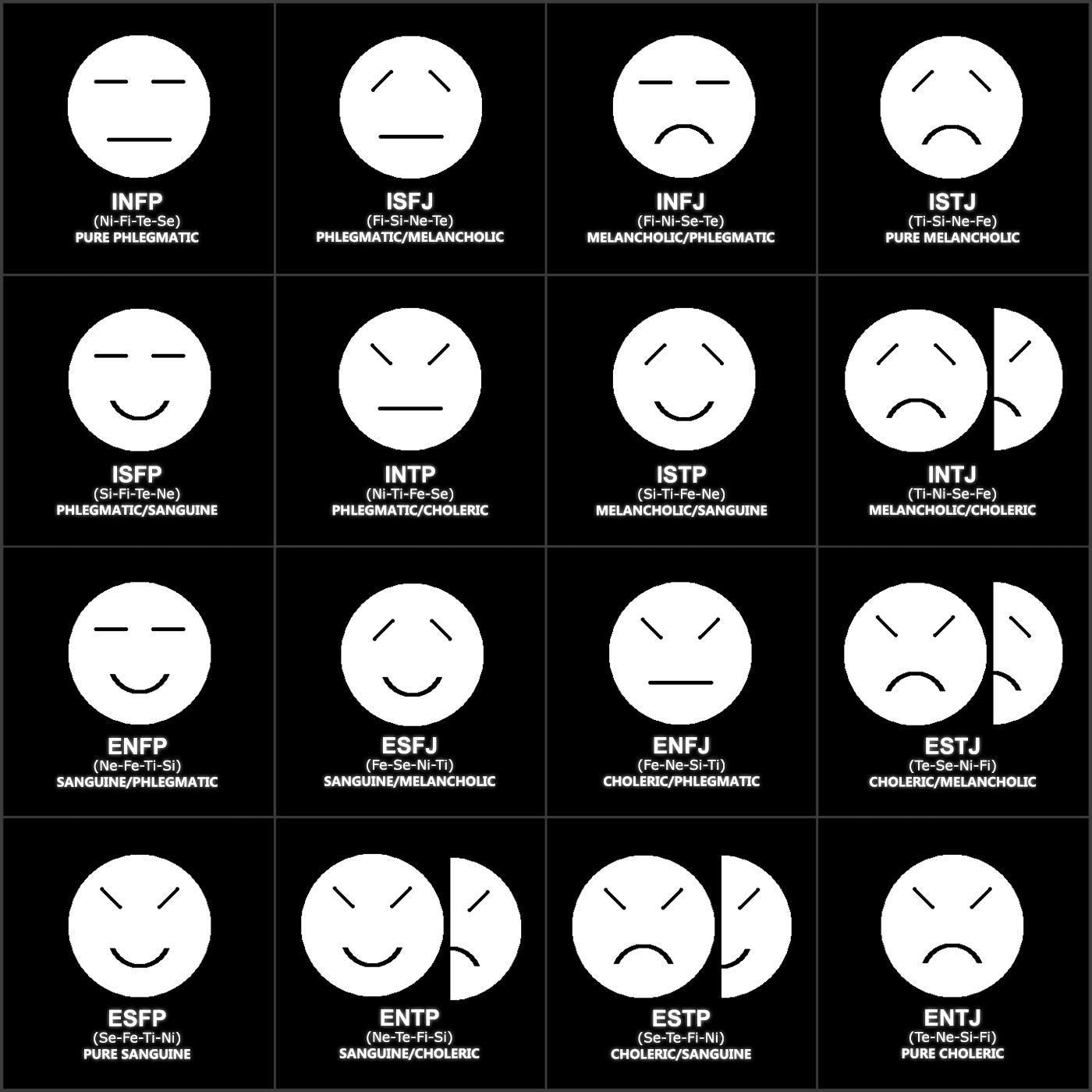
The MBTI types are not particular emotions or faces, of course. No one has the monopoly on being angry, or happy, or sad. These collections are just a funny way of trying to capture the most common or peculiar look/air/vibe that comes from people of each psychological type, using the four classic temperaments as a guide (phlegmatic, melancholic, sanguine and choleric). It's not so much about the physical but about the inner expressions (although sometimes they can be similar).

The MBTI types are not particular emotions or faces, of course. No one has the monopoly on being angry, or happy, or sad. These tables are just a funny way of trying to capture the most common or peculiar look/air/vibe that comes from people of each psychological type, using the four classic temperaments as a guide (phlegmatic, melancholic, sanguine and choleric). It's not so much about the physical but about the inner expressions (although sometimes they can be similar).

The MBTI types are not particular emotions or faces, of course. No one has the monopoly on being angry, or happy, or sad. These collections are just a funny way of trying to capture the most common or peculiar look/air/vibe that comes from people of each psychological type, using the four classic temperaments as a guide (phlegmatic, melancholic, sanguine and choleric). It's not so much about the physical but about the inner expressions (although sometimes they can be similar). I hope Shazzbaa doesn't mind my use of her beautiful drawings here, when I saw them I thought they were wonderful for the experiment :)

The MBTI types are not particular emotions or faces, of course. No one has the monopoly on being angry, or happy, or sad. These tables are just a funny way of trying to capture the most common or peculiar look/air/vibe that comes from people of each psychological type, using the four classic temperaments as a guide (phlegmatic, melancholic, sanguine and choleric). It's not so much about the physical but about the inner expressions (although sometimes they can be similar). I hope Shilin doesn't mind my use of her art here, it was precisely these expression drawings that gave me the idea for the experiment :)

The MBTI types are not particular emotions or faces, of course. No one has the monopoly on being angry, or happy, or sad. These tables are just a funny way of trying to capture the most common or peculiar look/air/vibe that comes from people of each psychological type, using the four classic temperaments as a guide (phlegmatic, melancholic, sanguine and choleric). It's not so much about the physical but about the inner expressions (although sometimes they can be similar). I hope Ravietta doesn't mind my use of her beautiful drawings here. When I saw them I thought they were wonderful for the experiment :)
Anonymous said: How come I can't find Fi Ni Te Se on the internet? Why isn't this theory anywhere else but Tumblr?
I think you mean Fi-Ni-Se-Te (the actual functions of INFJs). Ok. I know you're not implying this but, before we start, we need to remember that just because something is [not] online doesn't mean it's [not] true (yes, those are 4 sentences in one :D). Internet is no [dis]proof of anything. Also, this is not a "theory". I know for some that's just a way of speaking, but a lot of people like using that term (and "opinion", etc) to avoid recognizing the possibility that someone might have figured out the truth about something. The famous e-i-e-i/i-e-i-e function order is incorrect. That's just a fact. And this arrangement is how the real functions and the letters match. That's another.
Now, you can find the correct functions of the types outside tumblr: first of all, in Jung's work, of course. If you read carefully what he wrote and apply there the acronyms that we all know, you'll get to the same conclusion. Then there's also an explanation in this thread, and more examples in some of the comments that the author (reckful/reddshoes) makes here. If you can't find it anywhere else that's mostly for two reasons:
1) Most people seem to feel satisfied with reading about the [superficial] traits that go with the different pairs of letters that correspond to the famous "functions" (NP-traits to "Ne", SJ-traits to "Si", etc). That's the "best case scenario", of course. A lot of times the descriptions are just a nonsensical arbitrary mess, and readers and "typologists" get trapped there, trying to find something in them (they are just wasting time). None of these people are talking about functions, although they think they are. The functions are much deeper than that.
2) The mistaken order has been monopolistically everywhere, for decades, so, apart from finding and acknowledging the truth about this (which tends to be harder the longer you have been taking the misconceptions for granted, and even more if you have built any kind of [self-]image, reputation or career around them), anyone pondering the idea of writing/talking about it needs to go past the fact that, essentially, [s]he will be placing a grain of sugar on a mountain of salt.
The "literature", the "knowledge", the "communities", the potential "contacts" and "friends", the "circuits", the "lectures", and of course, the market and the money, are all in the nonexistent alternating stacks, not in criticizing/exposing them. I think there are quite a lot of people out there that know about this, but they just don't bother. I do, because I know the patient needs carbohydrates, not sodium chloride.
Anonymous said: Hello there :). When I first noticed all the contradictions and weird dynamics of the MBTI method, I read Psychological Types (and some other articles), too, so I'm well aware that luckily some researchers and amateurs are trying to rethink typology and correct some mistakes. For instance, I've read that most of them only have doubts on the third function, because apparently on a couple of occasions Jung theorised that they "work" this way: E-I-I-I and I-E-E-E. Continues ...
... continues. So I was wondering if you could point me to some articles or pages of Jung's essay that specifically mention the E-E-I-I and I-I-E-E dynamic. I've read Psychological Types years ago, so my memory of it has partly faded, and with a quick search I found nothing unfortunately. Thank you :). And good work with your blog. I think more people should start to question and rethink MBTI on the internet, there's so much superficiality out there.
Hi :) Jung talks about the attitude (e/i) of the functions in different contexts, mixing conceptual descriptions with actual observations. That's part of the reason why it might be difficult to see e-e-i-i/i-i-e-e in what he wrote (other reasons include his use of different words for the same thing, and the same word for different things, at least in the English translation), but it's definitely there, for example in this quote: "If you take an extravert you will find his unconscious has an introverted quality, because all the extraverted qualities are played out in his consciousness and the introverted are left in the unconscious; therefore it has introverted qualities, and with the functions it is the same" (more in post #154). This is something I tried to summarize in post #24. Apart from the previous quote and the ones I put in point 5 of that text (which, together with a careful reading of the rest of Jung's book, give you a clear idea of how he meant that conscious/unconscious is always i/e or e/i), you can also find this at the end of his Chapter X: "an unconscious intuitive feeling attitude may correspond with a conscious practical intellect", which means either Te-Se/Ni-Fi (ESTJ) or Ti-Si/Ne-Fe (ISTJ).
The e-i-i-i/i-e-e-e version refers to a supposed early stage in which only the dominant function is differentiated, leaving the rest unconscious and in the opposite attitude, so it would be e/i-i-i for the extraverts and i/e-e-e for the introverts (but those unconscious three would be all mixed, so it doesn't really make sense to consider them as isolated elements). When another function gets differentiated enough (Jung wrote that in his investigations the presence of an auxiliary was constant: "invariably present"), it goes to the left of the /, adopting the attitude of consciousness in order to help the dominant one, and resulting again in e-e/i-i or i-i/e-e (which is actually how the functions always are, and how they should be represented).
The text that I would recommend is this one. I haven't looked for more articles about this because when I found it I just knew that was it. This is why I always talk about the necessity of an insight in the reader's mind: when you finally realize it you don't need any more information because you are your own "source". Also, as I said here, I suppose most people don't even consider going against the alternating-stacks mountain, even though it's an illusory mountain.
And thank you, too :)
Anonymous said: Still me, thank you for your answer :). Yes, I perfectly know how stubborn some people are when it comes to MBTI, even when you point out obvious inconsistencies. That's partly the reason for my question: I've always followed my own gut feeling, but whenever I try to share an intuition I get dismissed or asked for proof of some kind, and that's exactly what happened a couple of days ago, hence my question.
Yes, that's another problem caused by the widespread misconceptions: seemingly endless fights over everything. Tell people to read things carefully, several times. You have a lot of material here (and, as you said, in yourself). Tell them that this is not a competition, and that we are not talking about some kind of instruction manual. We are not assembled furniture :)
im-not-fi-ne said: I'm confused.. how is infp ni/fi/te/se?? i thought it was fi first, and ne. please answer this may be the answer to my universe
INFPs are not Fi-dom, and they don't have Ne. The famous "function stacks" that tend to be taken for granted are all incorrect. At best, they only refer to superficial traits that go with different pairs of letters (what they call "Fi" refers to FP-traits, their "Ne" is essentially NP-traits, etc), not to the real functions. In the case of INFPs, their real functions are Ni-Fi-Te-Se: they are the true introverted intuitives (along with INTPs), while the INJs are Ni-aux. That's how everything actually matches. You can read about this in my posts (and the links included in them). Take a look around. There's an index here. You can start with these three, for example: post #01, post #13 and post #19.
Anonymous said: I appear to be phlegmatic externally, but internally I feel that I am melancholic-choleric ..I appear to be calm because I repress anger. ISFJ
Temperament is not so much about how you feel. The best interpretation is what I posted in MBTI List 14 and expanded in the second column of this summary table. You have also MBTI List 21.
Like the MBTI dichotomies and the cognitive functions, it's better if you look at the 4 temperaments as two pairs of extremes: choleric is the opposite of phlegmatic, and sanguine is the opposite of melancholic. The first pair forms the line between wanting and understanding. The second one goes from enjoying to abstracting. I'll try to give you some more words to consider:
Choleric is determined, decisive, direct, etc.
Phlegmatic is reflective, imaginative, wandering, etc.
Sanguine is hedonistic, trustful, interacting, etc.
Melancholic is scrupulous, distrustful, formalizing, etc.
With that, you can take a look at some illustrations related to the combined internal/external temperament of each type, in these posts: post #01a, post #01c, post #01e and post #43.
People don't have the slightest idea of how slight is the idea they have about typing. For a lot of them typing is synonymous with classifying (that is: labelling, categorizing, sorting out), and that's an incredibly damaging mistake. Classifying is one of the easiest things in the world, but typing is one of the hardest.
First of all, having a list of all-encompassing categories at hand is a big temptation. It makes some people think they know a lot, and it gives them some kind of weird illusion of control, because everything (everyone) falls into one of those boxes, somewhere, somehow, so there's nothing strange out there. There's no mystery anymore, it's all explained. Right?
Also, having people categorized is very attractive because that way you can always give an answer to seemingly random behaviors and such. Typology can be used to explain and justify whatever one needs to, especially the bad things (when talking about yourself), while regarding the good ones as "personal achievement", of course (or "it's just their type", when talking about others). This is part of the allure of the biggest superstitions and lies about our differences, for example astrology (imagine: your type is written in the stars, wow, talk about easy). Those artificially and cleverly complex systems work to fill in the blanks, supplying all kinds of instantly made-up meanings. And the same can be said of the way a lot of people "understand" and apply personality type.
The fact that those interpretations rely on vague concepts and ideas that help the fabrication of meanings gives them a striking characteristic: they absorb the intentions of the one making the "analysis", like a sponge. It's probably a mainly unconscious effect, but the quasi-superstitious take on any typology system results in "conclusions" that tend to funnily resemble (and reinforce) the fears and desires of the "typologist". They end up being used basically as excuses.
But real value is not in excuses, it's in actually seeing yourself and others for what you truly are. It's not a question of what happened or what's going to happen. It's not a historical matter. It's not about who or what is "the right choice", either. Looking for the truth is not about "accepting" events like there's some kind of trade going on, nor is it about any discharge of personal responsibility.
And typing, instead of classifying, is looking for the truth. It has no direction, and it actually doesn't take the boxes that seriously: they might be wrong. So, at least to me, real typing is always a moving process. You may have an idea, but you could be mistaken. And you have to be careful. It's a million times better to forget about all this than to do something based on any typing that you or anybody else has made.
Speaking of typings you didn't make yourself: don't believe them. And most importantly: don't repeat them. The more you see a particular [famous] typing, the bigger the chances of it being a mistype. Yeah, that's kind of backwards, right? It should be the other way around. But no. Truth doesn't tend to be popular, at all. Just look at the mess they made with the "functions". Some might think they are getting points for reciting a list of famous errors and mistakes, but they are actually making it worse for everybody.
So, do you really want to know people's types, or do you want to show that you know [something]? Because there's not too much overlap between the two. Even typing (not classifying) people that you personally know is so difficult that when you actually realize it you stop talking about it. That's it. That's the sane and sensible response. You stop because that way you don't harm them with wrong diagnoses and you don't publicize your ignorance on the whole issue. Also, you are supposed to interact with people, not with types. Please remember that.
Now imagine how far in the distance is your ability to accurately type someone that you don't even know. Someone whose life gets to you after passing through lots of other different people, who take interest and notice and interpret and remember and translate in ways that don't even compare to yours. Someone who knows [s]he is a public figure and therefore (in a more or less calculated way) presents an image, not his/her real self, and gets approached and understood by others as that image. Someone you only see through edited montages of rehearsed and staged actions and performances or, with a bit of luck, maybe his/her own work, but only because it was successful enough, not because it was the most personal. Someone from another country, another culture, another time, in a job that you might try to imagine but actually know nothing about. Someone with a plan and a goal, someone who wants something but is not telling anyone.
And this is all assuming (quite an assumption) you have typed yourself correctly. What if that was wrong, right from the start? Have you ever consider that? Yeah, you probably have. You want to type yourself, not classify yourself.
I've already talked about what's clearly the main problem with all this typology thing: using the "functions" of the famous (and atrocious) stack, or any other model that puts the dominant and the auxiliary in opposite directions (which results in alternating introverted/extraverted positions, like e-i-e-i or i-e-i-e), or says Js have a perceiving dominant and Ps have a judging one. Those models ignore what Jung actually discovered (that is: the basic truth of the matter), and make people believe that we have a fundamentally insane consciousness that is turned both inward and outward. Stop it, everybody. Just leave it, and let it be someone else's big embarrassing mistake.
When in doubt, it's way better to forget about all kinds of "functions" and focus instead on the official MBTI dichotomies, with all their combinations (J, P, ES, EF, INJ, IP, IF, ST, ENP, etc), because they have been proved to faithfully capture lots of interesting traits, so they are much more useful and real.
I've also published a post about another widely spread poisonous trap: classifying instead of typing, which could also be titled "Categorizing Is Too Easy (And Bad); Typing Is Too Difficult (And Hard)".
In this post I'm going to write about repeating false stereotypes, thinking only about a narrow range of people, and believing in any kind of "authority" on typings.
FALSE STEREOTYPES
There are true stereotypes that can be very good indications, but there are also many false ones, so the problem is, of course, knowing which ones are real and which ones aren't. The true ones are closer to the idea of archetype. False stereotypes are all those wrong images that go against the archetype but seem to be fixed and taken for granted every time someone mentions a particular type or personality trait, or typology as a whole. Under the weight of stereotypes it feels like everything is already mapped, all the connections have been discovered, and all the answers have been given. It seems there's no need to understand things for yourself, you can just look at the list of what everybody keeps repeating, and you're set. In fact, if you try to question those concepts, you find that nobody listens. The years pass and they are still around, or they have changed, but surely for the worse. I've even seen people trying to fight false stereotypes with more false ones. Man, that's just pathetic, and in that case it was more than that because all those were not incompatible.
How do false stereotypes form? Well, I don't know. I suppose they start with some examples and statistics that get distorted (especially when there's not much information about these topics). Then some authors don't get everything right at all, but manage to become popular, so their mistakes and erroneous descriptions spread, and become a kind of "standard". You already have some myths there. New information gets twisted so that it fits with the previous "knowledge", and at some point you are not even talking about anything real, anymore. You are only repeating lies.
I'm not going to talk about particular false stereotypes. I might mention one or two to explain what I mean, but that's not the way to stop them, it's counter-productive. The best way to fight them is ignoring them, and finding the truth for yourself. (That includes finding the true ones, the archetypes).
Some false stereotypes imply thinking about the types as if they were different conditions, situations, modes, states, emotions, activities, occupations, or jobs. You know how it goes. But you also know that not everybody in a party is an ESFP, and just because he's following the rules doesn't mean he's an ISTJ. One of the worst clichés here is the idea that artists tend to be ISFPs, when the reality is that the most common types among artists are not ISFPs. There are lots and lots of false stereotypes like that. For example, another one that's really really bad: just because someone suffers doesn't mean he's introverted.
Different types have different temperaments, but that's not the same as "emotions". There is a layer of interpretation of the image collections I posted earlier which presents the emotions=types mistake as a joke: the same person, going from one expression to a different one, is seen as changing from one type to another. This is obviously not true: you only have one type, and if we actually know someone's type we recognize their true inner expression, the one that really defines them and doesn't change.
Other false stereotypes are those related to the supposed meaning of physical similarities and differences. That's another big temptation: thinking that external appearance has anything to do with psychology. Yeah, this is an old one. But hey, it's also very easy: you only need to remember that twin studies (and twins themselves) have shown that identical twins can have different psychological types. Voilà. Problem solved. This also disproves the rest of the "body/history-means-mind" superstitions, like astrology, for example.
This point includes being misled by a person's age or sex. I think it's useful to remember, for example, that old guys can be ISFJs, and young girls can be ENTPs. I mean, they are out there, somewhere, like ESFJ boys, INTP women, and any other combination. It's a problem if we keep thinking about some types as if they could only be found among particular groups of people. Statistics are a global indication, but just because they say certain cases are more common, doesn't mean that's what you are looking at, right there. And for some people this happens with the uncommon, which is also a distortion, of course. Those who see INFJs everywhere are the best example here. (Apart from that, not all studies say INFJ is the "rarest" type).
Part of this bad habit, especially when referring to occupations, is not realizing that personal history, properties and economic means have very little to do with what a person really "IS". In typology we have to forget about many fixed definitions and "known" connections, about things, shapes and statistics. We need to do our analysis with some other tools, and a very different approach.
NARROW SPECTRUM OF PEOPLE
One of the biggest problems in typology is having a narrow spectrum of people in mind when thinking about the types. If we keep our perspective locked into a particular frame of reference, for example a culture (even when it refers to quite a lot of people, like "American", "Anglo-Saxon", or even "Western"), we are limiting ourselves and our understanding. Typology is something that goes beyond that: its range includes all human history and population, worldwide, and, in a sense, also everything that's "possible". This is about finding the truth, and in that sense everything must fit, we can't have exceptions or different systems for different centuries/countries/classes. ENFJs among ancient Egyptians must have the same psychological descriptions as ENFJs in modern Japan, and ENFJs among Amazonian tribes, for instance. Not one for each, and no "subtypes" or anything like that.
The other side of this problem is looking for spectrum in things that are not people, or inside specialized groups that are likely to include a majority of certain types (not all of them) and be known through those types, not through fringe cases.
Some culprits of the first kind are this plague-like blogging people that pair anything with the 16 types, from parking techniques to washing detergents (and no, I'm not trying to give them any ideas, I bet these are already vintage classics). It's all nonsense, but not exactly harmless nonsense. You see, the problem is not the items on the lists, but the careless angle of interpretation and the reductionist manner of treating one of the most crucial sets of information that we have to truly understand ourselves.
They say "it's just for fun". Ok, right, but what would you think if somebody did the same with different heights, or skin colors, pairing them for example with animals, just for fun? Not very clever, right? And actually even that would be less limiting, because with typology we are talking about the mind, not something you can easily examine by looking in the mirror. You can do it "just for fun", of course, but your joking gives a silly and short-sighted picture of what people can't change and hardly see about their inner selves, the intricate and obscure workings that make us the way we are and, most importantly, what we actually need to understand if we want to improve our lives. Basically, you are not helping, at all. That kind of fun = not a kind of help.
A similar thing happens with those images and lists that pretend to show the full range of 16 types using characters of the same book, movie or tv series. Apart from the seemingly forgettable fact that characters are not real people, sometimes they are not even designed to stand for that, but are just concepts or [unconscious] manifestations of the author's ideas, wishes, memories, etc. So, more unhelpful nonsense.
Other people think they can find the 16 types in any group or profession: from actors and musicians to veterinarians and physicians, from astronauts and firefighters to chefs and tv anchors, from architects and dancers to skateboarders and spies, from bankers and poets to dictators and airline pilots, etc. Ok. There might be a full range of 16 types in a large diverse group like "famous people", but maybe not in "celebrities". See what I did there? And I'm not buying all those "introverted" actors and musicians, for example. In fact, I'm not buying typings at all (see "Authority" below).
The main problem here is not, again, in the lists or the echoing mistypes (although that's harmful, too), but more in the assumptions and implications: this approach gives a deceptive impression of evenness between types and professions/groups/activities, making them all equally "democratic" and also somehow "valid", since they include every possible type of personality. If everyone is included then there's no discrimination and you have that precious "equality", right? Well, that's nothing good. You want people doing their best with their individual talent, not everyone doing various levels of "meh" in everything, just because. The view that "any type can be good in any job" is not what makes sense. What makes sense is that some types are waaaaay better than others at particular tasks, and waaaay more likely to do them for a long time, and be known or famous for that. The opposite position has all the markings of absurd political correctness.
ANY KIND OF AUTHORITY
Considering some external source of typings as an "authority" is a huge mistake, too. I don't know about the MBTI people and their tests, because the results are private, but the public authors and sources are essentially a cacophonous fountain of misinformation, contradictions, confusion and plainly awful mistypes. And again, the main problem is the illusory idea that "consensus" is a guarantee of anything, when all those sources insist on the same [wrong] typings, and people go "well, that must have been proved". That's only mindless repetition.
Famous people and websites are prone to the same mistakes and bad habits I'm talking about here, and sometimes with them it's even worse than with more "private" individuals, because there's money involved. Money distorts everything, and doesn't care about what's true, only about what sells. And those two are very often mutually exclusive.
The only typings you should consider for future reference are the ones that you make. And that "reference" includes lots of re-evaluation and re-thinking, and very little of "saying out loud" ;)
—
The list could go on for a mile, but I think this covers some of the general difficulties that everyone faces when trying to type someone or look for useful information on this topic.
The types are not all the same. That's basically what matters the most about them, right? It's the whole point. So, what are they different in? Can you give an example? Ok. Can you give another one? Mmmh. What actually constitutes "a type"? What is it that no other type is? What does every ENFJ have or do that ENFPs don't? How about ISTPs and ESTPs? You'd have to do it with every one of them. Ok. Now: how long are those descriptions? Look again, because that's how much you know about typology.
There is a very interesting and meaningful division of people in 16 groupings (famously referred to as the MBTI), and ultimately those are ALL different, with no characteristics in common. That's the strict definition of a typology: every segment you make is completely severed from the rest.
But that's not the conclusion you get when you see some of the most insidiously "happy-go-lucky" and "politically correct" posts about the MBTI. It's obvious that a lot of people are in some kind of "well intentioned" (read: injurious) fight to make them all meaningless (much like the "funny take on" variant, too). They do this in various ways, but they never reveal their actual intent, probably because it's an unconscious one.
In order to keep that collection of four-letter names at least somewhat meaningful and useful, I'm going to write about this apparently ever-present trend. I'll start with the distorted view of the reality of typology that many people have, and then I'll try to establish some groundwork for later posts in which to talk about how we can understand the differences between the types.
1. IF ALL TYPES ARE SOME KIND OF EVERYTHING, THEY ARE NOT KINDS OF ANYTHING.
These people that don't get typology at all love to make countless lists of "How Every Type Is An Artist", "How Every Type Is A Villain", etc. They mix them up together under every adjective and description, every stock character, and every concept. All types are "wonderful", and "horrible". They are all "intelligent", and "hard-working", "creative" and "lazy", "empathic", "silly" and "serious". All types are clowns and warriors. All types are companions and leaders. All types are sages and novices. They are all everything, so they are, individually, nothing. They don't represent anything, they don't account for anything. They are mere "constructs".
This is the same offensive and tiring discourse (read: drivel) of those who don't seem/want to acknowledge natural differences between people, like sex or race: here the actual differences they [supposedly] can't stand are about "personality type". The term "personality" is already an obviously intentional aberration, because the types are not about a flimsy and anecdotal thing like a "personality", they are serious, profound and deep. They are not only "psychological" (which is a much better term for them), but physical.
Your type is not like a dress that you choose in the morning. It is literally what goes underneath, all day long, this second, the previous and the next, every day of your life. So I'd say people who mainly use the word "personality" to talk about that don't really get the idea. With twists like that they keep showing (inadvertently) how they want all items in all classifications to be "equal", but that's not what the types are, and no amount of "equalitarian" lies about it will make it different.
So that's it. To these "optimistic" and "motivational" people, who want everybody to "feel beautiful and powerful", the types actually don't exist. From their perspective something really different among humans just can't exist. The thing is: they talk about types, a lot, but that's the same talking as the one you do in a theatrical play: it's all referring to an imagined reality, not the real reality. And they may say they love typology and funny MBTI things, but they are truly the most anti-typology folks out there. They hate the truth behind any segmentation of people.
Well, I tell you: whether you hate them or not, the types are real, and they are precisely the most (and probably the only) meaningful division you can find among us, because it's a true division, instead of an imaginary one.
2. THE TYPES ARE VERY MUCH LIKE THE FOUR BLOOD GROUPS.
The main problems in the world are the concepts that divide us, the images that obstruct or distort the view of what's real, not the physical things that are simply there. And that's a fundamental distinction, because the types have a physical foundation. They are not simply "incorporeal concepts", but tangibly present variations. Your type is essentially like your blood group: it's first of all a material thing, actively ever-present in your body, which acts, both by extension and also as a source of physical changes, as the key to the development and the contents of your mind.
3. IF YOU TALK ABOUT "HOW TYPES ARE THE SAME", YOU ARE NOT TALKING ABOUT TYPES.
So, whenever someone uses the same word to identify all types they are taking a physical thing and thinking about it as if it were a mere invention. And that's like saying a person with blood-group B and other with A both have the same kind of blood. I guess you see the problem there.
Not all types are "artists". Some are way more artistic than others. If you say otherwise, the word "artist" loses its meaning.
Not all types are "warriors". Some are way more warrior-like than others. If you say otherwise, the word "warrior" loses its meaning.
Not all types are "serious". Some are more serious than others. If you say otherwise, the word "serious" loses its meaning.
Not all types are "hard-working", "creative" or "empathic". Some are much more like that than others. If you say otherwise, those words lose their meaning, and you are left with a mouth that only speaks infection and disease.
If you feel bad because calling someone "artistic" might seem "discriminatory" because that implies [s]he's not "productive to society" or something like that, that's obviously your problem (and/or society's), not his/hers. Instead of trying to destroy the meaning of neutral analysis and words, you should try to assimilate (accept) the meaning of concepts like dualities, incompatibility, etc, and the fact that things are actually much more "even" and "equal" than what all those protests always imply, just not in the fantasy-land-where-we-are-all-ethereal-entities sense that you imagine it should be.
4. THERE IS A DIFFERENCE BETWEEN BEING HUMAN AND BEING YOUR-TYPE.
Some say your type has no relation to what goes on in your mind and its properties, like talents, intelligence, attitude, motivation, morality, empathy, etc. Yep, they plainly say so. No kidding at all. No sarcasm, no irony, no wink-wink. For them, a psychological class must be something like the people who prefer the same coffee drink, I don't know. It's just absurd.
The other day I saw a list with items like that, and I thought it could probably work as a summary of which exact areas make the types different from one another. Its reverse accuracy was pretty good, so I took it as a starting point to organize a little more of what I think and know about typology, and to try and make a clear delineation of some of the largest gaps between the groupings. (I'm working on this for the next posts).
Reducing the meaning of being a certain type to mere trivialities is nothing new. Lots of people seem to think that what goes in your mind are only things like "taste" or mere fleeting "opinions". That you choose what "functions" you "use", almost randomly, or perhaps according to your mood, or the fashion of the year. They say you can "develop functions", that they are only "preferences" and don't determine what you are or how you think. Haha. I've also seen a lot of people who, when comparing, for example, ISFPs to ENTJs, end up saying that, deep inside, they are both the same.
Well, all this discourse of "sameness" is pure rubbish. It's tiresome, contradictory and nonsensical. The focus of a proper analysis here should be on what makes us truly different, however "painful" or strange it might appear to be. That's what the types are for. If you are not willing to admit that studying typology is precisely about trying to find what makes us totally not-like-the-other-groups, in every meaningful [inner] sense, just don't talk about that, because types are not people. If you want to say that "all people are amazing and horrible" go ahead. You would still be talking nonsense, but at least you wouldn't be trying to pass it for "psychological knowledge" or something like that.
A reminder from the previous point: treating the typology categories as if they didn't imply actual deep contrasts between people is like doing a blood transfusion without knowing both blood groups. Yeah, that stupid.
So, which things are type-related and which are just "being human"?
Quick Guide: If there is a moment in your life when you are not being/doing a particular thing, that is not a your-type thing.
For something to be your-type-related it must be:
1) something that you are/do every second of your life, AND
2) something that some other people always are/do, too, AND
3) something that some people never are/do.
You are human, and you have things in common with other humans, but you are also a type, at the same time, and this makes you different from some, and similar to others.
You are always "being" your type, it's not some on/off switch, and it's not "selectable". Its properties and workings are not optional, they are always "on". And your type is NOT a toolkit. It doesn't come with a set of hammers and drills for you to use. See? That "you" is already your type, it always was and will be. You can't escape it. So maybe you are beginning to get an idea of how convoluted is the thought of someone actually understanding his own type (or others'!). He needs to understand a lot of weird things first.
Examples of Not-Anyone's-Type (aka Human) things:
- Breaking things (because sometimes you don't break things).
- Imagining things (because sometimes you don't imagine things).
- Not asking for help (because sometimes you ask for help).
- Forgetting things (because sometimes you remember them).
- Talking a lot (because sometimes you are quiet).
- Scracthing your head (because sometimes you don't scratch your head).
- Being alone (because sometimes you are with other people).
- Being comfortable around people (because sometimes you aren't).
- Working/studying (because sometimes you are resting).
- Etc. etc. etc.
I think you get the idea. Basically, if you can use the word "sometimes" then it's not a your-type thing. "Sometimes" is not "always". Always is not a choice, or an event, or a happening. It's not conditional. It doesn't depend on anything. And it needs to be always (and shared only with some) to be a your-type thing. (Edit: There are manifestations of type that aren't there all the time, of course, in fact they can be quite fleeting, like some things that come from the unconscious. At this point, when I started the blog, I was looking at the types from a very distant and general perspective, trying to cover everything relevant, painting with a big brush, and not looking at details. That's why the first posts have that global/broad view, which is nice, of course, and actually recommended as initial/default approach. Then you can start adding complexity, and increasing your range by getting closer but also keeping that zoomed out perspective).
So, how would you even start naming the things that are type-related? They don't seem to be verbs at all, haha. That one is easy :P What else... They must be some kind of general characteristics or properties, right? If they can be replaced by an example of action we are back to "sometimes-things"... Hmm... I'd say they are very general, in fact, so much so that they could even be described as subtly universal. How weird, if they are particular to some groups, not "universal", right? Yeah, this is not easy. Let's see what the original typologist said :)
5. THE GALLERY
We know that when describing the types Jung talked about extraversion and introversion, thinking and feeling, sensing and intuition, etc. He talked about differentiation and projection. Sometimes he added bits about relationships and how others in general (or "society") saw that given type. He also talked about physical and psychological problems. He arranged all that for each type, in a kind of broad portrait. He put up a gallery. The Gallery Of Humans.
And then you look at the pictures. The first thing you notice is that you try to stay there, outside, looking at all the portraits at once. You can't get too attached to any of them, otherwise you lose perspective. Then you realize some pictures are actually nothing like others. You see small similarities, but the artist is clearly trying to give you a full set of crayons, not a messy blot.
He says people value very different things, even opposite ones. And look: that portrait there just can't see the same world as the one on the left, it seems they don't even share the same senses. This happens between 8 pairs in the full gallery of 16. That's quite a big thing: 8 mutually other-worldly aspects (imagine the Venus/Mars thing, then multiply it by 4). Jung also writes about people being caught in their own mind/world, in all sorts of strange ways, needing comprehension, disregard and/or help from outside. He says the types get along almost by some kind of miracle.
Perceptions and values, then. Hmm... What is that? Well, absolute contexts and total frames of reference. Unavoidable interests, and sometimes even obsessions. Not "preferences" at all: the types have a very definite position/direction, the only one [way] they see. If someone says they "prefer" something that's the miracle at work, not the types. Each one of them perceives a different world, and selects different things from it to act [upon/against/etc]. If you want a summary, try this:
The types are different in everything because everything is different for each type.
Two persons of different types getting on the bus in exactly the same way are doing completely different things, maybe opposite ones, in their own worlds.
That's psychological typology for you.
A Gallery Of Worlds.
You can define "intelligence" in various ways, but you have to be careful, because too many definitions and the word loses its meaning. Some definitions basically mean "talent" or "skill in something specific", and they usually come in some kind of collection (5-6-7 of them).
In the summary table I made about the types there's a column about judgment that's sub-titled "intelligence", and it works more or less in that sense: it refers to the fact that different types make better decisions in different areas, thanks to their conscious mode of judgment. (Sometimes I say "mode", "form", "style", "manner" or "frame" instead of "function" when talking about Te, Ne, Fi, Si, etc). These modes of value influence us in lots of other ways, but here I'm focusing only on aspects that can be interpreted as "being smart" about some broad category of matters. In the next section the descriptions contain ideas for possible variations between particular individuals or types (this is not about the details, only the big picture).
All four ETs (= conscious Te), for example, have "practical intelligence" (you can call it "factual intelligence" to distinguish it from S/N Practical/Conceptual). Their work is the most productive in a developmental/complexity sense, and/or in scale/impact. They are the best at trying/knowing/relying on what works in the physical world (physics, techniques, formulas, etc).
All four EFs (= conscious Fe) have what you could call "social intelligence", so they are better than other types when it comes to manners, meetings, diplomacy, and everything related to approaching, involving, organizing and dealing with [groups of] people. Within this general idea they vary in the hierarchical sense, among others.
All four ITs (= conscious Ti) have "critical intelligence", and this makes them the most capable of following/setting up internal standards and practical rules/theories (which can be more or less personal). They are the most skeptical/critical when others don't seem to understand, work on, or find solutions for [their own] problems.
All four IFs (= conscious Fi) have "inner intelligence", which makes them the best at considering decisions related to personal authenticity/responsibility, from an independent and/or moral perspective. They are the most skeptical/critical of the real intentions and implications behind different choices/behaviors.
The opposite to your mode of intelligence is what appears most difficult to you, although you might try really hard and get some things done in that area, of course. Those things usually have some kind of "rough", "plain", "unsophisticated" or "unsystematic" air to them, in different degrees. (The opposites here are Ti-Fe and Te-Fi). You can find more about these four groups in this post: MBTI-DiSC correlation.
ACADEMIC INTELLIGENCE
There is another definition of intelligence that refers to educational/economical systems and their understanding of what "aptitude for achievement" is, which we could call "academic intelligence". The standard idea of "achievement" is rooted in the arrangement of society itself, and it basically refers to things that maintain [the development of] that other idea of "civilization". Said "achievement" is not an automatic by-product of that "intelligence", of course. You can be really smart but still be unemployed, for example. (There are lots of other factors that come into play whenever we go from the internal/personal to the social/collective, for example what I explain in this post).
The interesting bit is that academic intelligence has a very good correlation with psychological type, following this general distribution: IN > EN > IS > ES. (That is: conscious Ni > Ne > Si > Se). The MBTI stats put the types in those four clear groups, when ordering them from higher to lower, in both aptitude (IQ, SAT) (a bit higher for Ps) and grades (achievement, class standing) (a bit higher for Js).
This is not to say that all ENs are "smarter" than all ISs, for example (in fact, the top 2% IQ includes people from all types). Statistics are about averaged measurements, not individual cases. When we interact with individual people we throw all that away, we don't even take a concept like "intelligence" into consideration because we are just being human with other human beings. But if we want to say something other than nonsense about typology we can remember that this has been tested several times and it seems to always be there.
The problem is that, for some "typologists" out there, upon hearing "intelligence" they instantly suffer some kind of seizure because they see it as a "good" thing, and "not-intelligence" as a bad one. Sorry, but that's the politically-correct-folks' problem. They supposedly are all against "good", "better" and "worse", but they keep seeing that in everything. They don't seem to understand that the ones with "less intelligence" are the ones with more of some-other-psychological-thing that's not intelligence, because no one can have both things at the same time. They don't seem to like that kind of actually-impartial-because-incompatibility-is-a-thing facts. (More about this here).
This inability to just stay calm for a moment and read or hear things without feeling someone is being attacked shows itself again (in some people) with other words used to talk about other differences between us, with some of these being in part consequences of what happens with intelligence (values), coupled with differences in perception, above all. Psychological type is precisely about that, so the types are definitely different in those ways. They are not equal.
Talents and limitations are probably the most important characteristics that make the types unique and meaningful. Every type is the best at some specific (and within itself also broad) thing, and for every type there are also certain impossible [broad] things. And those things require one another: a limitation is the complementary and inescapable side of a talent. In the psychological sense, both result from the incompatibility between introversion/extraversion, feeling/thinking, and sensation/intuition.
This is the whole point of actually getting your type right, as it implies realizing what makes other people truly different from you. Not better or worse, just different. I just don't know how some supposed "typologists" out there can think otherwise. It's like talking to a flat-earther astronaut.
Your type is one of the 16 mind-worlds that can exist. Apart from the 8 pairs sharing only their basic foundation, the types have no characteristics in common. In fact, some of them are complete opposites, so I'd say they are not even the same category of things. It's not as if different types were different colors, but that if one type is a color, then another is a song, and a third is an animal. That's the actual level of comparison that you need to picture in your mind.
We can't understand why some trivial things matter so much to so many, when nobody seems to get the "real" ones, right? And you can wait a thousand years, or a million. They just never get them. Well, that there is precisely a really real thing. From all perspectives, always true. The types have not only different frames of perception, but also different frames of judgement, which can be conceived as different value systems, and these, in turn, as different forms of intelligence. Our talents and limitations are nothing alike because of that.
The world we see and the things we value are totally dissimilar from those of other types. We might be looking at the same chair, for example, but we are not thinking anything like the others when it comes to its identity as a single object in relation to that space and other objects in that space, what it's worth, which other chairs are better or worse, which other things in general would be better or worse, what should be done with it every day, today, tomorrow, as soon as possible, never, if it ever breaks, etc. We see different physical relationships, we make different conceptual connections, we see different possibilities, different movements, problems and solutions, all in different time-frames with different people involved and for different ultimate reasons.
We just don't live in the same universe/dimension. And if the types are 16 parallel universes/dimensions (exactly my theory about what that idea actually means, and not some sci-fi thing), each person lives on a different planet, in a different galaxy, somewhere in one of them.
So our skills, the things we can do best, and our inherent "restrictions", those things we just can't do, are not even comparable. The very fact that lots of people can't notice this, and think that we are more or less the same in everything (using horribly mistaken expressions like "human nature"), is a consequence of that enormous distance between us. Some people can't see past the physical world, they only find reasons in matter and tissue, and they miss an entire half of motives and forces. Others won't ever step out of their subjective map, so they might actually hit their heads on something.
Having different types is like having different senses. We can't see the actions of millions of people, or their value. They are essentially invisible to us because they occur in aspects and levels we will never perceive. Sensors work on things that intuitives didn't even notice were there. Feelers commend and condemn actions for reasons that thinkers could never articulate. Judgers reach and maintain points of commitment that perceivers can't process. All this gets even more alien when the basis of the actions and values is introverted and the observer is extraverted, or vice versa.
Well, those are precisely our beautifully diverse talents. Someone has talent not in the sense that he can do what we like much better than us, but in the sense that we can't even see that he is doing something, or how he does it. If you are a cartoonist you don't admire a better cartoonist. That's part envy and part shame, among other things. If you are a cartoonist you admire a swimmer, a cook, a car driver, or a singer.
You might live in your own world, but what you admire is the wonder of the others.
Everything that constitutes a type makes it unique in attitude. If you are an E you are more active than I types. If you are a N you are less practical than Ss. All T types criticize more than F types, and every P behaves in a more unsystematic way than Js do. So, there are 16 different attitudes in total.
But if you want to use another approach, intentionally trying to find less attitudes, you can use combinations of letters and some other shared thing, for example, and you might come up with something like this: attitude is aligned with groups of types because it's the same as disposition, mixed with some influence from temperament, which is also associated with type.
If you arrange the 16 categories using their frame of judgment (T/F) and their inherent rhythm or cadence (J/P), you get four groups, each one with a distinct global attitude: directive, cooperative, pragmatic and informative. The first two groups are made up of what I call "mythical" or "eternal" Adults and Elders, while the third and fourth are all Children and Teens (you can read more about this at the end of my first post). The following descriptions include ideas about possible variations between different individuals or types inside those groups.
Directive types (TJs = T1) have some kind of managerial attitude: they like to have a system, with processes to be adopted, and duties to be fulfilled. TJs want to maintain order and control, and this can include different kinds of things, other people (from small to big numbers), or just themselves. They like rules and instructions, plans and correctness, precision and efficacy.
Cooperative types (FJs = F1) have some form of interacting attitude: they want involvement with/of people, they like attention and caring, training and development, guidance, encouragement, and different kinds of group activities. They tend to be inclusive and embracing. FJs want to maintain the realities, stories and messages that keep people together.
Pragmatic types (TPs = T2) have an inventive attitude: they like improvising and making [new] things their own way. They like brainstorming, having ideas, resolving problems and improving models or methods. They don't mind some amount of randomness and chaos, crisis and danger. TPs like figuring out how things work, in detail, and then explain, experiment or even take advantage of that.
Informative types (FPs = F2) have some kind of interpretative attitude: they like talking about [the] meaning of/in all sorts of things, from concepts and news to objects and behaviors. They like various forms of translation and expression that might reveal different kinds of affinities. FPs prefer to [not] do/use things and means according to the [tangible/potential/symbolic] significance they see in them.
Those four general attitudes can be described with more detail for each type if we also look at the main component of its temperament:
- Some of them are usually cheerful, and like being involved and enjoying things with others. These are the sanguines: ESFP, ESFJ, ENTP, ENFP.
- Another group is usually occupied or worried about something, and often working on it. These are the melancholics: ISTJ, ISTP, INTJ, INFJ.
- Others tend to be more reflective, and often keep things to themselves. That's the group of the phlegmatics: INFP, INTP, ISFP, ISFJ.
- And then you have the cholerics, which are the most ambitious and want to accomplish definite things: ENTJ, ESTJ, ESTP, ENFJ.
Try some combinations, and you'll find only four pairs that share both descriptions: ENTJ/ESTJ, ENFP/ESFP, INTJ/ISTJ and INFP/ISFP. This means that, even if you try to come up with the minimum number of attitudes, you end up with 4 "shared" attitudes plus 8 "single" attitudes = 12 different attitudes in total.
Here we have to remember that willpower is not a function, so there's no "more motivated function", and people inside the same type can be more or less "motivated", if we are talking about that. From a slightly different perspective we can take motivation as a desire or willingness to act, and in that case we could say that the cholerics show more motivation, because they are the most determined and decisive. Then you have the sanguines, who want to enjoy a variety of things. Then there's the melancholics, usually motivated because they are trying to prevent/preserve something, and finally the phlegmatics, who could be considered the least "ambitious". (I made some pictorial tables showing the different temperaments of the types: 1 2 3 4).
Now, the term "productivity" can be used to talk about slightly different things. One of them is the amount of work that someone does (or gets done), as in "how many pages can you write per day". The other "productivity" seems to be a word that people use to talk about how a person contributes to the flow of money. Yeah. That's basically it. Bill Gates is the most productive, and a homeless man is the least productive, right?
Being on lists of mostly "good things", I guess productivity is considered a favorable trait to have. But that's an error, again. Productivity is just a measure, a quantity, and thus a nonexistent abstraction: a number. The problem is thinking that it is exclusively a good thing, taking its "benefits" for granted. That's the economic system "morality", not a truth-morality. And, sorry, but it's the tyrannical dictators that hear "not productive" as a bad thing.
So, how are the types different in this one? Well, the first kind of productivity (let's call it class A) can be very high in all types if the person is doing what he likes and knows. That's obvious. You just can't compare them, because you'd be comparing the work of a farmer with that of a journalist, for example, and that's worse than doing apples+oranges (both are the farmer's here, so imagine). Another important point is that the things the types like to do are not equally available everywhere, or for every pocket (this ties in with class-B below), so a lot of people might simply be unable to "produce" in this sense.
The second "productivity" (class B) has nothing to do with the first one. You can be very class-A-productive in something, but that doesn't mean you are willing to trade/sell it, or that there is a market for it. So the term here depends on motivation and what drives money the most. If you sleep for a month and then sell a diamond on the 31st you are a disaster on class-A-productivity but still make millions, so your class-B is high. The thing is: what the 16 types do best is not equally marketable (and we already know it isn't equally available, either), so their class-B-productivity is not the same at all.
Which types are more likely to find their activity available and marketable, and then put it up for sale? Well, class-B-productivity (aka money) makes efforts to promote activities (and people) that contribute to it, in turn, and it abandons those that don't make it grow [with the same efficiency]. Money is always on the look for anything that makes it move faster, because it behaves essentially like a virus, using people's minds as hosts.
So we could say that the more a given type earns, the greater its productivity, right? Yeah, I think that makes sense. It's basically money rewarding itself. Ok. If we put the 16 types in order of their average income, from higher to lower (which is also virtually the same as their rate of employment), the resulting distribution is something like this:
ETJ (Te1) > ITJ (Ti1) > EFJ (Fe1) > ESP (Se1) > ISFJ > ENP (Ne1) > INF > INTP > ISP (Si1)
(Another income statistic says: ETJ > ETP > ISTJ > EFJ > INTJ > EFP > ISFJ > ISTP > INFJ > INTP > IFP)
In general, J types produce more than Ps, Ts more than Fs, Ss more than Ns, and Es more than Is. So the types are not equal in productivity, at least not in the one that gets promoted, measured over and over and taken for granted as a "good thing", because it helps the economy and blah blah blah. I could write a text or two about whether that's actually good or not. (Hint: it's not).
Empathy is, in a broad sense, the capacity to pick up what others feel, and understand their perspective. So empathy is obviously greater in feeling types: F > T. That's typology 101. It's actually really hard not to get that right from the beginning. It might be overthinking that leads some people to start questioning even the it's-in-the-very-name things.
Another possibility is that some people believe "no empathy" to be exclusively a bad thing. They don't realize that those less-empathic types have characteristics of their own, in place of that one (and not necessarily in a "hateful" sense), and that all of them can be useful in the global psychological sphere. Those egalitarians want every person to be the whole body, but that's not how humankind works: some are the arms, while others are the ears, and so on. I guess theirs is the part that would resemble a dangerous cultist the most, because they are the ones feeling that "less empathy" is something that should be prohibited.
Now, inside the F types there are two main variants when it comes to empathy: the EFs (with conscious Fe) and the IFs (with conscious Fi). The first are more like an embodiment of an external or visible feeling. You can actually see their agreement, they have physical anchors and refined manifestations. That is: their empathy is demonstrative, and probably closer to the word sympathy. Each individual has his/her own particular version, from courtesy, small gestures and politeness, to open friendliness and expressiveness.
The IF form of empathy is truer to the word, that is: it's implicit. You can't see it, but you might feel it. Society as a whole is a big extraverted thing, so this empathy tends to pass unnoticed, be ignored or even, somehow, criticized. And that's clearly society's loss. Inner empathy is an invisible bond, an unseen connection that goes beyond words and gestures, beyond moments and objects, and stays with the subject wherever [s]he goes. There are diverse styles whithin this group, too, going also from what could be considered the "colder" versions (including the obsessive varieties) to the "warmer" ones.
Something that could help understand this issue would be the different materializations of dissympathy, because those two conditions are clearly linked: if an E[F] doesn't like you that's probably public knowledge, condensed in a dramatic moment or extended for a period of time, but an I[F] tends to keep it private, talking to you in person or remaining silent.
So, not all types are equally empathetic. F types are, by definition, more so than Ts, and if you look closer at the Fs you find that there are also, at the very least, two contrasting forms of empathy. In the end, and going back to the fact that each type lives in a different world, you can say there's essentially a different kind of empathy for each one.
MORE ON SYMPATHY/EMPATHY
Just like the definitions of the functions themselves, many people have the sympathy/empathy correlation backwards. This is in part because of the famous but false "eiei/ieie" order.
- "Sympathy (which comes from the Greek sym, meaning "together," and pathos, referring to feelings or emotion) is used when one person shares the feelings of another; an example is when one experiences sadness when someone close is experiencing grief or loss". That's more Fe than Fi. Fe is the expressive one. "When a friend grieves over the loss of a loved one, you might send that friend a sympathy card. The card says that you are feeling sad along with your friend because your friend is grieving".
- "Empathy is also related to pathos. It differs from sympathy in carrying an implication of greater emotional distance. With empathy, you can imagine or understand how someone might feel, without necessarily having those feelings yourself". That's closer to Fi than Fe. Fi is the internal/distant one. "You have empathy for a person when you can imagine how they might feel based on what you know about that person, despite not having those feelings explicitly communicated". Empathy "connotes an awareness of one's separateness from the observed".
In any case, remember that Feeling is not emotion.
✸ → Types #1X