INDEX
ABOUT
FAQ
GLOSSARY
MBTI TYPINGS
MBTI RELATIONS
DISCORD
PHOTOS
STORIES
GENERAL
DIFFERENCES
TYPING
FUNCTIONS
TABLES
LISTS
WORKS
VARIOUS
NAMES
MORE
This is a consequence of the dominant-auxiliary relationship. Not only is the auxiliary function in the same attitude as the dominant (e/i), it's that it never reaches (or "enters") the opposite attitude precisely because it depends on the dominant.
ESTJ's Se2 never reaches Si because it depends on Te1.
ENTJ's Ne2 never reaches Ni because it depends on Te1.
ESFJ's Se2 never reaches Si because it depends on Fe1.
ENFJ's Ne2 never reaches Ni because it depends on Fe1.
ESTP's Te2 never reaches Ti because it depends on Se1.
ESFP's Fe2 never reaches Fi because it depends on Se1.
ENTP's Te2 never reaches Ti because it depends on Ne1.
ENFP's Fe2 never reaches Fi because it depends on Ne1.
ISTJ's Si2 never reaches Se because it depends on Ti1.
INTJ's Ni2 never reaches Ne because it depends on Ti1.
ISFJ's Si2 never reaches Se because it depends on Fi1.
INFJ's Ni2 never reaches Ne because it depends on Fi1.
ISTP's Ti2 never reaches Te because it depends on Si1.
ISFP's Fi2 never reaches Fe because it depends on Si1.
INTP's Ti2 never reaches Te because it depends on Ni1.
INFP's Fi2 never reaches Fe because it depends on Ni1.
All that can be a source of confusion or frustration for some people, especially if they don't know about this. For example how certain INTJs lament that all their conceptual knowledge and internal planning doesn't prevent accidents from happening (that is: they can't really predict all Ne-possibilites), how the good behavior of many ISFPs (Fi) can never be "fashionable" (Fe), or how ENTJ scientists never really grasp universal truths (Ni) because their reach is always limited by the present knowledge (Te). (With the dominant there's no such problem, as we know where it belongs). (This is oversimplifying things a bit, I'm trying to keep the post short :P).
In a sense, the "auxiliary" of the nonexistent "eiei/ieie stacks" was actually referring to a certain wishful thinking of each type (X2→G2), but that's only if you switch IPs↔IJs, of course.
For those who are aware of this, the next "stage" may include the gradual separation of X2 from G2: the better, greater or more intense the auxiliary becomes, the worse, lesser or less intense G2 becomes. This is the classic compensatory effect of the unconscious, of course, and it's more marked in X1-G1 but also quite easy too see here in X2-G2. A fictional example could be the plot of The Picture Of Dorian Gray: the more ESFP's Fe2 improves (because it's maintained by Se1), the more his gFi2, his self-evaluation, degrades. The One Ring in The Lord Of The Rings has a similar effect: it places the bearer in Si-world, and the more he stays there the more his external appearance decays. For Tolkien/Frodo this is Si2-gSe2.
Note: in the first part I was probably focusing on function contents with an independent quality, not on everything that goes through them (that's why I wrote "all Ne-possibilities", for example). An ESTJ can see things perfectly (Se2→gSi2), but the idea is that his/her inner sensation, apart from being always dependent on something else, is not "proper" in strict function terms, so it's not Si in a solid and independent sense. (The same with an ISFJ's drawings: Si2→gSe2, etc). X2 could perhaps be understood as reaching the opposite attitude only partially or "ghostly", not "truly", "totally" or convincingly, especially for the person, because [s]he always goes back to X1>X2, of course, that's the main point here.
teopz said: I asked two friends to take the dichotomy test after the 16p quiz. Both are stereotypical "ENTP" and "INFJ" (16p quiz) like their descriptions are on point for them but when given the simple dichotomy they turn into "ESFP" and "ISTJ" and then to support it I gave them the longer version on questionable parts and they turn into "ENFP" and "INFJ". I asked a couple of additional questions and it seems they are E*FP and ISTJ but are not convinced. Now I'm confused on what to believe, to be honest :(
I know, typing can be really hard and confusing :/ I can't give you any kind of "shortcut" because that idea implies a sure-fire way of identifying things, and psychology doesn't work like that. What I can tell you is that with some (close) people I've spent more than 5 years going back and forth, trying to get their types right (that's actually a sort of "broad average", because with some it's been much less but with others it's even more), so one of the factors that keeps coming back in all this is patience :)
These are some hopefully related comments:
1) Forget about the tests, they are a complete disaster. I'm beginning to think that sites like 16 personalities are just mistyping everybody (especially as "INs") with incompetently or purposefully skewed questions. Also, their descriptions tend to feel correct because they are designed for that. They don't reach any kind of psychological depth, but stay on the surface with general statements that most people can agree with ("X type doesn't like dishonesty" Wow, how special and unique, you totally got them pinned down :P).
2) I try to do it without asking people. At first I tried making lists for the person to choose from, but people don't use the same words to refer to the same things, at all, and that can be extremely misleading. So now I always try to figure it out on my own. There's an additional problem when you involve others: people tend to put themselves in distorted psychological modes when they know they are being analyzed. They basically can't help it. And this affects self-typing too, of course. An example would be those who look for some kind of "external confirmation" of their "value", or maybe for supposed "flaws" (in themselves and others).
3) Unless a particular typing is already a topic of conversation (because I've made the mistake of sharing my impressions :P), I don't go around telling people their [supposed] type. The ideal would be that they find it themselves, always, because they want to, and because they understand what the letters and/or functions actually mean. So the focus is on offering people tools and clues for them to know what this is really about, so they can try it if they want.
4) I use everything in this blog, and all that's implied by it: the typing series, the lists, the tables, the works, the typings, etc. With a given person in mind, I try to see what (and/or who) is closer to him/her most of the time. Sometimes I reread Jung's descriptions (that's usually the best you can do to center yourself again in this subject), and sometimes I use a process of elimination: "she can't be ET because X, and she can't be EF because Y", etc. That way I've ended up with several weird typings ("how can this person be this type?"), but I've kept them there as speculation, and they are certainly holding up. So each time I'm reminded that this is a constant learning thing (^_^;)
In a very real sense, typing is exposing oneself to the possibility that the images and stereotypes that one has about the different types might be incorrect, because you start discovering how people with the same MBTI show a surprising variety among themselves (although some are more versatile than others). So typing is being intelligent enough to admit that one is/might be wrong about the types. That's true intelligence, by the way, not the one that you can get from memorizing what others have said before.
5) I don't take it as a question of "belief". Everyone has a type, even if it's only a slight differentiation, and it can be found. Most of the time you are stuck between two codes, often with one or two evasive letters (the classic J/P, or S/N, maybe T/F, or even E/I, etc). But it's useful to put that in question, too: the person might not even be one of the ISTs, or the ENPs, for example. The idea is that having doubts between two types is virtually the same as having doubts between all 16. That's how it should be interpreted, at least: either you got it, or you don't. If you don't know, you don't know, that's lovely, really, it truly is, just don't "believe" anything :)
Ok, so, how do you know when you got it right? Well, it can hardly be explained, but everything has to fit. And it has to keep fitting no matter what happens later, no matter what the person does, no matter what else you find about him/her and other people, about typology, etc. It's a very strange and demanding kind of "fitting". Sometimes you need to go back and retype entire groups of people. (╯°▽°)╯ ┻━┻ I mean: it's tough.
For some it might be a good idea to have a sort of starting foothold, a basic framework with some really good typings to build upon, right? Perhaps that's what you're trying to do, and yes, it's a great course of action: knowing personally at least one representative of each type, so you can check everyday things, maybe intimate ones, compare them, and be able to think more deeply about the psychological dimensions that we are trying to identify here.
In that sense, you could say that famous people are the worst subjects for someone that's starting to type (not to mention fictional characters), because they often have many layers of "unreality" built around them, many versions and missing parts, including conflicting opinions about them, and you can't really watch them or talk to them.
Anyway, I'm sorry if I've just restated what you already knew. If you have doubts about somebody's MBTI, don't worry, do something different, try typing other people, or forget about typology for a while, just be with your friends, and then (after days, weeks, etc) go back to each one, separatedly, from a different angle. See what happens (^_−)☆
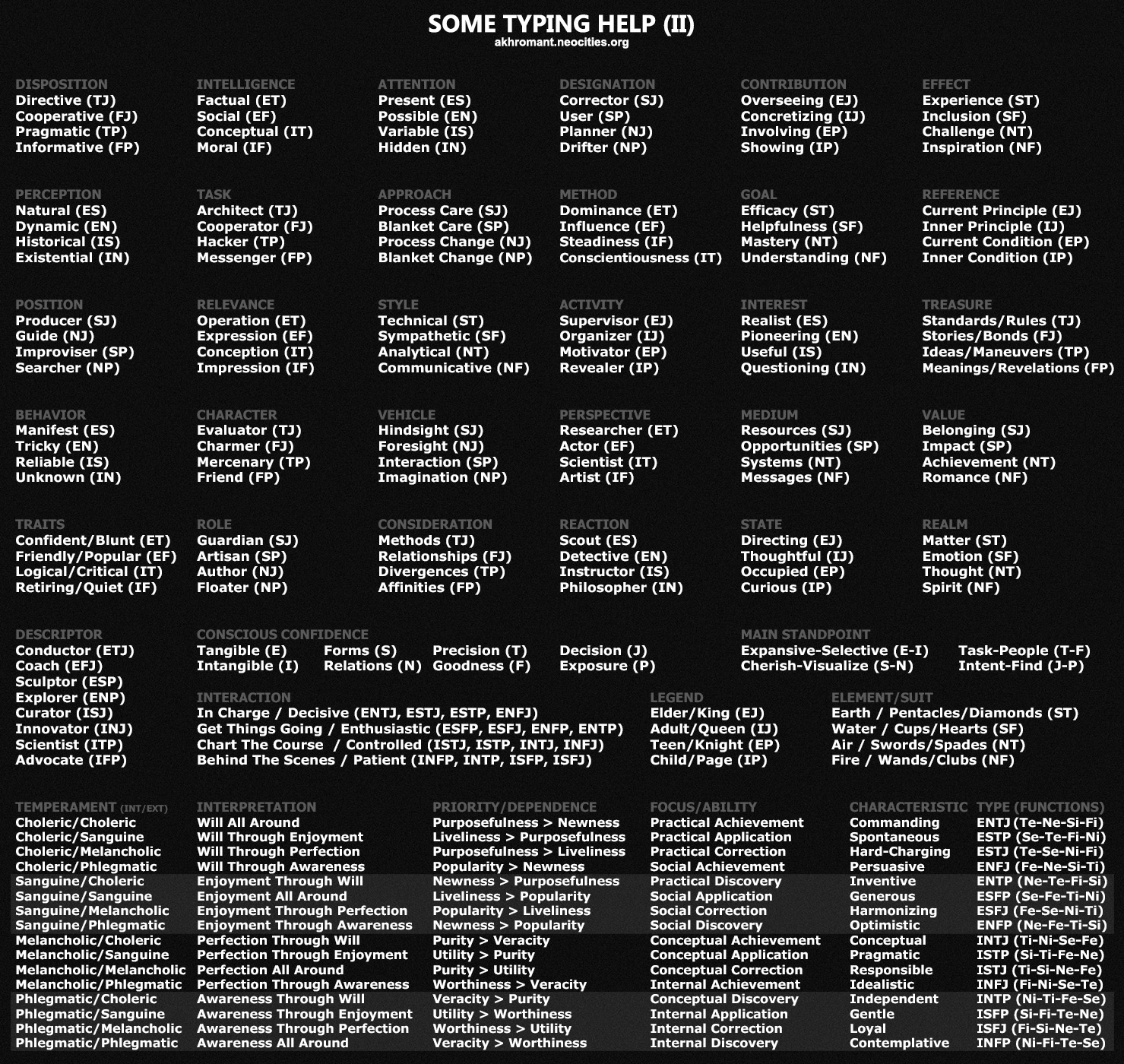
This table is an extended and slightly updated version of the one I published in post #49 (it's better if you read what I wrote there first). The titles of most sections are not really important, and many are easily interchangeable. Designation, Perception, Reaction and the new Role come from post #69. State is about the average condition in which you tend to find those types (if not visibly, at least internally). Notice how "directing" doesn't always imply other people, and how "occupied" doesn't necessarily mean "working". It's more like "already engaged", or somehow "unavailable". Main Standpoint is another attempt at summarizing the 4 psychological dimensions. The idea is to picture the whole line for each pair of letters, and try to determine on which side the person would be (it's not as easy as it sounds). The Element/Suit correlation is included only as symbolic reference. It can be useful especially as a companion to Legend (aka Myth).
The bottom section is a table with 6 columns. The first one is the internal/external temperament of each type: the word "through" indicates that the primary (internal) uses the secondary (external) as a medium. In the second column I tried to make a summary sentence that reflects MBTI List 14. The third is a copy of MBTI List 15. The fourth column combines Designation and Intelligence (like I did here), and the fifth is the main characteristic of each type, taken from this post. The last column is the type that corresponds to each row.
As usual, most keywords are figurative. You might find some apparent contradictions between different sections, but this works better if you don't take the terms literally. Don't read them as if this was a perfectly crafted and locked system, and the meanings were the most common ones. It's not like that. We aren't trying to make job or product descriptions here. This is about people's minds, so we are talking about very indefinite (but equally real) things.
You have to think and ponder in what sense a given word is not the others in the same group. For example: how "romance" is not "belonging", how "affinities" are not "relationships", what makes "interaction" different from "hindsight", etc. Also, you can take two opposite combinations of MBTI letters and see how the corresponding terms try to convey that opposition. For example in what sense "ideas" (TP) tries to be the opposite of "stories" (FJ) (while still knowing that FJs can have lots of ideas), how "actor" (EF) is not so much about the career but about trying to describe the opposite of "scientist" (IT), etc.
Anonymous said: Why do you correlate an MBTI ESTP to an ENTJ in Socionics?
If you know some real-life ESTPs and then read the Socionics description of ENTjs you'll find it's about them, not about ENTJs. This happens with the other types, too, but it requires some previous effort, of course. You need to understand the dichotomies well enough, and you need to find, examine and compare good representatives of each MBTI type. You need to understand the real functions, too, and notice what the socionists are trying to describe, even if they use the wrong words everything.
ENTj in Socionics is described mostly as a practical joker and comedian (there are other things, of course, but this is very obvious), an optimist who doesn't think too much about the consequences of his/her actions (that's SP>NJ, and spontaneous), someone often interested in action sports (S>N), and with a tendency to informality (P>J).
Good humor goes definitely with Jung's description of Se1, not Te1. This is probably the biggest red flag. It's also ·/sanguine (SP) much more than ·/choleric (NT). ESTP's "excentricities" and/or carelessness with clothing come precisely from that Se1 and from being a Perceiver, not from being "intuitive". Also, being an "inventor, experimenter, and technician" is more ST than NT: practice > analysis, efficacy > mastery, etc. (This misconception extends to other type pairs).
Even the contrast between their names, Enterpriser-Marshal (pragmatic-directive, etc), goes much better with ESTP-ENTJ than the other way around. (Socionics has this totally nonsensical idea about "Se" being some kind of "commanding" function, that's part of the reason why they also switched ESFJ and ESFP).
Another factor that aggravates the problem is the supposed "superiority" between types. Because another problem with Socionics is the way they describe the asymmetric relations, in which one is always "better" than the other, totally the wrong way to do it. They think their "ENTj" is "superior" to their "ESTp" :/ This matches the fact that ESTP is ENTJ's Concave type, which means that they can act as some kind of critic, but not that they are "better". There is no such thing between types. ENTJ has full access to Te, for example, which is only an auxiliary for ESTP.
In the context of people-interested-in-typology ESTPs are clearly more numerous than ENTJs, so they are getting "ENTj" for themselves and dislike the idea of being "ESTP" because they have learned to react to that type as "an inferior" type. The misconception has also affected MBTI itself, where many people are mistyping ESTPs as "ENTJs", and vice versa.
The problem is so big that they seem to have noticed and fixed it a bit with those ES(T) and ET(N) profiles, which look more modern (although I don't know who wrote them, or when), and actually correspond to ESTP and ENTJ. (The ESFs have been fixed too, but the INFs are still switched).
teopz said: I read Chap X and I have to comment on the pure picture of Ni though that it doesn't really directly imply "meaning/truth". It stated that when the Ni dom is paired with any of the aux does it try to find its meaning. Ni actually in its raw form is this VISION where you can play with trying to find its details (Kinda confusing to use details since I correlate it with Te) while detaching the self from this vision. Only through Ti/Fi do you find meaning whether to yourself or to the world.
No, INP's explorable "vision" is Se4/gSi4, not Ni. Ni is not about forms, that's always Sensation. Ni is about intangible relations so, by itself, it doesn't have anything to do with "looking", shapes or "details". It is, in fact, the "opposite" of that. (The very fact that you associate details with Te means that what's closer to it is another extraverted function: Se). The moment someone talks about "images" in the sense of "objects" or something that can be described or appreciated, [s]he's not talking about Ni. Jung uses that reference to the unconscious counterpart because Ni is very difficult to explain (it's not a concept, either, or a value, etc) and, as an INTJ (Ti-Ni-Se-Fe) himself, he has a hard time separating one from the other. Also, the "finally fades" bit matches an unconscious or ghost function, not a proper conscious one (see point 4 here, for example).
I'll try to explain the use of the other words.
There are two levels of meaning here. One is between the functions themselves, and it works like this: Ni is the meaning of Se (and vice versa), just like Fi is the meaning of Te, for example. In this case "meaning" is close to the idea of E↔I implication: Se implies Ni, Fe implies Ti, etc (it's quite an amazing fact what Jung found there). Within the function-pairs context I use meaning particularly (and almost exclusively) with Ni because, well, Se is reality as it is, so the best use of "meaning" corresponds to Ni. There is no other function that deserves it more: it tells you what's the universal condition behind the tangible object.
The other level, the one you point out, is what I explained in post #31.2, but it's not that Ni tries to find the meaning of Ti/Fi, it's that X2 concretizes a J (in this case) or P component from what X1 says, so Ti2/Fi2 "obey" or follow Ni1, which is truth (don't confuse this with Te-objective-facts or with the true/false distinction between the proper and the ghost functions of a type, as explained in point 4 of post #24). Truth is not the judging element, it's the perceiving one, the reality of what is. Ni is truth especially in contrast with Ne, which is possibility. Remember that you can look at the introverted functions as the encompassing factor/side of the extraverted ones. Ni is "the inner and eternal meaning of events" (= truth), and it's that for everyone, regardless of their relation to it. Some don't know it or acknowledge it, for example. Others can't see it independently, for what it actually is. Perception-only INPs do (Ni1), and work with the internal impressions, which are a sort of representation or indication of truth. And finally, INPs with differentiated Ti or Fi adapt to it through their thought/behavior. That's more or less what happens: X2 adds an adaptation to X1, a consequence.
Anonymous said: i just realized "truth or dare" shows the two opposite functions, Ni and Se.
Hmm... I like that kind of ideas and investigations, you can find interesting things, but you have to be very careful, because the functions are tricky.
In this case, if you think about it, people don't tend to ask about universal truths, they prefer personal ones, right? For example "who do you like?" Or things about the tangible past: "what really happened that night?" That is: visible events, something that can be recorded, etc. In that sense "truth" would be actually closer to Fi, Te and/or Se. Some might even ask about possibilities in the future: "who would you choose for this?" That could involve Ne. I mean, I don't picture a group of friends turning the game into Philosophy Hour, haha :P And "dares" are not simple presences, they might revolve around external objects but they are always actions (verbs), and they need to be intelligible as objective facts, because the players have to communicate and recognize them, so it's not "bottle" but "drink the whole bottle", for example, and it can't be just "person" but "say this to that person".
So I don't know, it's probably not that easy to simplify, because we are using all the functions all the time, but if I had to, I'd say the basic game seems mostly about Te, then some Fi, and bits of Ne and Se.
Ni is truth but not a historical or localized one, not in the sense of secrets that people would like to know, or the sort of information that's supposedly required in a trial. In fact, most people don't even want to admit the kind of truth that Ni implies. A large amount of the things that people think and do are actually attempts at ignoring or avoiding it.
I know my use of words is complicated and sometimes confusing <(._.)> I need to cover a range of aspects and realities that's much more extensive than that of everyday language. I need to talk about everything.
This is an attempt at an additional overarching description of the cognitive functions, using a slightly different angle than the essence one (which is always the best, of course, anything else is going to be just approximate). As usual, the foundation here are the four pairs of connected functions, their E↔I implication: Te↔Fi, Fe↔Ti, Ne↔Si and Se↔Ni.
Looking at each pair as a psychological line, first I'll try to describe its ends or extremes with a few keywords and ideas, and apply that to the corresponding types, to see how they can manifest as dominant-inferior (X1-X4). Then I'll take one word for each function to make some summary sentences about how they can be interpreted within the particular arrangement of each MBTI code. Thinking about the functions this way can help you understand some of the things that Jung wrote in his book.
Try to see the descriptions as something independent from time, not like a series of steps or events, but a sort of simultaneous balance or counterpoint between the outside and the inside. Try to see how the two functions of each pair are interconnected because you can't have one without the other, not because one goes "before/after" the other. You either have both of them, or you don't have any.
Also, remember that there are countless terms that can be used in relation to each function, and it's not only about synonyms and alternate meanings, but the fact that the structure of cognition manifests in lots of different ways and scopes. I try to choose flexible general words, but in the end what I write below is only an example among many others that could be made. On top of that, you have to keep in mind that people don't follow this post to describe themselves, how they think, or what they do. This is very important. They switch terms and definitions, or use entirely different words. So, be careful with that.
Ok. Let's go (ง •̀_•́)ง
EXTRAVERTED THINKING ↔ INTROVERTED FEELING
Te = action/fact
Fi = responsibility/desirability
Te↔Fi is the dimension of what you do and its moral implications. It's about an intrinsic evaluation of intelligible facts (which sometimes are called "truth"), and it's also the line from desire to actuality. Te implies some kind of tangible determination or purpose, and Fi includes notions like appeal and guilt.
Some ETJs (Te1//Fi4) can do and/or interpret actions as if they weren't good or bad, or even as if the potential blame was on other people. One manifestation of this is the classic Te1 "you force me to do this": the person is doing it because [s]he wants to, not because someone else is moving his/her arm, for example. Those who talk like that are only projecting their own guilt/desire (Fi4) on others. It's also easy to imagine how some ETJs, for example in the military, can obey any kind of orders without question. Apart from that, Fi4 can imagine the most twisted (impossible) intentions.
Some IFJs (Fi1//Te4) can hold evaluations (sometimes of themselves) that don't refer to any tangible action or reality. For example: feeling responsible for something they didn't do, or wanting something impossible. Another example of this function disconnection could be an INFJ who didn't actually commit a crime but somehow moved others to do so (matching the idea of perfection through awareness). I think this is the kind of situation that can result in some of those complex cases/trials where it's very difficult to determine the person's culpability. Fi1 gives some IFJs a sort of private magnetism, that's definitely a factor there.
EXTRAVERTED FEELING ↔ INTROVERTED THINKING
Fe = expression/recognition
Ti = identity/concept
Fe↔Ti is the dimension of the social recognition of what you think (even of "you thinking"). It's about the individual mind and [its place in] the group performance or interaction. In contrast with FiTe, here the value judgment is outside ("social responsibility", for example), and the action/fact is inside ("intellect", "abstractions", etc). Fe includes ideas like manner and agreement, and Ti implies intangible distinctions.
Some EFJs (Fe1//Ti4) can lose themselves in the shared atmosphere (leisure/work, fashion, mob, etc), expressing without question what others have thought (praise and criticism included), or imposing/demanding a group evaluation that's actually self-serving and/or self-justifying. The latter are projecting their own Ti4 on others, believing that their thoughts come from someone else (often "the people", but also "god", etc). This of course resembles the image of an actor on stage. Many EFJs consider themselves (or are considered) representatives of something else (ideologies, tribes, countries, living beings, inanimate objects, etc), sometimes like icons.
Conversely, some ITJs (Ti1//Fe4) can have a sense of being isolated from all social agreements and relationships, of being part of an absent or unreachable society, etc. They can have/know many secrets (like spies do), and many unspoken personal rules, forming an underlying fabric and strictness that's not directly evident. They keep and expand their own intricate systems of thought as if they were their life tissue, and they don't really have the need to explain them to others (by contrast, many EFJs have a hard time keeping things to themselves). They can do it, of course, even as a job, but what's often seen on the outside are just indirect manifestations.
EXTRAVERTED INTUITION ↔ INTROVERTED SENSATION
Ne = progression/possibility
Si = experience/perspective
Ne↔Si is the narrative thread of different experiences, the set of options that can be seen from a certain perspective, etc. Ne includes the ideas of external change and luck, and that needs an internal point of view, a continuity of subject from where it can be experienced: Si. It's a bit like the notion of power/force on one side, with a fulcrum/hinge on the other. Taking Ne as physical absence, Si is what the mind imagines there, to somehow "fill" the gap[s]. That's why SiNe is so closely related to mythology and concepts like the under/afterworld (full of "entities") (Si), and to various ideas of "levels" or "echelons of power" (Ne), which might include the general superhero theme. SiNe, especially from its EN side, is behind popular ideas like "choosing a path for yourself", "aiming high", "never settle", etc. It results in things like careers and innovation, and it needs/implies time, especially as [hi]story. Compensating tendencies like familiarity, conformity, or "settling down" would be more IS contributions.
Some ENPs (Ne1//Si4) go in a completely random way from one thing to another, as if they didn't have a stable point of view. They are so absorbed by the turning of the stones, that they don't even see what's under them. What I mentioned here about ENTPs being very good at presentation can be understood as their identification with the "promises of the future", or something like that. Many [famous] ENPs probably feel that they are the embodiment of progress itself, especially in the sense of "necessary advance". One of the problems here is that there might be a lot of movement but very little patience or actual care for anyone. Si4 can manifest as impossible sensations.
Some ISPs (Si1//Ne4) keep doing the same thing over and over, as if they didn't realize (or mind) that it's getting them nowhere. They might see lots of options, but feel unable to choose [a different] one. An example of this would be the famous "tortured artist" stereotype, prolific but also very often the subject of some kind of substance addiction. What ISPs do tends to be useful in one way or another, and show careful attention, although sometimes there's a kind of quietly tragic or desperate air to it. I think some of them can feel unlucky, detached from the course of history, and/or imagine themselves living alternative/impossible ones.
EXTRAVERTED SENSATION ↔ INTROVERTED INTUITION
Se = presence/existence
Ni = meaning/reason
Se↔Ni is the line that goes from life to its meaning, from existence to its reason. It includes certain understandings of the duality between body and soul, between the flesh and the spirit, and between the world and divinity. If Se is the simple reality of objects, Ni is the "power above".
In contrast with SiNe, here the point of "perspective" is outside, and the changes are internal. How can this be? Most people understand the SiNe dimension quite easily, even if they are NiSe, because they have been (are being) exposed to it in various forms, everywhere (see the examples above). The real essence of NiSe is relatively unknown: it's about the intangible relations and changes that exist/occur "even if" or "because" or "while" everything stays the same. So in comparison to SiNe, NiSe is hard to see because it's not about time/history at all. In fact, it's the opposite of many things that are taken for granted. If Si1 looks at a flower and sees how it may change, with Ni1 it's the flower that looks at you while you change. When you try to explain that, people keep going back and putting it [inadvertently] in Ne-Si terms (that is: misunderstanding and/or ignoring it).
Some ESPs (Se1//Ni4) don't know the reason behind anything, so they feel lost and, at the same time, tied to the exploration and enjoyment of everything that's right there (people, places, objects, food, drink, etc). They perceive and navigate all the details, but not their connection to any kind of meaning or purpose. They might believe that it's all a joke, and behave accordingly. So the most reckless people are probably ESPs. They are also behind incredible acts and works of physical skill, artistry, etc, although sometimes they are extremely vulgar and crude.
Some INPs (Ni1//Se4) feel like distant observers of the world. They understand what's happening and why, but they can't have an effect on it. They can't touch it. In a sense, they are mere witnesses. Many tend to live somehow isolated, both in the physical and the historical sense (gNe1), like hermits. They are unusual and strange for most people, even those who could be considered "close". The meanings they perceive don't necessarily have a manifest tangible correspondence. In fact, sometimes they imagine impossible objects.
SUMMARY SENTENCES
The following can be applied to the person, to how/what [s]he thinks and acts, and also to other subjects/objects from his/her point of view. The idea is that the sentences can take form in all sorts of ways, both "good" and "bad". You can play with them a little, using some other term from before, for example, to see different angles.
ETJ (Te1//Fi4): action without responsibility
EFJ (Fe1//Ti4): expression without identity
ESP (Se1//Ni4): presence without meaning
ENP (Ne1//Si4): progression without experience
ITJ (Ti1//Fe4): identity without expression
IFJ (Fi1//Te4): responsibility without action
ISP (Si1//Ne4): experience without progression
INP (Ni1//Se4): meaning without presence
These would be the corresponding "internal engines" of the types (X2-X3), located inside the previous "global structure":
ESJ (Se2←Ni3): every meaning implies a presence
ENJ (Ne2←Si3): every experience implies a progression
ETP (Te2←Fi3): every responsibility implies an action
EFP (Fe2←Ti3): every identity implies an expression
ISJ (Si2←Ne3): every progression implies an experience
INJ (Ni2←Se3): every presence implies a meaning
ITP (Ti2←Fe3): every expression implies an identity
IFP (Fi2←Te3): every action implies a responsibility
Remember that all this can be described in very different ways. What I post here is just an example.
Anonymous said: does the symbolism in michelangelo's art go with every meaning implies a presence ?
It's important to determine what we mean by symbolism here. Ni3→Se2 recognizes an unknown meaning behind every presence in the world, and in that sense it can be related to many religious ideas, for example the concept of a creator. If we understand that Michelangelo had those in mind, then we can say that the phrase should apply in some way to his art, yes.
The thing is that some people seem to believe in a different kind of symbolism, basically the opposite. They say he left "hidden meanings" in some of his works, most famously the rather atheistic "god = brain" theory regarding The Creation Of Adam, but I don't think that's what he did. It goes against the rest of his work (especially as religious sculptor, which was his main specialty), and it looks very much like a personal reinterpretation.
The supposition was first made by gynecologist Frank Lynn Meshberger, and others followed, but many are aware that people can imagine connections and patterns where none have been intended. "Kathleen Weil-Garris Brandt, a fine arts professor at New York University and a consultant for Renaissance art at the Vatican Museum, disputed Meshberger's theory as a "retrofit" of his own knowledge. "All the elements in the image have profound traditional roots in the visual culture of the Renaissance and Middle Ages," she said. "God is more than a flying brain"."
Anonymous said: (1/?) hello, i've been reading your posts and analyzing a lot for a while now and recently started reading Jung's work as well. there's one thing i'm really curious about that i can't quite make a sense of (maybe Jung talked about this but i just haven't read up until that part👀): how do cognitive functions and mental illnesses correlate? in particular, personality disorders like schizoid pd which entails a person feeling disconnected
(2/?) from themselves that everything they do doesn't seem true to their true selves and dissociated in a more inherent way (rather than having bouts of dissociation) to such degree that the outside world seems unreal. basically, just having a kind of split between the real self and the one he puts up for others to see. but in a more consistent way than a normal person would do occasionally, for example, when talking to authority
(3/3) figures. where does this fit in the picture with functions? ahh i hope my question makes sense, i don't think i saw you talking about this exactly in detail before, but if you did i'm sorry for not noticing!! your blog really has opened my eyes to a way deeper understanding of myself and just human nature in general. thank you so much for your work!!^-^
Hi, and thank you for your words :D
I understand the question :) I don't talk about those things because I really don't know :P My focus is always on other aspects, and if they approximate what's taken as "science" out there, it's always unintentionally and from a different perspective.
This is not about your message, but I don't like the "academic" approach of studying, cataloging or treating "mental illnesses" or "disorders". I mean, that's not how I see psychology or the mind, at all, partly because what the "established knowledge" always does is dis-establish itself after a while, and partly because it implies some kind of "perfect" human/condition, a "model" for everybody, and that doesn't exist. In fact, believing in it is the truly harmful thing. There's also a tendency or temptation that makes some people see everything as a "malfunction" (implying a refusal to listen and perhaps learn from psychological human diversity), and even invent problems where there are none.
So, anyway, the thing is, I prefer understanding all these issues by myself, with my own terms, etc. That's why I don't use specific words like "schizoid", even though I might be talking about that inadvertently, in some other (probably less stigmatizing) way.
Jung wrote a lot of things :P and apart from the functions and the types I haven't read too much, so I can't tell you what you might find there. In any case, a very important thing to keep in mind is that he didn't use the same vocabulary that gets printed nowadays (or even back then), and many people think they understand him, but they don't. They misinterpret many things, and fill the gaps with their own ideas and prejudices, so I wouldn't trust any attempt at finding "correlations". Jung doesn't speak from a Te standpoint (quite the contrary), which is always the "official" or "accepted" one, so his ideas are not that easily "updateable". Here I'll just try to identify some basic links that, hopefully, are not too far removed from a moderately pertinent answer (^_^;)
The general idea of the disconnection that you mention might be related to an extreme conscious/unconscious separation, not to any particular function, so there are probably several versions of that. Jung talks about "dissociation" in those two directions: conscious and unconscious (so we could be talking about 16x2=32 possibilities, each one with lots of sub-variations, of course). He says it happens when the ego "splits off", together with a function or group of functions, from the other components of the personality. Another term for this would be identification of the ego with those functions (that's the one I tend to use). If an ESP (Se1) identifies too much with his/her unconscious, for example, then the conscious personality, the one that's interacting with tangible reality, might seem a separate entity. I guess that's how it works.
But your example of seeing the external world as "unreal" can be a different thing, too. Jung talks about that in his description of ISPs (Si1), with phrases like "illusory conception of reality", and I think something similar can happen also to some ENPs (Ne1), because for them the tangible world is actually a ghost function: gSe4. So I'd recommend taking a look at all that :)
anon that asked about mental illness here. thank you for putting things into perspective, it feels like i have a grip onto something now. to be honest, i've always felt the same about mental disorders, they do imply that a person has to be some sort of right and perfect way and if they aren't, then, well, let's label them as having an illness!!🙃 i feel assured now so i'm glad. i'll keep in mind everything you said, ISPs and ENPs do seem like they would have such experiences.. thanks again!!!
Thank you :)
Anonymous said: what are the possible misunderstandings/disagreements when it comes to the differences between J & P, for example ESTJ "action without responsibility" and ESTP "every responsibility implies an action", or also the perception difference, "every meaning implies a presence"/"presence without meaning"
Those sentences are at the origin of many things that you already know or can deduce about the types, provided that you understand the dichotomies well enough, of course. So, even if it's a bit repetitive, I'll talk a bit about them, but remember that you can arrive at these same conclusions if you just think about the letters (the two approaches have to fit).
All else being equal, ESTP needs something that keeps him/her moving, so [s]he's more "capricious" and unpredictable, and can "waste time", while a comparable ESTJ can always find something to do, so [s]he's busier, and also more reliable/dutiful, because [s]he's not conditioned by the connection to desirability. If they talk about certain things their disagreements probably reflect that. ESTP criticizes obedience, attachment to methods, robot-like behaviors, etc, and ESTJ doesn't like lack of commitment and the possibility of things not getting done, for example. Maybe they find a middle ground, but I think you can also imagine all sorts of ensuing problems.
With perception the idea would be that ESTJ somehow sees there's a reason for [doing] things, something difficult to explain that's beyond what's simply apparent, something that needs or implies some kind of respect (even if it's mixed with the person's own [dis]likes), while marked ESTPs might feel disconnected from or just completely unaware of that, and laugh at the seriousness and the worry, being more easily disrespectful.
A misunderstanding could involve, for example, an ESTP who sees ESTJ doing something and believes [s]he's doing it because [s]he genuinely likes it/wants to. ESTPs tend to assume that in people, and sometimes provoke them to get a reaction (ENTPs can be like this, too), or try to justify their own shamelessness with phrases like "I'm just saying what everybody is thinking". You can also have an ESTJ who doesn't understand how ESTP can act with such disregard for accurate knowledge, safety and control, and/or without any meaningful purpose. As I wrote here about ENTJs, and as their attitude suggests, playing like that is not ESTJ's main focus.