INDEX
ABOUT
FAQ
GLOSSARY
MBTI TYPINGS
MBTI RELATIONS
DISCORD
PHOTOS
STORIES
GENERAL
DIFFERENCES
TYPING
FUNCTIONS
TABLES
LISTS
WORKS
VARIOUS
NAMES
MORE
This is an extension of the facets method for typing. There are more items here for both the letter-by-letter and the two-letter part. And, just like before, it's better to start with the first one, get a result, write it down, forget about it, look at the combinations, get some kind of result there as well, and then see if it matches with the previous one. If it doesn't, go back and revisit everything, from the beginning.
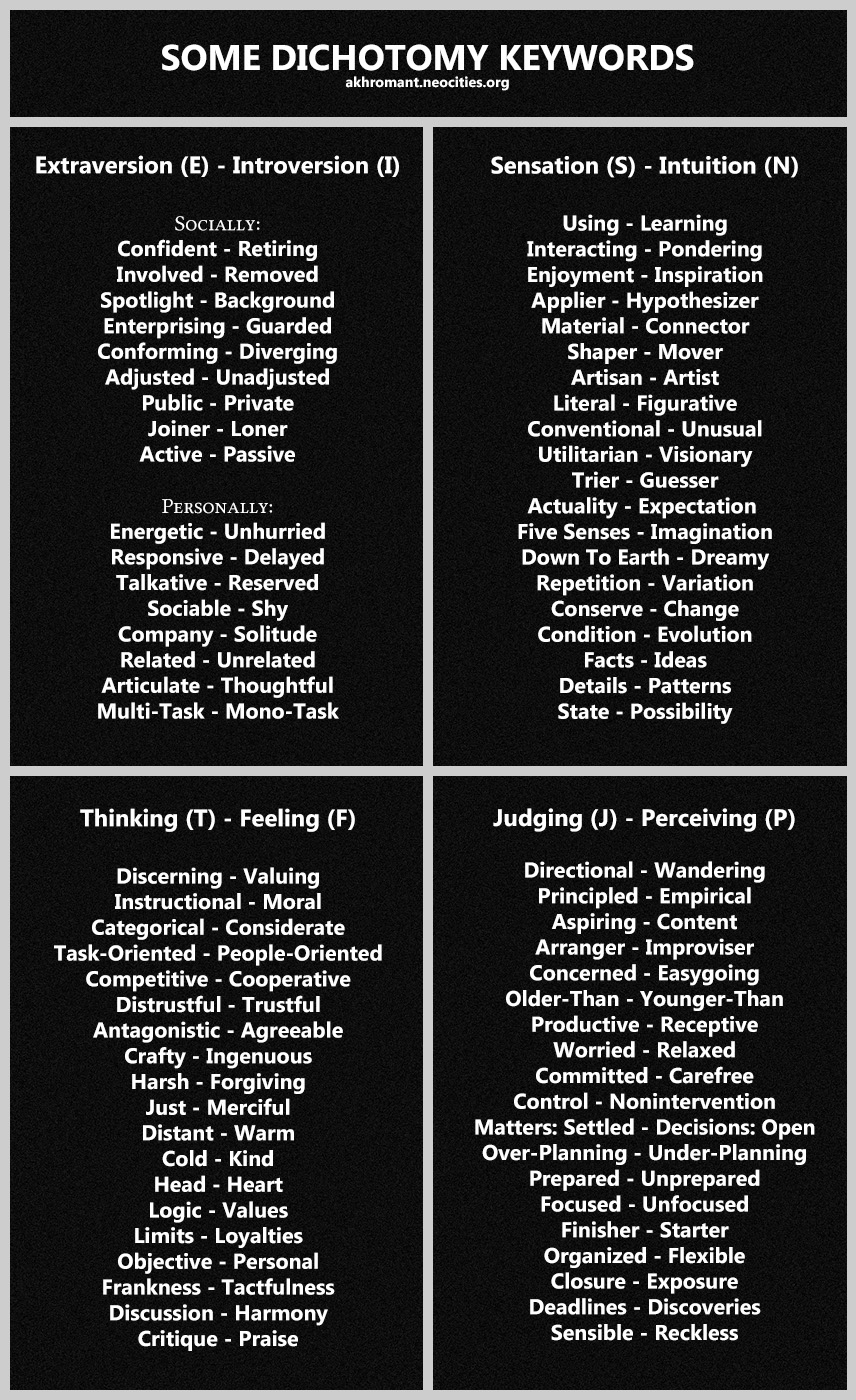
The lists in the image below include different kinds of adjectives, preferences, and concepts. They are not exactly the same as the official MBTI facets, but they try to convey a similar approach: presenting a series of descriptive lines, with slightly varying orientations, scopes and resolutions, defined by two extremes (poles/anchors) which belong in some referential sense to the opposing letters of each dichotomy. Then there are a few more 4-concept lists that point to different combinations of letters.
You can use anything in this post, after going through the official facets and the previous combinations, as an additional or alternative resource/idea to help you with your typing. Keep in mind everything I explained in that post (especially all about honesty and patience), and also in this one. Don't read the keywords all at once, that's not how they work when you already have a particular person in mind (that kind of reading is better left for later, or for getting a global perspective of the dichotomies). You have to think about each pair (and each classification below) for a while, very carefully, trying to visualize the landscape between the two poles (or the four cardinal points), and trying to see each pair/list as independent from the others. Then choose the one that applies to you the most, and go to the next pair/list. (You can use kingscrossing's www.facetsquiz.com, which also includes the short facets version from post #14).
MORE LETTER COMBINATIONS
✸ If they had to choose one, which "role" do you think other people would apply/assign to you?:
Producer: SJ
Improviser: SP
Guide: NJ
Rebel: NP
✸ Which one could be considered closer to something you admire or aspire to?:
Efficacy (includes usefulness/efficiency): ST
Helpfulness (includes nurture/pleasure): SF
Mastery (includes conceptualization/command): NT
Understanding (includes humanism/improvement): NF
✸ Which one of these broad concepts could you treat like a treasure?:
Rules (includes methods): TJ
Stories (includes relationships): FJ
Ideas (includes happenings): TP
Meanings (includes revelations): FP
✸ Which one do you manage/navigate better?:
Resources: SJ
Opportunities: SP
Systems: NT
Messages: NF
✸ Which one do you develop/criticize easier?:
Procedures: ST
Services: SF
Concepts: NT
Ideals: NF
✸ And the last one is about someone's general or most characteristic approach to / effect on other people. It doesn't imply anything good or bad, and it refers to section 2.3 of this post. It's only a very broad impression, because it doesn't necessarily apply to everybody, as it depends on the others' types and lots of external things (like all relationships do):
Interesting others (includes intriguing, puzzling, worrying, etc): IP
Involving others (includes teasing, inspiring, fighting, etc): EP
Helping others (includes influencing, guiding, instructing, etc): IJ
Overseeing others (includes supervising, directing, demanding, etc): EJ
daniluni said: Is it possible to be a shy person and still be an E personality type? Because I identify myself with most of the ENFP things yet im phleg-san and im not outgoing at all
If you are [very] young it might be too early to try and determine your type. Some people are really playful and outgoing as children/teenagers but they are actually introverts, and the opposite might be true for some extraverts. Among other things, your personal history and environment (including family, opportunities, culture, etc) have a great influence on this. Going by the apparent attitude of young people is one of the reasons behind lots of mistypes. Also, if you take a look at post #20, for example, you'll see that 'shy' is only one of the keywords associated with introversion. It's important, of course, but you need to get a global perspective, incorporating all the indications possible (and not only from that post).
There are a few more points to consider. First, remember that the observable things that you do are not the actual core of your type. Neither is it the way you "feel" about yourself, the words you might [initially] use to describe that, etc. What being an extravert means is that your attention and your decisions are focused and based more on what's actually present around you in the tangible world, on what is happening there, on the customs, properties, states and possibilities of objects and people, etc. It's not that you automatically like, adopt, follow or invest your energies on all that, but in your mind that's the most interesting and decisive side, so you try/prefer to.
Another thing is that what you (or others) mean by "shy" might be just inexperience. Also, if you are an F you probably need some kind of "human factor" to feel and act more "outgoing". So for example, if you still don't know a lot of people, if you don't feel comfortable with them or what they do/like, or if they are always busy or whatever, maybe you just don't have all the external elements to see yourself as an E (which you might be).
You need to give it time. Remember the patience part (post #14). It's very important (and the whole post #12, too). Above all, don't try to fit into anything, and don't take descriptions of the types as a model for what you are or want to be. You are your own person, and typing is something you do as an attempt at getting some answers (which always include other people, not just you). It should be more like a reaction than a duty.
Anonymous said: Hi, I have a difficult time understanding the frame of typing based on your posts with reference to myself so I think it would be better to have a person in mind to help me understand. For Gregory House in House MD, how do you type him them? Applying the ideas Functions, Temperament, Disposition, Interaction, Group, Judgement, Perception, Value, Myth, and Mirror.
Hi :) This question got me thinking [again] about several things. I'll try to put them in three sections.
1. APPROACH
Before we get into details, a correction: the series I've written about typing yourself doesn't include anything related to Functions, Interactions or Mirror types, and the rest of the things you mention are only part of the resources available there. Temperament, Group, Disposition/Attitude, Judgment/Intelligence, Perception/Interest and Myth are included here, along with the official MBTI facets, and Value is here, with more facet-like keywords and lists.
The typing method that I propose here is not so much a "method" as an approach. That's why the instructions are vague, and the tools are always just words. Words for the mind. The basic idea is the simplest I can think of: your type is composed of 4 letters out of 8, so the best way to type yourself is to figure out which of those 8 letters apply to you the most. First you do it one by one: they come in four pairs, so you need to identify the one that's closer to you in each pair. Then, if you want to be sure of the type you get, you can check a few lists of concepts that refer to different combinations of those letters, and see how it all matches. You don't need to give an answer for every pair/list, but the more you leave blank, the more distorted the end result might get. You can always try to identify what doesn't apply to the person, and reach an answer by elimination.
Inside this process you need to be able to see yourself in relation to several characteristics that different people have in varying degrees, and you need to discard any false image that you may have about yourself. You shouldn't put a time limit on any typing (so no "let's get this over with" kind of resolutions, for example), and your only criterion for approaching conclusions should be "more than half": if the majority of the results for the identification of your E/I turn out to be E, for example, then you write down "E", and in the next step, if the majority of results you get with the combinations coincide with that "E", you can consider yourself an E[xtravert]. The same with S/N, T/F and J/P.
Sometimes there's no majority, and sometimes there is one but it's not actually convincing, so the typing seems inconclusive. That's usually because some people have more "defined" types than others (I'll try to write more about this later on). But it doesn't matter: if it feels weird it probably can't tell you anything you don't know already about yourself. And of course: don't try to fit into anything, however "definite" your typing may feel.
Now, in order to identify your letters you need to understand what they all mean, so you need to read about them, somewhere, and you need to think about them, somehow. That's where the MBTI facets and the rest of the ideas come in. They are more or less extensive pieces of information about the types, so they should check out, or at least point in the right direction with what they are trying to say. The idea is that, by thinking about them, you are [indirectly] thinking about the meaning of the four dichotomies, you're trying to get a mental picture of what their extremes actually stand for, what psychological dimensions they try to reflect, etc. And this is all very "internal", very subtle and nuanced, and very difficult to explain. So, in the end, the "frame of typing" that you refer to includes knowing what this is all about. In a sense, what the posts say is basically "read and think about the dichotomies", and what I give you in them are only examples, points of reference, like the ones in a compass or a map, like signs or beacons in the distance, hoping to be meaningful enough for you to realize where you stand.
After you acquire a minimum knowledge of MBTI, whenever you start with a typing you already have at least one type in mind, even if you don't notice it. For some people this first impression (which I sometimes call classification) is the "typing", and the possibility of the actual type being different doesn't even feel real to them. Well, it should. Before and after the analysis. Always.
As you get closer and start examining the person carefully (with the keywords, concepts, etc), you may find that your "automatic" categorization doesn't fit. But this only happens if you actually put yourself to the task, and remain open to what's there. If you don't then you'll keep going, stubbornly, with your first-reaction image, which is not a proper typing, but for some it feels like it because the idea that you can type people instantly is very tempting. People love having some tags and throwing them at everyone and everything. The unclassified makes them nervous.
But you have to be honest, and try to catch yourself being "lazy" with all this. Ask yourself every question, and don't just pick what would be in agreement with what you already have. Yes, this implies that sometimes you'll have to go back and revisit everything. That's what learning looks like.
Another important thing to keep in mind is that typing needs to be about the "normal/natural" state/mode of the person, and not so much about the things [s]he does under stress or when fantastical things start to happen. It's not about special situations, temporary or forced states of mind, etc. (I talked about this here).
2. CHARACTERS
It's not a good idea to focus too much on fictional characters in typology, because they are not real people. Most of the times there's an intention behind the creation and development/evolution of a character (even when it's based on someone real, and even when it's a supposedly "biographical" account), and this often includes ignoring important parts of their behavior (the "boring" ones which, in any typing, are precisely the most significant because they are always there, in the background), focusing on the most shocking/spectacular but not necessarily the most proper actions/moments/etc, forcing changes and contradictions that wouldn't be possible in a human being, etc. Sometimes there is more than one writer contributing to (or messing with) the character, sometimes they are essentially playing with it and/or with the audience on purpose, sometimes the actor playing the part adds too much of him/herself, and sometimes the character isn't even written as a person.
So, I know it's a big temptation because it can be a lot of fun, it's easy because fictional people tend to be both interesting and rather simple, and it doesn't look immediately dangerous because they can't be misled or even hurt by our possible mistypes, but remember that characters are not a good reason for typing yourself in the first place. You are your own "character", that's the one you really need to know and understand. Also, too many false images of this sort can be harmful, because they give you a very shallow and cartoonish impression of the human world and, in the end, only real people have real types.
Now, having said that, I get what you mean: it might be helpful to have some kind of typing example, and a fictional person could be good for that. The thing is, I don't know anything about House MD, so I have to give you an answer using another character and hope that, somehow, this can still make it easier for you to understand the approach.
3. EXAMPLE
I'm going to take a look at Wirt, the main protagonist of Over The Garden Wall (2014). I'd recommend watching the series before reading what follows, not because of that tiring "spoilers" marketing trick (if something is ruined just by telling others about it, then it's not that good), but because that's what makes sense: first you get your own reaction, and then come back here to think about it. Don't jump through the text below looking for MBTI codes, try to stay with me :)

Wirt is particularly useful as a character for typing because he's accompanied by others who are quite different, and the contrasts between them are very revealing. On the other hand, and starting from a general point of view, one of the most noticeable problems is that almost everything we see about him is not his everyday atmosphere or behavior: in the real world it's a very special Halloween night, and in the Unknown... well, it's the Unknown, not a familiar or comfortable place for him, at all. So part of the job here is to try and catch or infer what the "usual Wirt" is, what's actually "behind" his behavior in a "permanent" sense. We are going to look for what's always in him that's not always in everybody.
Ok. So. The process of typing could go more or less like this:
✸ 1) Notice that you already have a type in mind. You haven't even started yet, but there it is. Yeah. Or maybe two or three. I mean, you have at least two letters, right? You are probably thinking about going through the process as a ship goes through the storm, fighting everything with determination, because you know you are right. Well, my advice is: don't forget the lifebelts, and be prepared to swim.
In Wirt's case, I could write something like this: "First-reaction image = INFJ".
✸ 2) Choose the 20 official MBTI facets that better describe the person.
E/I - Is Wirt more Initiating or Receiving? He tries to initiate basically one thing, but he's mainly Receiving, because he usually doesn't want to approach other people. Greg is the one who doesn't seem to have a problem with this. Is Wirt Expressive or Contained? He's quite expressive, right? But mainly because he carries a lot of the comical weight in the series. If he was a real person he probably wouldn't gesticulate so much, etc. Is he Gregarious or Intimate? This facet includes the idea of having a lot of friends vs a small circle of friends, so Wirt is definitely Intimate. Active or Reflective? This one seems to be somewhat in the middle. He often stops to think, and he's not very interactive, but in the end you can see he's not that bad at participating in things so... I'd say mildly Reflective (Greg is obviously more Active). Enthusiastic or Quiet? Wirt is rather Quiet. He doesn't like being the center of attention. Greg, on the other hand, doesn't mind this at all :)
S/N - Is Wirt more Concrete or more Abstract? He likes music and poetry, and doesn't seem to care too much about objects, right? Abstract, then. Realistic or Imaginative? He tends to focus on the evolution of situations (making associations, etc), and not as much on the tools at hand. I'd say Wirt's quite Imaginative. Is he more Practical or Conceptual? He's not really centered on mental tasks or constructs, he spends most of the time trying to solve concrete things, step by step, so: Practical. Experiential or Theoretical? Wirt likes the proven methods (the signs on the road, civilization, etc). And he puts to use what he experiences/learns, instead of theorizing for the sake of it. That's being Experiential in the context of the facets. Traditional or Original? He seems to like classical and old-fashioned things, in general, including his hobbies and his costume. He blushes at the idea of being married. Some people say that the story takes place in a modern setting, where tape-recorders are not used anymore (that's why Sara doesn't have one). And the whole atmosphere of the series is about traditional things, especially in the Unknown, which I tend to think takes its aspect (or at least part of it) from Wirt's mind. So, Traditional, then. Wow, this was a surprise. I think I don't have a boat anymore :P
T/F - Logical or Empathetic? At the beginning he seems a bit cold, but that's mainly because he's next to a very young child, and things aren't going the way he wants. We soon learn that he's not like that. He cares about people, he's not impartial about them, he gets emotional and he even falls [suprisingly easily] in love. Reasonable or Compassionate? Wirt is not someone that punishes others (not even the Beast). I think he has a lot of Compassion. Questioning or Accommodating? He doesn't like to interrupt, always tries to keep everyone happy, etc. This is Accommodating. Critical or Accepting? I think he tends to be rather Critical. It might be just bad luck, but he doesn't seem to find anything that doesn't have a problem from his point of view. Tough or Tender? When he seems tough he's mostly being stubborn. If you take the stressful situations away I think you'll see he's a Tender person.
J/P - Systematic or Casual? Wirt doesn't seem the kind of person who lets things proceed by themselves. He might be shy and have a difficult time getting things done, but he wants them to be in a certain way, that's for sure. He is Systematic. Greg is the Casual one. Planful or Open-Ended? Wirt seems a bit in the middle here, mostly because he's young and he's still learning the "basics". But if you actually think about him you'll see he likes making plans and sticking to them. That would be his "most comfortable" attitude. Early-Starting or Pressure-Prompted? What we see in the series is a Pressure-Prompted person. He couldn't anticipate any of that, and he's always reacting to things, basically. There are also comments about him being indecisive for a long time regarding specific options (for example about joining the school band), so he might be that way in "real life", too. But deep inside maybe he prefers not finding himself in those situations, so he could develop a more Early-Starting approach as he gets older. In fact, you can interpret all the sudden decisions as part of the show (twists, jokes, adventures, etc), not of Wirt's psychology. Scheduled or Spontaneous? Most kids have their daily routines established for them by other people (parents, school, etc). That's why the "natural tendency" of many seems to be only the unscheduled part, even though they might actually like timetables and such. We don't see how Wirt's daily life goes, but by the way he gets anxious about surprises I think he likes to have some kind of daily security. Let's say Scheduled. Methodical or Emergent? He is very aware of the need for continuous progress, and playing instruments requires precisely that, too. At the end he mentions that "Maybe we should listen to other tapes first, though, and sort of work our way to this one". That's being Methodical.
At this point we have 1E/4I, 3S/2N, 1T/4F and 4J/1P, so Wirt seems to be an ISFJ.
✸ 3) Go to these keywords and do the same there.
I'm not going to do it how it should be done (that is: one by one), but in groups, mainly because otherwise the post would get [even more] kilometric :P
E/I - Wirt is on the Introverted side of all those 17 pairs. You could make a case for Responsive, Talkative and Related, but that's mostly because he's the main character in an animated series. He can't be too detached from everything, or we wouldn't have a protagonist that interacts with the various things and people that appear in the story. I mean, you could have that, but then it wouldn't be this kind of show at all. (+I)
S/N - Wirt is not that curious about things in general. He likes certain things, of course, and he probably loves a few of them (and/or some people), but he's not exactly asking around about everything, experimenting, or wondering what things might be called/for/etc. That's essentially what Greg does (Mover, Figurative, Unusual, Dreamy, etc), while Wirt tries to stop him or prevent him from doing something dangerous. The intuitive aspects always appear as a source of discomfort/worry for Wirt. (+S)
T/F - Wirt is not very good at Praise, but he falls in almost every "trap" (Agreeable, Trustful, Ingenuous, etc), he decides from his Heart and Loyalties, he likes/dislikes (Valuing, Personal) instead of being neutral (Objective) about people, he is Merciful and Forgiving, etc. At the beginning he seems Task-Oriented, but in time it becomes evident (for us and for himself) that his true inclination is Considerate and People-Oriented. Also, with a little more self-confidence, I'm sure he can replace his awkwardness with real Warmth and Kindness. (+F)
J/P - Wirt is basically on all the Judging options. What we see a lot of times is how the situation goes against his natural approach (Over-Planning, being Prepared, wanting Closure, etc). That's a main source of comedy in the series. Apart from that, playing musical instruments and reciting poetry are performance activities, and that requires being Focused. Also, it's very likely that he would be considered Older Than his "age-group" peers (there's even a funny contrast between him and the Halloween party, with its modern music, etc). (+J)
✸ 4) Go to the letter combinations and, for every 4-concept list, try to imagine what is actually being described there, and where does[n't] the person stand.
Keirsey Group: is Wirt more like a Guardian, an Artisan, a Rational or an Idealist? As a first impression I would have thought he's an Idealist, someone in love, wondering about fate, etc. But after going through all the previous steps I don't think that way anymore. You see, most of all, Wirt wants to feel safe. You can call him a poet, a dreamer, a hero, etc, of course, but what he always does is defend and preserve what he values, including relationships, groups and people. He's a Guardian (SJ) in more than one sense.
Disposition/Attitude: is he Directive, Cooperative, Pragmatic or Informative? He's essentially Cooperative (FJ). During the series, even though he starts off as a bit selfish, he discovers his role as a protector. Also, he doesn't mind following some discipline (playing musical instruments, at the school, etc), and he always looks happy while working with others. Greg would be more Informative, and Beatrice seems rather Directive.
Judgment/Intelligence: what's Wirt's most notable intelligence? Practical, Social, Critical or Inner? He's not out there doing/using practical things, and he's obviously not very good with the social stuff. He tends to worry about the right thing to do from an internal and not-directly-related standpoint, and his most conscious preoccupation is about loyalties and values, more than rules or concepts. I think he relies on his Inner intelligence (IF).
Perception/Interest: Objects, Progress, Known or Unknown. Well, this one is quite literally right in front of us, all the time: Wirt fears the Unknown. He's constantly worried about what might happen in the future, what others are/will be thinking/doing, etc. He's not comfortable at all with surprises or the implications of events. And all of that means he stands on the opposite "side": Wirt's preferred mode of perception is the Known (IS). That's what he looks for, what he trusts, what he remembers, and what he likes.
Myth: Wirt is an Adult (IJ). A funny in-the-making Adult, but an Adult nonetheless. The Woodsman himself, as a kind of revelation concerning his nature, tells him what his real position is: the one who needs to be sensible and responsible. Greg is, obviously, a Child or Teen, and some of the villains are obsessed Elders.
Temperament: everybody calls him "pessimistic", and that's essentially a Melancholic trait. He's virtually always worried and, apart from the songs that entertain him, he only seems to relax when he's taking care of things. He's also seen several times being introspective, which is a Phlegmatic characteristic. All of that points to IFJs. Greg is the Sanguine representative, and the Choleric temperament is reserved for the bad characters or some "dark sides".
✸ 5) Continue with the other letter combinations:
Producer / Improviser / Guide / Rebel
Wirt is not so much a Rebel as an outsider that wants to fit in. He's also not an Improviser, obviously (that could be Greg's role, in a sense, although he's also quite rebellious). Wirt could be considered a Guide, especially in the context of the series, but think about it: he doesn't actually know the way, does he? On the contrary, he wants to find it, and fears being lost. In the real world I think he combines the ideas of care, tradition, craftsmanship and protection, so he's more like a Producer (+SJ).
Efficacy / Helpfulness / Mastery / Understanding
The whole series is about help, not about those other things. The kids need help, Beatrice needs help, the townsfolk ask for help, the school needs help, Lorna helps and needs help, and basically everybody needs some kind of help. Sure, there is some self-discovery, but that's not the driving force for Wirt. He wants to do a few things, and those things are never questioned, the only problems are about how to do them. He could admire Efficacy, but that sounds too mechanical for him. I think Wirt's main aspiration is Helpfulness (+SF).
Rules / Stories / Ideas / Meanings
This one is quite easy. Wirt is interested in Stories (+FJ): what happened, what may happen, the journey home, his relationships, etc. That's what he wants to discover, what he holds like a treasure, what he finds difficult but at the same time thrilling to reveal/explain, etc. There are some hidden meanings in the series, but Wirt's perspective is not about uncovering or commenting them. He just wants to go home (and maybe talk to Sara).
Resources / Opportunities / Systems / Messages
In the context of the adventure Wirt tries to make the best out of the different situations, always with the same goal in mind. He manages both Opportunities and Resources, but if you think about it it's people that he really cares about, and in this particular list people are essentially Resources (+SJ). There are a few more bits supporting this, for example the way he rewinds the tape, the making of his costume, etc.
Procedures / Services / Concepts / Ideals
He criticizes his own and other people's actions, not ideas or abstract things. His poetry probably contains Ideals, and his music is essentially a Service, so... I don't know. We can leave this one without an answer, I guess.
Interesting / Helping / Involving / Overseeing
Again, Wirt likes to Help (+IJ). Starting with himself, of course, but eventually including more and more characters. The one that could be kind of Interesting or Involving would be Greg. With these four concepts it's important to remember that there's no positive or negative value attached to them: you can Interest someone in something that's incorrect and/or useless, you can Help someone do something bad, you can Involve [yourself with] precisely that kind of people, and you can Oversee those who are going to get hurt if you don't intervene (this one is the most difficult to implement in a good way, and the more prone to abuse).
✸ 6) Ok. Now examine what you get. At this point you should have a primary type, your "current best guess", and maybe some secondary or "alternative" type[s] for the person. Compare this [careful] typing with your first impression (or "automatic classification"), with others that you may have done/seen in the past, etc. Try to recognize what lessons reside in all that, why did you think that way, why other people might have thought otherwise, what you need to [re]consider, etc.
If Wirt was a real person he would probably be an ISFJ. He liked Lorna probably because she's quite similar to him (ISFP). Greg would look like an ISFP or ENFP in the real world, but he's still very young, so he might be any other [FP] type. Overall, these two kids are a good example of the J/P dichotomy (maybe S/N, too), and display some possible contrasts between the SJ Guardian and the SP Artisan or NP Rebel.
Anyway, this typing could have been much better. I kept going back to the same things because there's just not enough material to work with. Maybe I should have chosen a different character, I don't know. I just hope this very long post succeeds in showing how this approach is about indirect interpretation, about trying to see beyond the tangible and into the mind of the individual.
I hope there are some new lights out there in the distance.
What follows is only one of the countless distortions that those nonexistent stacks generate. They have been making a mess of everything since the beginning.
The most common descriptions of "Te", "Fe", "Si", and "Ni" tend to imply the keywords associated with Judging, because they are all based on XJ traits, while the real Te, Fe, Si and Ni can be in the consciousness of perceiving people, too, including the dominant position in IPs (Si1 and Ni1).
Something similar happens with "Ti", "Fi", "Se" and "Ne": they are usually described alluding to Perceiving keywords because they are actually referring to XP traits, while the real Ti, Fi, Se and Ne can be part of a judging person's conscious, including the dominant position in IJs (Ti1 and Fi1).
That's why any good approach to the real functions should be free of references to XJ- or XP-traits, because those are characteristics of the person, that is: of the combined manifestation of someone's functions, not of those functions taken as isolated elements. A good approach should reflect the simple correlation between Te/Fe/Ti/Fi and J, and between Se/Ne/Si/Ni and P.
Ok. Another way to put the idea from before:
You can have conscious Te and not be a Judger, because you can be an ESTP or an ENTP.
You can have conscious Fe and not be a Judger, because you can be an ESFP or an ENFP.
You can have conscious Se and not be a Perceiver, because you can be an ESTJ or an ESFJ.
You can have conscious Ne and not be a Perceiver, because you can be an ENTJ or an ENFJ.
You can have conscious Ti and not be a Perceiver, because you can be an ISTJ or an INTJ.
You can have conscious Fi and not be a Perceiver, because you can be an ISFJ or an INFJ.
You can have conscious Si and not be a Judger, because you can be an ISTP or an ISFP.
You can have conscious Ni and not be a Judger, because you can be an INTP or an INFP.
Whatever you think about the functions, it needs to be compatible with this:
Real Te = the auxiliary of ESTPs (Se-Te-Fi-Ni) and ENTPs (Ne-Te-Fi-Si).
Real Fe = the auxiliary of ESFPs (Se-Fe-Ti-Ni) and ENFPs (Ne-Fe-Ti-Si).
Real Se = the auxiliary of ESTJs (Te-Se-Ni-Fi) and ESFJs (Fe-Se-Ni-Ti).
Real Ne = the auxiliary of ENTJs (Te-Ne-Si-Fi) and ENFJs (Fe-Ne-Si-Ti).
Real Ti = the dominant of INTJs (Ti-Ni-Se-Fe) and ISTJs (Ti-Si-Ne-Fe).
Real Fi = the dominant of INFJs (Fi-Ni-Se-Te) and ISFJs (Fi-Si-Ne-Te).
Real Si = the dominant of ISTPs (Si-Ti-Fe-Ne) and ISFPs (Si-Fi-Te-Ne).
Real Ni = the dominant of INTPs (Ni-Ti-Fe-Se) and INFPs (Ni-Fi-Te-Se).
As I explained here, I'm working on several posts about the functions, their positions, what they mean, how they interact with each other, etc. But this is one of the most difficult things to do, so they won't be ready any time soon. If the exploration of this topic is like diving, up until this point we have only come to the shore, and entered the water. It was a sunny day, and everything was clear. But from now on we are just floating around in nowhere, deeper and deeper in darkness.
(I'm going to publish something different in the meantime, with dedicated tags, in case anyone wants to filter them out).
Anonymous said: Am I still INTP if I like to draw? (I'm bad at it but that's besides the point)
Although doubting your type is always a good default position, re-typing yourself ["officially"] should be something based on more than one indication or apparent "symptom" of mistype. Not every name, adjective and description has to fit perfectly, you know that. And in this case, it's obvious that many different types might like to draw, for different reasons, for different periods of time, etc. The list you're alluding to is not so much about "professions" as about inclinations or roles, and (as usual) it shouldn't be interpreted only from a literal point of view, but also from a certain distance. An INTP, for example, might like drawing as a Theorist, Drafter, Modeler, Architect, etc, and some INFPs might like to Illustrate (describe/explain) through something other than drawings. The list as a whole is pointing to some kind of general intent (why) or way (how) of doing things, not only to what is being done: not all teachers are ENFJs, but a lot of ENFJs probably like the idea of Teaching, somehow.
With that in mind, a good reason for considering a mistype could be finding quite a lot of reliable lists where you identify more with what's written about other type[s]. That's a very good practice, by the way, putting aside your [supposed] type and looking at the whole thing :) (it's part of what I recommended in that post). If this is your case, then yes, you can go back and examine yourself again with the letters and the combinations.
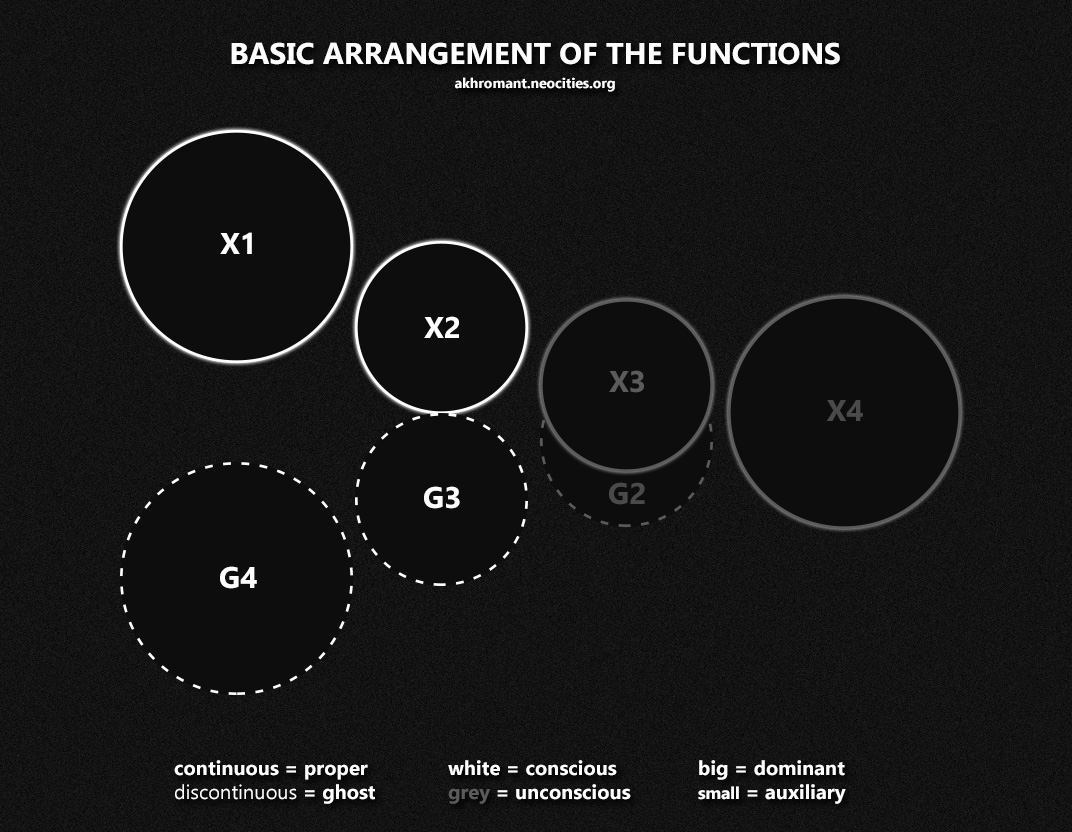
The diagram below shows the basic arrangement of the functions at what could be considered an "average" or "moderately advanced" stage. Not everybody is at (or even gets to) this stage, of course, but I think it is the best one to keep in mind if we want to have a general perspective of things.
The positions and sizes are only symbols for the self-clarity and interrelation between the functions. There's no "up/down" or "big/small" in the context of the frames, of course. It's all much more indistinct than that. The image is only a very limited way of trying to illustrate the differences and relationships between some very complex, subtle and vague concepts, so that we can talk about them with at least some precision.
The basic meanings are written at the bottom: continuous outline = proper (Xs), discontinuous outline = ghost[ly] (Gs); white = conscious, grey = unconscious; big = dominant, and small = auxiliary. There's also another idea included there, but it's only approximate because it has quite a few exceptions: distant circles are more likely to be disconnected and unmixed (differentiated), while close circles tend to be connected and mixed (undifferentiated), especially if they are grey.
Every circle/position (sometimes called "place" or "location") is always occupied by a function, and all of them are different. They follow this pattern:
- For the extraverted types: X1, X2, G3 and G4 are "e" (extraverted), while G1, G2, X3 and X4 are "i" (introverted).
- For the introverted types: X1, X2, G3 and G4 are "i" (introverted), while G1, G2, X3 and X4 are "e" (extraverted).
For each MBTI type, its Xs are the ones in the second column of the table I included in this post (written in the form "X1-X2 / X3-X4"), and its Gs are the same but changing e → i and i → e. (The 16 resulting diagrams are in the first table of post #140).
1. DISCLAIMER
Jung didn't write too much about the arrangement of the functions, at least not with this level of specificity. That's part of the reason why, from this point forward, things are increasingly difficult for me to identify with precision and then also explain clearly. What I write here is mostly based on what I see in myself and other people. Some things are more distinct than others, but it's all still quite blurry, so please remember that, whenever I talk about the functions in detail, some things/words/ideas might be slightly off (but hopefully not too much, as I try to keep the most uncertain away from the blog).
It's also very important to point out that maybe a lot of people don't relate to [any of] this, nor to anything regarding the functions [and the different positions], for reasons connected to themselves, and not to what I publish here. Three of the main problems could be: a) being mistyped (of course, that way nothing will fit), b) trying to make sense of things using the mistaken stacks, and c) not having a strongly defined type. The people that Jung studied, described and tried to help were those closer to, or already with, some kind/degree of "neurosis" (an apparently depreciatory term that actually isn't), that is: with a forceful separation of psychological contents between conscious and unconscious, which creates a way of thinking characterized by peculiar features that don't appear in other people. These peculiarities include effects caused by some functions being disconnected from each other. In fact, instead of neurosis I prefer using the term disconnection, and referring to the functions, not to the person. This separation occurs only in some individual psyches, those which, in themselves, know that their limits are being exceeded or their potential is not being realized. Jung described it as "an attempt at self-cure."
I don't know how many people have these marked types (that's the people I was referring to in this post), and I don't know what would be the diagram for the people who are a long way from the disconnection of functions. The idea is that the functions stay undifferentiated, so the circles remain somewhat mixed, in a previous or alternative stage, with both arms closer together, and with no special white/grey disparity, preventing the isolation or "independence" of distant functions. Whatever the case, the conclusion is that, for some readers (and on top of what I explain in point 3 below), what might look like an error or problem in these texts could be another thing entirely.
Don't use this as your only reference for typing, or as the first one. It's better if you start with the letters, which are actually much more difficult to understand than most people think, because they actually mean something. Most people just disregard them as if they didn't, and they end up mistyping everybody. So try to get them right, before coming back here.
And please don't trivialize this. Don't start calling yourself or others "neurotic" just because you have difficulties with certain tasks or people, or because you don't experience a continuous state of bliss. Having problems is a human thing, and throwing labels around won't make them go away. There are many people online that love to present themselves with "illness" or "disorder"-related terms, using them as some kind of weird badges of honor, pride or victimhood, either to justify their behavior or to demand special treatment. This is actually an abusive misconduct, which makes the real problems worse. These people dilute (destroy) the meaning of serious and specific words because they apply them where/when they shouldn't, and then it gets to a point where others hear those words and don't take them seriously anymore, so [the people with] the real problems might not even get recognized. What I wrote in post #99 is partly a consequence of this.
2. CODES
Ok. Back to the diagram. The positions of the functions don't have "official" names, only X#/G# identifiers: X means "proper", and G means "ghost[ly]" (sometimes even "ghosted"). The numbers (#) are a bit confusing: on the proper functions they indicate the unconscious depth of the frame (higher X-number = higher unconsciousness), while in the ghost ones they indicate their conscious level (higher G-number = higher consciousness). The trick is to draw the tilted V using X4 as vertex: when you are trying to visualize all the functions of INFJ, for example, you start with the Xs moving to the right: Fi→Ni→Se→Te, and then you do that same F-N-S-T thing, starting "below" Te (X4), and going back to the left while changing attitudes: Fe→Ne→Si→Ti (=G1-G2-G3-G4).
It's a bad idea to try and assign exclusive words or titles to these locations, because they are all multi-faceted, they can be occupied by very diverse functions, and if you use fixed names you might be keeping yourself from noticing other possibilities, other modes of interaction and manifestation, etc. When you name something you are basically assuming that you know everything about it, and that's never true if it's living (yes, in a sense, names are only for the dead, and this ties in with what I said in the disclaimer). We have to use words to describe and talk about the positions, of course, but I always try to give those variety, and never present them with anything other than their simple code.
3. MOVEMENT
The idea behind the image includes my attempt at trying to reflect a kind of movement: the unfolding of the functions, both horizontally and vertically, like a plant or a flower (tilted sideways), with X4 working as hinge or focal point. (I can't do animation, but I think you get the idea). The main component of this process is, obviously, the differentiation of the functions. The assumption is that, the younger you are, the closer everything is. It begins with all the circles grouped and mixed together. Then X1/G4 and X4 start emerging at the sides, with half of G4 already below X1 (each G always moves with its X counterpart, like a symmetrical reflection). These three main circles keep moving away from each other, with the other four still mostly merged with themselves and with the left side of X4. Then, when/if there's enough space in between, X2/G3 pop out of the mixture and go next to X1 and G4, respectively. X3 and G2 start moving, too, and eventually everything reaches the positions shown in the image.
It is at this point when we can put most of Jung's Chapter X, and also his methods and ideas about bringing unconscious contents to consciousness (dream interpretation, etc). This happens through what he called symbol or transcendent function, which is essentially an encompassing natural process that works better when it is acknowledged and attended, of course. But that's a topic for another time.
As I mentioned here, the unfolding is not so much about the functions actually "moving" but about consciousness being able to see them more clearly. It's like a change (improvement) in the resolution of what we can perceive/think. This is the principal reason for the misleading idea that "your type changes": in reality it doesn't, it's just that you get to recognize it better. The various stages of this transformation make the descriptions of the positions extremely difficult, and sometimes apparently-but-not-really wrong.
4. PROPER/GHOST
This is the main distinction between the positions, more important than conscious/unconscious, because this one can't change. In fact, it's quite ok to say that we only have our proper functions, and that we don't have the ghostly ones. You've probably read somewhere that other people call the non-proper "shadow functions", but that term is confusing because it suggests a link with the Shadow archetype, and that's something different (the idea of ghosts is also much more appropriate).
The difference between the proper and the ghost positions comes down essentially to true/false: our proper functions are real, and our ghosts are unreal. This disparity takes lots of varying forms and internal expressions. All other things being equal, some words to describe them could be, for example: noticed/ignored, solid/hollow, firm/volatile, content-full/content-less, reliable/unreliable, familiar/unfamiliar, required/optional, needed/superfluous, relevant/irrelevant, useful/useless, adequate/disappointing, innocent/guilty, meaningful/meaningless, understandable/dizzying, trustworthy/untrustworthy, compatible/incompatible, etc.
Your ghosts might be something you see as a play-thing, a toy or a hobby, only for entertainment (like an amusement park, for example), but eventually you get tired of them. That's on the "good" side. On the "bad" side Gs can look like threats, menaces, dangers and traps, something that can fail, etc. So you may try to warn others about the bad things associated with them. This is distrust, caution or avoidance. If you try something with the Gs it usually needs to be done very carefully and in controlled/specific conditions, without interruptions, etc, because it's not at all automatic for you, quite the contrary.
The middle ground is criticism/reformation (and where the "optional" impression manifests itself): it's ok to take everything useless or wrong away from any G, no matter if it ends up empty or cancelled. But you can't really act directly upon them, so you concentrate on the proper ones, and maybe analyze their interrelation.
➤ G4 is completely disconnected from X1. You know they don't have anything in common, because you are X1, not G4. G4 seems to reside/happen somewhere else, in another time, or in/to someone else. It's so weird. Why/How is that even there? Where does it come from? (I need to expand on all these ghostly things, this is just a preliminary description).
➤ X2 and G3 are touching very slightly (that is: X2 covers only a tiny bit of G3). This means that we can distinguish them without problems but, at the same time, also realize that G3 is entirely needless. It's only X2 that's true, G3 is just there, like some kind of phantasm. They often seem to be fighting for X1's attention (your attention). That's why some common mistypes are between ETJs, EFJs, ESPs, ENPs, ITJs, IFJs, ISPs and INPs.
➤ X3 and G2 are more or less mixed together (X3 is supposed to be seen "above" G2, like an eclipse), so we see almost everything that's supposedly related to G2 as just a question of X3.
➤ X4 and G1 are only one of them: X4. You could even call them X4(G1). On top of being incompatible with our conscious dominant, G1 could be called the "non-function", because it's completely eclipsed/replaced/assimilated by X4. The only G1 is X4.
It's possible that X1/G4 go through an early phase where their interrelation is similar to what's described for X2/G3 [and X3/G2 before that], and maybe X2/G3 go through an X3/G2-like phase, too.
5. CONSCIOUS/UNCONSCIOUS
The basic concept behind the various conscious/unconscious levels is that, the lower the number, the easier it is for you to see and interpret what the function tells you. Remember: the functions are essentially the senses of your mind, so the more conscious are the keenest. What does this mean? It means that you can see, understand, retain and entertain all the parts, the nooks and the crannies, the paths and the modes, the details and the subtleties, just as they are, pure and unmixed, and you can do it faster, longer, deeper, wider, and with confidence. Going in the opposite direction, the more a function moves into the unconscious, the less clear it gets. Its contents start to merge, it becomes blurry, more difficult to discern and comprehend, and sometimes it even seems to disappear. It doesn't, of course, it's just that we can't see it.
For different people the effects and manifestations of their unconscious functions are different, too, and this also happens among people of the same type, of course. So even though you might have an MBTI code in front of you, you can't assume anything because, on top of those variations, that particular person might have a mildly definite type without separated functions, a clearly defined (=marked) type without disconnection, the same but with a moderate level of disconnection and a specific set of peculiarities, a severe disconnection with its own range of characteristics, etc, and [s]he might move between those situations. So you know very little.
How do you distinguish between those states? What do they have in common? That is: what can you say for sure about a given type? Mmm... Not too much. How does one thing become the other? What is actually a problem that might require external help, and what doesn't need intervention and is better left alone? Or even better: what is help? Yeah, exactly. That's one of the most important questions you can ask yourself.
Anyway, this is all very difficult. It's psychology, and it's also much more than that. It's not only a field of study. And the types are not a curiosity. I hope you are getting the idea.
As a standard, we usually take X1, G4, X2 and G3 as conscious, and X3, G2, X4 and G1 as unconscious. In reality X2/G3 could be seen as ¾-conscious, and X3/G2 as ¾-unconscious. Maybe I should have used four different shades of white-grey outline (one for each "level"), to indicate those intermediate degrees of unconsciousness, but I think that would have made the diagram a bit too complicated or overwhelming.
The unconscious includes many things not pictured in the image, and the grey circles are more or less mixed with and influenced by that, but we need to make an important distinction here, because we don't know to what degree nor, in many cases, in what sense. That is: talking about the unconscious in general is not the same as talking about the unconscious functions. Do they intertwine? Yes, but how exactly? How can you know, if everything is unconscious? Let's just keep that in mind, and examine some things about those concepts.
The unconscious (in general)
The expert on the unconscious is obviously Jung. If you read a bit of what he wrote you can get an approximate idea of what the unconscious is, what does it include, and how does it manifest. The best definition of the unconscious is that of "every psychological activity which is not conscious". Yes, and it doesn't get much better than that because, essentially, the unconscious is [the] unknown.
With a little more detail you can distinguish between the personal and the collective unconscious. The latter is the amazing and incredible world of mysterious, fantastical and mythological contents and archetypes, which comes in/from "the inherited brain-structure" that we all share, while the personal unconscious includes "the forgotten, the repressed, the subliminally perceived, thought and felt", also mysterious and amazing, of course, at the individual level. Now, "repressed" doesn't mean "that you secretly want". It means that you don't pay conscious attention to it, that you purposely try to forget it, etc. It doesn't imply some obscure wish to do harm. There's always a lot of negative words associated with the unconscious (and the mind in general), but you just can't really study it from that pessimistic perspective, assuming inborn/continuous sources of trouble. That's condemning people right from the start, and it's both mistaken and damaging.
Beyond this point you can't get more specific: "It is also quite impossible to specify the range of the unconscious, i.e. what contents it embraces." And: "what the whole unconscious content could be is quite incalculable. What is the furthest limit of a subliminal sense-perception? Is there any sort of measurement either for the extent or the subtlety of unconscious combinations? When is a forgotten content totally effaced? To such questions there is no answer."
Ok, well, so, how does the unconscious manifest itself?
First of all, the classic: dreams. Then also "interferences in the wake state: ideas 'out of the blue', slips, deceptions, lapses of memory, symptomatic actions, spontaneous fantasies, etc". These would be the accidental/spontaneous and untimely/halting descriptors. Then there are some other adjectives, taken from a wide range of situations and conditions: compensatory, mixed/undifferentiated, projected, stagnant/regressive, primitive/infantile, bizarre/distorted, abnormal/pathological, destructive. Alright, but it doesn't necessarily imply any of that. Sometimes unconscious only means "asleep/dormant". So, be careful putting things there, making assumptions and/or being afraid of it, because you don't know what it is. And if you fear, fight or prepare for something that's not there, you might provoke something else instead. And it will be only your fault.
All of this might apply to how the functions work in some cases, in some sense, or not.
The unconscious functions
At its core, the whole point of Jung's Psychological Types was that consciousness is one-sided: "It is useful, however, to distinguish between conscious and unconscious, since the presence of two attitudes is extremely frequent, the one conscious and the other unconscious. Which means to say that the conscious has a preparedness of contents different from that of the unconscious." He repeats the same idea over and over: "His entire consciousness looks outwards to the world", "This automatic phenomenon is an essential cause of the onesidedness of conscious orientation.", etc, etc. So, all the conscious functions have one and the same attitude (extraverted or introverted), and all the unconscious ones have the other. There's no place for the [widespread but utterly misinformed] idea that the conscious dominant and auxiliary have opposite attitudes. It doesn't make any sense. This has been proved statistically, too: the famous alternating "function stacks" are all wrong. The real proper functions are e-e-i-i for the extraverts, and i-i-e-e for the introverts.
Now, unconscious doesn't mean "absent", "morbid", or "inevitably wrong". That's another of the worst misconceptions about psychology and typology. Some people think, for instance, that being an introvert and having two unconscious extraverted functions means you can't operate "in the outside world", but that's because they have the erroneous conception of the functions being "skills" and/or categories of actions, and the uninformed idea that unconscious means "unavailable".
Having unconscious functions doesn't mean you are bad or flawed, in any sense. There are many people out there that only seem to be looking for that, whether it is with MBTI or with any other "system" (they actually don't care about that, or about the truth that might be behind some of the models), maintaining that everybody is somehow "damaged", "imperfect", or "unconsciously monstruous". Well, that's not true. Among the many distortions included in that cynical belief, there's the mistaking of possibility/capability for "certainty", "property" or "characteristic". Being capable of violence doesn't make you a violent person, for example. Many people have a huge problem with that distinction.
Again, this is not about everyone having some kind of "dark side" or "hidden intentions". That's not the right way to approach it, at all. It's similar to what I mentioned here about the nonexistent "weaknesses", and also to the way some people think about particular "functions" (or what they believe are functions), as if they were some kind of manufacturing error. There's obviously an obsession with stigmatizing people for being what they are, and then selling them some "cure", or even feeling justified in attacking them. And that's a problem of the "typologists", not of the person, of course.
6. DOMINANT/AUXILIARY
Although we tend to think that we are only inside X1, we are actually all around the diagram. It's our consciousness that has a fixed point of view: it's always looking from X1 towards X4, so it can see all four Xs, more or less, with G4 being essentially outside our conscious field of view (as we prefer/tend to ignore it), and X4 being distant and blurry. We always see X2 through X1 (as if looking from behind some X1-glasses), never isolated, and we also see X3 through X4 (and probably G3 through G4, although the ghosts are weird), because our mind, as a whole, includes all the locations. What we are is the four proper ones.
The glasses analogy is a way of picturing the dominant-auxiliary relationship between those functions: each dominant as the eyes/lens through which we always look at and interpret its corresponding auxiliary.
This causes a fundamental disparity between the 4 proper positions, because the small ones are always subject to something apart from themselves, so they are not "free". You can put it this way, as a very broad summary:
- X1 and X4 are independent, autonomous, and self-sufficient. They are demanding of their auxiliary, and accepting of their own content.
- X2 and X3 are subordinate, aligned, and conditioned. They are accepting of their dominant, and demanding of their own content.
X1 is the most important location. It's by and for itself, just because. The function in X1 is what you identify with, your identity, to such an extent that sometimes other people see and treat you in a way that's related to how they see and treat that particular function. X1 is what you are, and where you live. You don't have any problem with it. In fact, if you criticize it, it's not your X1. If you doubt it, or don't trust it, it's not your X1. If it feels strange, uncomfortable, weird or annoying, in any sense, it's not your X1. If you call it "second nature", if you think that you "find it" or that "it appears" or "happens", then it's not your X1. You are your X1. You can't even doubt it, it doesn't work that way. You might say or do things related to it that constitute a real shock to other people, because they are "too X1" ("too daring", "too far reaching", "too intense", etc).
X4 has an equivalent unconscious importance. It's also by and for itself, but it feels like a part of you that's not where you are. It's the required, the relevant, meaningful and true that's not close to you, so you miss it, and you look for it. Sometimes the person prefers that others bring, represent, produce, explain or expose X4, and sometimes [s]he goes to others for it. It's better still when it's nobody's work, and it's just something else, something that's simply there (this is probably part of the projection effect). X4 can be seen as having a life of its own, separate from the person. It's seen from the outside, from every angle at the same time. Not divided, but unified. All in one. So it's like another world. And it feels unreachable, and non-participable. But the person wants to protect it because it's extremely valuable, certainly the most valuable thing "apart from" his/herself. You can't/won't make changes/choices regarding X4. You want it to be and go well, all at once. Maybe there's some kind of discomfort, worry, suffering or sadness for being away from X4. This might have something to do with it being essentially the main symbol for the unknown part of your Self.
X2 and X3 can be interpreted as lots of different things, for example as objects/subjects of study or work (this would be part of the 'interest' I mentioned in point 4), but always in the sense of not being the absolute most decisive thing. In fact, they must never interfere with X1/X4: for you, they are limited by those functions. One interpretation or manifestation is the idea of X2 and X3 being resources or tools (sometimes even weapons) at the service of something else, in which we tend to be skillful/agile with X2 and clumsy/shy with X3.
With X2 there's this idea of just finding it and being inspired/moved/changed by it. I think in early stages it might look like some kind of beacon, relief or salvation. X2 is not personal, not exclusively "yours", and not owned or ownable by anyone. It's not escapable, either: everyone is subjected to X2, you see it everywhere, in everyone, whether others also see it or not. And it evolves, and it's supposed to get better with attention and time (always from the point of view of X1, of course). With X2 there's the idea of "building/taking care of it very carefully". It is the most cherished in a good, close and inclusive way.
X3 is similar to X2 but without the clarity of consciousness, so it might include other elements, more emotional/fantastical/etc. You respect X3 because you know it's dangerous: it must never go against X4, so you don't want to interpret/translate it wrongly. That's why people usually end up incorporating it only in very thoughtful ways, in small quantities and scopes, with forms/results like miniatures, very refined or distilled/simplified. These could be like jewels or pearls for the person, but for other people they might be of no interest or value at all, and in fact some won't even notice them. This can be saddening or worrying, of course. That's also probably why many people don't openly show/display or even point to them. At the beginning, and in contrast with X2, there might be something about possessiveness here in X3, about some kind of exclusivity, etc.
7. FEEDBACK
There are countless more things to say and discover about the functions, the ghosts, the unconscious, etc. This is just some kind of sketchy map, with indications that probably feel very strange and difficult to recognize. I might try to explain and expand some ideas in additional posts, but still I hope that other people can identify at least with some of what is up there, and maybe understand themselves a little better.
So, thank you for reading. Give it time, and think it over.
Anonymous said: Hey could you please explain the functional stacks and how they are truly meant to be like the Infj being Fi-Ni-Se-Te thing.
Hi :) The term "stack" is not very appropriate for talking about someone's functions (that's why I tend to put it in quotes, and otherwise just keep it for the tags). It has its origins in the classic mistaken interpretation of these concepts, and it refers to something that's too "physical", too "concrete" and clear-cut, too "defined" and simplified. It also implies the idea that you can "rearrange" its components, somehow. The very fact of coming up with that word (and/or taking it for granted) could be considered a sign of not having found what the real functions are. The functions are not pieces, they don't work with that kind of independence, they don't rest in some kind of pile, they can't be moved or replaced, there are many more factors that come into play apart from their order (especially all about the ghostly frames), and that order is only linear/incremental in some senses, but not in others.
Having said that, I know that in the series of posts that I'm writing about the functions this might seem the logical "next step", but you have to remember that Jung wrote a whole 100-page-long chapter talking only about X1/X4, so this question, which includes all Xs and Gs combined, would basically result in an entire book's content. Maybe someday there's enough in this blog to constitute that, but apart from the fact that it would take a lot of time, it's important to notice that one of the most valuable aspects of what I'm doing here is not the giving of definite answers, but the offering of some tools, sketches and signs for other people to see, examine, navigate, think and expand on all these things, by and for themselves.
The posts are useful as they are now, [for] much more than most people probably think (that's one of the reasons why I have an index, why I don't post that often, and why I keep linking back to things). And in fact, as I said here, in many cases making additions and trying to particularize only brings confusion. Whenever you start getting too close, the reality of the types/functions starts eluding you, mostly because you end up focusing on words, and words can't describe everything (they are better used as beacons, cardinal points, etc). Still, I'm already doing that, for example with this list (which is essentially a way of describing X2-through-X1 from a particular angle), and I'm working on more posts for later, of course.
As it happens with the typing series, what I present here about the functions is a general approach, a way of trying to get everything in perspective, without leaving things out, but without trying to pinpoint the exact location of every single "item" that we can think of, either. A lot of people out there seem to be demanding some kind of minute explanation for every little thing that goes through their minds, as if they were circuit boards where you can locate and trace all the ones and zeros, but neither the brain nor the mind are like that. We are not machines, and we don't work as they do. People need to be open to other kinds of perspectives, realities and understandings, less "mechanical" and more "figurative", but not less true.
Anyway, your question is obviously very interesting and pertinent, but also too broad and extremely difficult to answer. I think it's better to take it as some kind of wide-ranging itinerary, and hopefully we'll get to visit the most remarkable sites, eventually :) In the meantime, the best response would be essentially an extension of what I wrote in the second half of this post: for any given type, you need to take what I explain in the previous texts about the functions (especially this one) and put it in the one about their arrangement. Keep in mind that what's described in that second post (the most relevant to your question) only applies to a certain kind of people, those with clearly marked types (so, for example, not every INFJ is going to relate to Fi1+Ni2+Se3+Te4, only the most "defined" or "intense" INFJs will). Try it. Observe what happens. It won't give you detailed or specific descriptions, but it can make you think, and you might start seeing things for yourself :)
Anonymous said: I've read that you described the unconscious/X4 as "UNKNOWN part of your Self". How is it different from intuition or N (ex. Ni or Unknown of your inner world) and would that mean that Ni doms are more prone in exploring their unconscious?
Good find. Yes, if you understand what I mean in that post, there's not much difference there, although in some cases the unconscious might not be identical to X4, it might include part of X3, or even X2. Two notes: I use "self" for the whole mind/psyche/soul of a person (just like Jung did, especially in contrast with "ego"). And N is only the letter for the function of intuition in general, without specifying its attitude (e/i). It's only when it's introverted (Ni) that it perceives the inner world. As Jung said: "Intuition, in the introverted attitude, is directed upon the inner object, a term we might justly apply to the elements of the unconscious." And "In this way introverted intuition perceives all the background processes of consciousness with almost the same distinctness as extraverted sensation senses outer objects."
This means that INPs (Ni1) can see the unconscious basically like a "normal person" (Se1) sees the external world (that's one manifestation of the particular function that you have in X4: the way you see the/your unconscious). But I wouldn't say they are "prone", partly because that word has a certain negative connotation, and partly because they just can't help it, that's what their conscious mind does. Then that perception brings about different things. Some INPs take an artistic approach, for example, and are occupied with the tangible representation of those inner images. Others have a more differentiated auxiliary function (X2), so they find a meaning in them, either conceptual (Ti2) or moral (Fi2).
Anonymous said: What is the symbol or transcendent function from #24?
It's a sort of global product, result or consequence that comes from the integration of opposites, those being the conscious and unconscious functions of the person. It is something that appears when you stop identifying only with one side, and realize that, somehow, you are the whole sphere, not just the lighted (conscious) or the shadowed (unconscious) half. In his extended definition Jung says the symbol is "neither rational nor irrational", because it's actually about the two dimensions together: J+P. And I think what he has in mind is very often the union of ghost and proper functions, especially G3+X3 and G4+X4. For Js the symbol can be seen best in something that they design, build, run, produce and/or organize. For Ps it's more about what they are, how they behave, etc.
Jung calls it "symbol" because his definition comes from his own G3+X3: gSi3+Se3, which includes the way dreams appear in or refer to reality. This is why, in his description of the marked (morally oriented) introverted intuitive (INP: gSi4+Se4), he says that "he makes himself and his life symbolic" (not to be confused with something historical, or with performing or playing a role as if the world was a stage. The latter is what Fe1s do).
Anonymous said: Actually xxxJ types are J not because they have a dominant function that is a Juding function ( Fi,Fe,Te,Ti ) but because their first Juding function is extraverted. INTJ is J because their first judging function is Te. The same for xxxP. INFP is a perceiving type because their first Perceiving function is extraverted (Ne). J and P indicates how you relate with the external world.
No, that's Myers' classic, contrived, psychologically blind, and disingenuous "train of thought", that is: her sales pitch. (And in this context when I say Myers I'm not referring only to her, but also to anyone that buys what she sells, and/or tries to resell it). I have explained it all before, especially in post #01, post #11 and post #18, which I'm pretty sure you haven't read (and if you did, you weren't paying attention). I wasn't going to answer this message, being so obviously from someone that hasn't read anything in this blog (and probably doesn't care), but since I'm writing another text about how this J/P thing really works, I thought I'd take this post to try and focus on, or summarize, how it doesn't work.
First of all: from Myers' and the "official" MBTI perspective, Js are Js because the test says so. And that's it. That's what they work on, and what they sell: the test. And tests measure some things (traits) in order to determine the letters, not the functions. Don't fool yourself (or others) thinking otherwise. The test is about traits → letters. All the subsequent talk about "functions" is purely decorative: they are assuming what functions are behind the different 4-letter codes (and pretending to be correct), not the other way around. Their "functions" are just a gimmick. And, just like other gimmicks, they have been proved wrong, and serious members of the organization have suggested abandoning them.
Where does this gimmick come from, and why is it wrong? It comes from the very beginning, when the MBTI was created, and it's wrong because the people that started the indicator didn't get the psychological concepts right. The purpose of the indicator was (and still is) not psychological, but to serve as a tool to make better working teams (that is: to put people "in their places"). This approach distorted what Jung discovered and explained.
Myers got some things right (especially about each of the four groups that make her favorite division: ST/SF/NT/NF) and other things wrong (especially about the remaining letters, which are actually more important). Some of the errors were fixed later, but the "functions" weren't, and at this point it's very doubtful they will ever change them, because that would mean admitting they never understood the functions in the first place.
So basically, the crucial thing here is to realize and accept that Myers misunderstood Jung. You won't get anywhere if you don't. At this point you need to examine yourself and try to detect any prejudice or bias that you might have. I'll give you some examples (read the ✘ at the end as your favorite "error sound effect"):
"Myers was a woman and Jung was a man, so she was right." ✘
"Myers was American and Jung wasn't, so she was right." ✘
"Myers' work was newer than Jung's, so she was right." ✘
"Myers' work has been around for decades, so it must be right." ✘
"Myers' work has millions of followers, so it must be right." ✘
"You're just some weird random person on the internet, going against what everybody is saying, so you can't be right." ✘ :D
Etc, etc. (I think you get the idea).
There are several fundamental things that Myers didn't understand, or didn't want to understand, because she got a little bit obsessed with making her test work, so she found herself ignoring and/or wilfully distorting things. The following are some of the most important.
✸ 1. The essence of psychological type is not about behavior.
Myers was aware of the concept of different types of people (her mother was into that, she wrote novels around the idea, etc), and she started looking for patterns in the things that people do, that is: looking at them from the outside. Jung had warned explicitly against that, because psychological type is much deeper than that. It is about the mind, the psyche, the soul.
The functions are about consciousness and the unconscious, not about behavior. They are cognitive functions, not behavioral functions. And the core of cognition is about, or at least includes, perception and judgment, awareness and intention. So it's not what you do before or after, here or there, but why you [don't] do it. And it's not a historical or sequential why. Many "smart people" like reducing everything to that. But no. Sorry. We are not pool balls.
For thousands of years, countless people have been trying to infer characteristics of the soul from external "marks", "clues", or whatever they want to call them. Now, think about all the incredibly ignorant, disruptive, divisive, harmful and outright murderous things that can and have been done with that approach. Yes, keep going. That one, too. Right. There are even more than that. Many more. You have no idea. No one has. "He looked at me the wrong way". "He said the wrong words". Millions of people are doing this right now, probably right there where you are. People are being stigmatized and condemned, sometimes even killed, just because someone saw a "sure sign" of them being "evil". Well, that's absolutely the wrong way of doing anything.
So anyway, keep that in mind. Two people doing exactly the same thing might have completely different intentions behind it, that is: completely different psychological types (post #04.5). And if you want to identify someone's functions that's what you try to find: the true reason. Not his/her [un]tidy desk, but why does [s]he have it that way. The more you stray away from that, the more you start mixing things and looking for black cats.
✸ 2. J/P is not independent from the dominant function.
J/P is not an autonomous thing: it comes along with the dominant function. The "moment" you are introverted or extraverted, you are also a judger or a perceiver (and a T/F/S/N, too). This doesn't appear later, and it doesn't depend on or come into play only in the external world, of course. J/P goes with I or E, not apart from it. You can't be I or E without being automatically a J or a P. Both concepts go and mix hand in hand.
That's why Jung grouped the types in EJs/EPs/IJs/IPs, their most meaningful division (post #01/2.3). He explained very clearly why T/F-doms are judgers, and why S/N-doms are perceivers. It's just how those functions manifest when people have them as dominants. It's how those people think, the cause of obvious differences and misunderstandings between Js and Ps, etc. It's the whole point of the dichotomy.
Calling someone with a judging dominant a "perceiver" (like Myers did with herself), and/or someone with a perceiving dominant a "judger" is simply nonsensical and anti-psychology. And changing those terms "officially", in a tool that's going to be widely used, is not only shockingly lazy and dangerous, but also strangely stubborn, like someone trying to make a mess of everything on purpose.
✸ 3. The auxiliary function doesn't work in isolation.
Myers didn't understand the relationship between the dominant and the auxiliary as it really is. It's not about any "order" in space or time, but about dependence. The auxiliary depends on the dominant, it is conditioned, filtered and directed by it, so it's never isolated, and it can't "act" alone in any sense, or determine qualities of the person as an independent agent. It can't be the factor that says whether someone is a J or a P: that's precisely one of the "powers" of the dominant.
That's probably the closer to a key in all this mess. The functions are not like construction blocks: when one goes as dominant it's not that it goes "first", it's that no other function is ever going to be more important, more decisive, etc. That's why it's called "dominant": it's the most influential component in the consciousness of the person, in every sense.
And in fact, the essence of psychological type is not about time (post #17.2). Time is actually a figment of the mind that comes from the distance between each proper function and its ghostly counterpart (X//G). This distance starts at zero for X1/G1, and then grows the more the proper function is unconscious (see post post #131).
✸ 4. J/P is not about "the external world".
The consequence of the previous points is that it doesn't matter if your "first" judging function is introverted or extraverted: if it is your dominant, you are a J. If it is your auxiliary, you are a P.
If people were J or P depending on their "first extraverted function" in those (nonexistent) alternating stacks, that would make all E/I pairs essentially the same, destroying precisely the most important concept of psychological type: the extraversion/introversion dichotomy. And it would make the extraverted functions "superior" in some bizarre sense, too, because whenever they'd "appear" they would "win", as if people were only interested in "controlling" or "experiencing" the "external world", and turned into judgers or perceivers by that alone.
The functions just don't work like that. You need to read things carefully [again], and realize it for yourself. Otherwise, you are only repeating lies.
I'm going to put here that beautiful table with the real functions of the types, so you (and other click-averse people) don't need to go anywhere else to read it.
ESTJ is Te-Se-Ni-Fi
ENTJ is Te-Ne-Si-Fi
ESFJ is Fe-Se-Ni-Ti
ENFJ is Fe-Ne-Si-Ti
ESTP is Se-Te-Fi-Ni
ESFP is Se-Fe-Ti-Ni
ENTP is Ne-Te-Fi-Si
ENFP is Ne-Fe-Ti-Si
ISTJ is Ti-Si-Ne-Fe
INTJ is Ti-Ni-Se-Fe
ISFJ is Fi-Si-Ne-Te
INFJ is Fi-Ni-Se-Te
ISTP is Si-Ti-Fe-Ne
ISFP is Si-Fi-Te-Ne
INTP is Ni-Ti-Fe-Se
INFP is Ni-Fi-Te-Se
You're welcome :)
Anonymous said: Do you think that the truth is only accessible to certain people? I mean, the process of discovering it
Oh, this is a very interesting question (and such a beautiful topic). The short answer is yes. The long answer includes some things I have been mentioning in this blog (you seem to have been paying attention, or maybe you already knew about them), especially in the posts about the differences between the types (post #04, post #05, post #06 and post #10, for example). Other related posts are post #17 and post #24.
The general perspective is that people with different types get different kinds of insights thanks to the differentiation of their functions. Within themselves, those insights vary slightly from one person to another (depending on the crystallization of their frames, among other things), but the more important aspects are essentially the same, so you can say that, in a broad sense, people with the same marked type tend to have very similar ideas and/or arrive at the same conclusions.
You have those that depend more on what is present in their current location and circumstances (E), and then others which are more independent and universal (I). Some are more practical or usable (S), while others are more symbolic or conceptual (N). There are those that tend to be somewhat mechanical (T), while others incorporate notions related to what should[n't] be done (F). Some are more attached to hierarchy, method and process (J), while others are more open and encompassing (P).
I think this is where most of the great personal "achievements" come from, and my guess is that a lot of famous people in history had marked psychological types (I'm not distinguishing between good and bad here, that would be another side of it). Some of them are those that you and I (and others) probably consider as having arrived at some[-kind-of]/the truth. Many things can be discussed about all this.
Now, there are several definitions of truth (of course, that's the thing), but most of them are not true at all. The following, for example: for some people truth means what they (or others) feel or want, usually about certain facts/truths or in place of [those] facts/truths. That is: emotion. For others it's essentially the past, history, "what happened", data, and other kinds of memorizable elements. That is: knowledge. For others it's just flat-out assumptions, fabrications, contradictions and meaninglessness. That is: lies.
You might stop there and remember perhaps some of those not-very-intelligent but apparently "deep" sayings like "there are different truths, so you can't get to it", or you can notice what you just read and think "wait a minute, the existence of those differences is true, so there's a meta-truth, something that includes everything". This happens with all the short-sighted aphorisms that try to deny truth: they are always self-contradictory, because you can't deny truth. If you do, you are affirming it instead. And in fact, the more you try to deny or ignore what's true, the worse things get. For everybody.
Anyway. In your question you are already referring to a certain kind of truth, of course. You mean something that can be recognized or realized with the mind, not with the use of tools or through other people. And I think you mean something timeless and universal, at least. Right? That's what the real truth is. You are obviously aiming at the highest one. In fact, there's no other way to get to it, because that "way" is not actually a process, but more like an internal disposition, capability or potentiality. Maybe you have it in yourself.
Something really strange happens when you try to talk about truth: all the approaches seem inadequate. You don't know where to begin. You don't know what to say. But you want to say something. And after thinking about it, you just realize that you didn't get to it through a definite method, so that's probably why the manner of expressing it always feels insufficient. It is. Truth is always something else. And that's part of the difficulty of transmitting it to others: if I see a flower I can tell you about it, I can take a picture of it, I can draw it, etc, but in the end it's you, only you, with your own eyes, that needs to see it. Otherwise it's not the truth, but a representation of it.
Truth is not its representation. Hey, that could be a start.
Ok. What else?
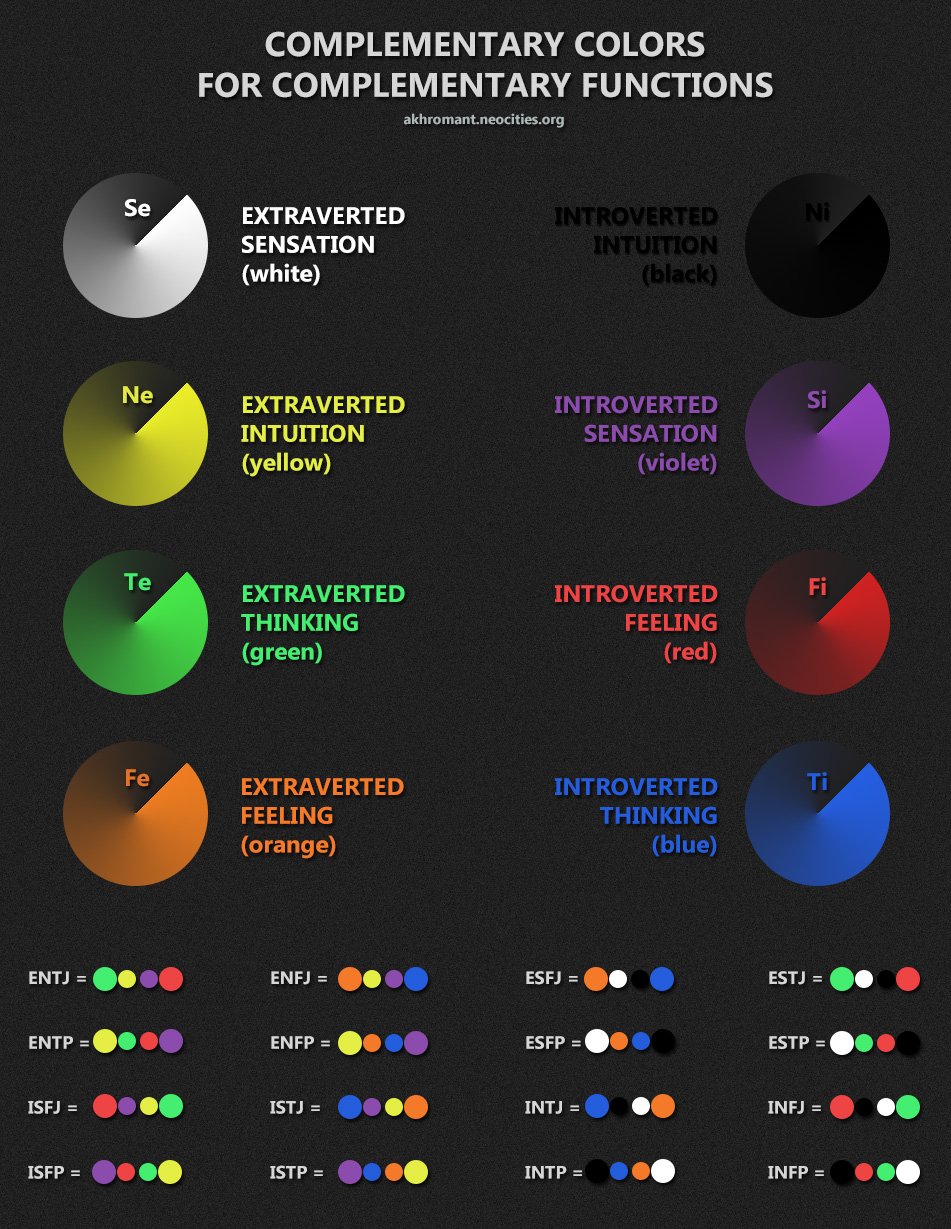
The functions are not colors, of course, and it's actually very limiting to represent them as such, but in some contexts it might be useful to have a simplified way of referring to or symbolizing them without words or acronyms. I don't usually pay much attention to this (because it doesn't matter at all), but I think you can make it somewhat wrong and somewhat right, so I gave it a try. Just to see what happens.
The first rule is that the colors must be complementary, because the functions come in pairs of opposites: Te-Fi, Fe-Ti, Se-Ni and Ne-Si. The second rule is that the introverted ones should be darker than the extraverted, to reflect their essential contrasting characteristics: removed/present, internal/external, background/foreground, intangible/tangible, slow/fast, etc. Then you can assume that feeling needs to be somewhat warm, and thinking rather cold. That would be a pretty straightforward third rule. Sensation and intuition are the difficult ones, but if you follow the first two rules, if you remember that the classic lightbulb of ideas and possibilities is yellow, and you take what's pure presence as white (like a pearl, a cloud, or a star in the sky), you can end up with something like the image above. (For details about function characteristics see post #15 and post #17).
I think it's a good approximation, using the 8 basic colors that everybody knows, etc. Still, there are a few problems (I don't think you can make it much better, but anyway). One is that the colors of the perceiving functions are closer if you go from S to N (and vice versa), but the judging ones are closer if you go from E to I (and vice versa). Otherwise they all look very different, changing abruptly. I guess it's a consequence of including black and white, but the thing is: if you don't, you end up with a palette of colors all too similar, because you can't use only a simple green or blue, and I don't know, it just gets weird :/
Another problem is that, for some people, this correlation might seem to insist on certain misconceptions about the functions, for example that introversion implies some kind of inferiority, that Fi has something to do with emotions, that Ni is something "bad", etc. Well, now you know: those are only lies, repeated by people who don't know what the real functions are, and who seem to have an image of them just as cartoonish as the colors above. And yes, another lie is the order that most people probably expect[ed] to find at the bottom :)
Someone requested a "clarification" about the functions, with direct messages. Even though it's all indexed and repeated in different ways throughout the blog, I explained it again, of course. Some of my alternative/new wordings were:
✸ Jung said that the auxiliary is different from the dominant, but not in attitude. That's one of the things that Myers misunderstood. He meant rational/irrational.
✸ The switching of attitude (i/e) is between a function and its "ghost" counterpart. For example: INTJs are Ti-Ni-Se-Fe, and their ghostly functions are Te-Ne-Si-Fi. They are usually ignored because they are not that type's standpoint, but they are there, and the person can "go through" them, taking them as optional, unreliable, etc, never as the most definite thing. I explained this in point 4 here: {post #24}
✸ The functions don't "develop". That's a term that he used but the thing is actually like this: the functions by themselves are always balanced, always e-e/i-i for the extraverts and i-i/e-e for the introverts. It's consciousness that's limited and produces an "imbalance" because it can't see all of them with the same clarity.
✸ The essence of the real functions is in point 2 of {post #17} and some differences are in point 5.3. (They are not actually comparable because the "stack-functions" are essentially traits, not functions). Then I wrote here: {post #17a} (again) that trying to give more details about the real functions is very difficult, partly because you start putting them in particular positions, and that can be misleading. It's better to go back to Jung's book and read what he wrote, and/or just keep those short essences and the other keywords in mind (including the ones from the graph in the first post). I'm working on some texts for later that might include more descriptions, but the real useful thing is for people to understand them by themselves, understand how they are in a deeper level than what's commonly "accepted", etc.
At this point, being unwilling or unable to process the information or the implications, to read carefully, to wait, or just to leave it at that, they abandon the topic and start going after me. The whole "clarification" thing was just a maneuver to do that, obviously. They proceed to jump from one place to another, very much randomly, trying to pick some terms and then make it look like it's all wrong, by association, somehow. I don't know. None of the things they mention has anything to do with the functions or the "stacks", of course, and all of them show an inability to recognize the reality of what we are talking about.
I'm going to put what they wrote next (right after my "etc.") in separate sections, for easier reading (the original was just two blocks of continuous text).
That someone said: "So what you're basically saying is that you can't give me a comparison between what MBTI says are the function and what you say are the function to demonstrate that you're right, but if I want so bad a definition of them I just have to reread Jung."
I don't know where you have been, but half of this blog is about that. And I've just said that they are not actually comparable: functions are not traits. There are several long posts here explaining precisely that. I'm not interested in finding out how many times I have to repeat the same things. And of course, I've just given you a definition, you just don't like it or can't grasp it. So... wow. It really seems that you just can't read. Well, if that's the case, sorry. I can't help you with that.
"Moreover you seem to hold Jung's work in an untouchable position, like is the Bible, but the fact that he explicitly say that the function develop during life doesn't mean, in your opinion, that they really develop."
Haha, now you are quoting Jung and at the same time implying that by doing so others are wrong. And you liked my previous explanation concerning this. I don't think you even know what you are trying to do here. You are definitely a bit lost. I say the functions don't "develop" because I understand what he means by that, and I'm providing a different angle so people can get it, too. You just can't, apparently.
This is not about any author, it's not about any particular person, and you are making a mistake by focusing on Jung and me. You need to calm down and breathe. The ones holding things as untouchable are the people that take the "stacks" for granted, repeating the same lies (even after being shown time and time again that they are wrong), mocking and insulting dissenting voices, etc. There seems to be a lack of mirrors out there.
"What you're stating here is basically that the psyche is already formed when we're born and that personal experiences and ambient's influence don't play any role in forming a person psyche, going against every theory about developmental psychology is wrong. You seem even to have a problem in recognising any actual value of experience when you state that "The types are the most important, meaningful and real differences between people" as culture, education and the ambient where one grows up are irrelevant, denying, yet again, developmental psychology."
"Developmental psychology: The branch of psychology concerned with the study of progressive behavioral changes in an individual from birth until maturity." You seem to have a problem with discerning behavior from cognition. And you seem to have a problem with discerning theory from truth, of course. That's one of your (and many others') main problems.
"Another thing that I noticed, because I read your posts even if it seems that you are convinced otherwise since you keep linking them, is that you state that the types are something physical as blood types, though we don't have any proof of that to be true because mind isn't a physical thing, but at the same time you say that types are like a person's soul and that behaviors don't have any relevance, when, according to psychology, they are the only way to understand the human mind (i want to underline mind and not soul, because they're different things). The fact that you use words like "soul" and your worship of Jung's person and book make me think that you want to build a new religion not a scientific theory."
Wow. What a trainwreck. I link things as a favor because in the chat it's easier to simply paste urls, they seem to work better for some people, things are explained much clearer in the posts (that's part of the reason why I recommend using asks), and even if you have already read them once, that's very often not enough. I'm glad you took them as an offense, though, I'm starting to think that you deserved it.
Now, a quote by Jung: "The contrast of types, therefore, as an universal psychological phenomenon, must in some way or other have its biological precursor." You probably don't understand this, either. Don't worry, that quote (like the whole post, actually) is not for you. It's for other people that might be reading this.
What else. Oh, underline what you will, you are wrong again: "psyche (ˈsaɪkɪ) n (Psychology) the human mind or soul". And by the way, you might need to make up yours about the word "soul" being valid or not, because you seem to have a problem there, too. "Understanding the human mind" only by behavior is like trying to understand fire only by smoke (let's see if you can get it with that). And "worship of Jung's person and book" is just a rather creepy fabrication of yours. You are kind of sick.
Of course I don't want to "build a scientific theory", because I don't want to build anything. You don't get what this is all about, and you keep imagining all sorts of things, like the idea that you are making sense. There are many people like you, who read a lot but don't understand absolutely anything. I think you should stretch the time frame between reading something and acting like you know what you're talking about.
"To conclude I want to point out some technical error, even if you say in your about post to not do this. First personality is not some slang therm, in psychology is a technical term that indicates "a set of psychic characteristics and behavioral modalities that define the nucleus of individual differences, in the multiplicity of contexts in which human conduct develops" that, look how strange, could be applied to Jung's theory."
You have a truly disingenuous and self-contradictory way of putting things. That's not a technical error because I don't use technical vocabulary (that's what's actually written in the about page). Neither do the majority of people writing and reading about these things online. This is just not a technical or "academic" context, and your attempt at displacing it is both weird and useless. I never said personality is a "slang" term. You keep fabricating what I say or mean. Over and over again. That's a very bad habit that you have. When I say that the types are not about "personality" it's because many people take that term as a superficial thing (not the true core of someone's thinking), and as something that changes quite easily. That's not what psychological type is.
"Second, neurosis can't, in any case, became psychosis, because they are two different types of mental ilness. There are some mental ilness that fall in between, like bipolarism, but one doesn't bring to the other."
Wrong again. Psychosis, in Jung's terms, is "an extreme dissociation of the personality. Like neurosis, a psychotic condition is due to the activity of unconscious complexes and the phenomenon of splitting. In neurosis, the complexes are only relatively autonomous. In psychosis, they are completely disconnected from consciousness." You just don't understand what he meant by those words. Jung's neurosis is not a "mental illness". The fact that you use that expression so lightly is like the sadly fitting finale in your series of "Things I Shouldn't Be Proud Of".
So yeah, I know what you tried to do. You did it very sloppily (mainly because it can't be done otherwise), and you made a fool of yourself, but you clearly went for it. The thing is: I don't care, because it's simply not what this is all about. Your (and anyone else's) "technical" background is only going to be a[nother] problem for you. You might memorize all the correct words and the current approved knowledge about whatever is called "psychology", in all its intricacy and "legitimacy", but that won't help you understand the types and what's behind them. Quite the contrary.
"You're welcome."
Oh, yes, of course. Thank you for finally revealing your true intentions, thank you for revealing your ignorance, thank you for supporting the actual functions (and the rest) by going off on every tangent you could find, thank you for making my grammar look good, thank you for the basis for this post and also, I would say, thank you for post #25. That one turned out just great.
Anonymous said: What is beauty? Do you see it is something objective or a matter of individual tastes, i.e., subjective?
Beauty is truth. And truth is beauty. Something is more beautiful the more clearly it reflects truth. And that something can be a physical object, an image, a melody, a poem, a sentence, a word, etc. Sometimes a picture is worth a thousand words, sometimes it's the other way around.
So beauty and truth are essentially the same but, if you want to have some kind of criterion, I suppose you could say that beauty is the relationship between the thing and truth (which is the most beautiful "thing"). So beauty would be an unmeasurable degree, and truth the unmeasurable absolute. Something like that.
Beauty, just like truth, is not its representation (post #26). So beauty and truth are not in those things themselves. Things can only reflect truth, or be an echo of it, and the better they do that, the more beautiful they are. We don't usually get that careful with adjectives, but in reality an object/poem/etc is not beautiful, it can only refer to beauty. Beauty, like truth, is outside the physical. We just try to communicate it through the tangible, because that's what happens with communication: it needs to step in some kind of bridge between subjects, whether it is words, pictures, etc.
If you are open to the truth (beauty), you can find all kinds of meanings and interpretations in the things that you perceive, and some of them have a greater effect because their link with truth is better (clearer, more "in tune", etc).
Now, the important part.
As people have mistaken definitions of truth (post #26), they also have mistaken definitions of beauty. The following are just some general examples, they can combine and mix in different ways, etc.
✸ For those that think emotions (and involuntary responses in general) are truth, things that make our physical instincts react (including the mere fact of different sensory perceptions, and also extremes like pornography or gore), might be considered "beautiful". But that's more about sensation and experience than about real beauty and truth.
✸ Some people seem to declare something beautiful when it refers to a particular order of events in time. From detailed rituals and practices to (imaginary) concepts like "fate" or "karma", for example. For these people a story (and history) can be "beautiful". But I think what they really mean is [again] "satisfying" or "pleasing", and that implies a preexistent desire or need, maybe even some kind of fear or anxiety. That is: nothing good.
✸ In the case of those that love the past, memory, knowledge, data, etc, what they call "beauty" tends to be either something closer to "correction", "perfect match", "perfect imitation" and/or complexity-for-complexity's-sake (what I call design or sophistication).
Imitation includes the ideas of model, copy, etc. An example here could be an orchestra that plays a musical piece without any "errors": people don't applaud beauty there, they applaud the close replication of something they know (this happens with a lot of things called "art"). Imitation is essentially repetition, and it's more machine-like than truly human. It aims at some kind of "perfection" which is not perfection at all, but precisely the antithesis of that. The only perfection is uniqueness.
It is here, and particularly in the context of design, where I would place what I call the "garden/forest" spectrum or line. It doesn't refer to extremes (especially not the garden), only to a way of showing the purpose/discovery dichotomy (which feels a lot like J/P, but might include other elements): how some people prefer things closer to (or even more intentional than) a garden, while others prefer the forest, or what's usually considered the natural side/state of things.
Well, I think it's easy to see: design is the opposite of beauty. The more you design something, the uglier it gets, because it moves away from truth, and it does so through someone's thoughts (that's mostly what thought does: bring confusion and lies, while trying to pass itself as "useful"). This happens with everything, from writing to painting and basically all that humans do, and it's probably one of the most meaningful topics to think and talk about.
It's not that things should be left untouched (although, in the end, it is exactly that, and one of the main lessons to be found here, but not the point of this post). It's that anytime the deliberate aspect weighs more, the work loses part of what could be its true beauty. And that aspect is not limited to (or many times even to be found in) the object itself, because it includes its causes and effects, the reasons behind it, and its potential uses. If we were talking about morality (we are, but that's also another topic), this would tie in with the idea that there is no such thing as "good intentions". The quality of being good doesn't depend on the alleged justification or the supposed outcome of an action: it must be completely "inside" the action itself.
A car, for example, isn't beautiful. It might be sophisticated, cool, fancy, etc, but not beautiful. The implications of its existence, the reasons and [intended] consequences, are not the car's (or any other object's) "fault", but they surely tell you things about people. It is in both directions (before and after the object itself) that you can see all the possible alternatives, the conscious decisions, the fears, the plans, the desires, the rules, etc. That's all thought, getting up to its old tricks. Not beauty.
In general, the objective/subjective distinction isn't useful (post #15.7). You need both the tangible and the intangible for everything, so there's always a subject, and without a subject (or an object) there's no "access" to beauty or truth (you might even say that object and subject are the same). Psychological type could be considered a good intermediate point to understand this: people with the same type are probably going to see very similar things (and beauty/ugliness) in the presence of the same objects, but those with different types aren't (post #06). That's why you can always find someone that just doesn't like it. In a broad sense, the closer to an "objective" component might be limited to shared types.
This is only a glimpse, of course (and a rather chaotic one, I know). There are lots of things that can be discussed here, but I think the post is getting too long. I just get carried away with this. Over the garden wall, and into the forest :)