INDEX
ABOUT
FAQ
GLOSSARY
MBTI TYPINGS
MBTI RELATIONS
DISCORD
PHOTOS
STORIES
GENERAL
DIFFERENCES
TYPING
FUNCTIONS
TABLES
LISTS
WORKS
VARIOUS
NAMES
MORE
Types #13X ← ✸ → Types #15X
In this post I'll try to give some indications to check and complement an analysis of the 4 letter dichotomies with one of the functions. If you're trying to type yourself or someone else, make sure to read about the dichotomies first, and get a fairly conclusive result before starting with the Functions and then continuing here. You have an ordered list of recommended links in the FAQ.
There are 4 main sections or steps: 1) read, examine and get a result with the letters, 2) read, examine, and think about the functions, 3) place them following the diagram of your type, and 4) check the descriptions of the locations (and anything else) to see if everything fits. If there are problems you might need to reexamine your typing.
1. LETTERS
The letters and the functions are different levels of analysis. Both are important sources of information, and both need to fit. If you don't pay attention to the dichotomies you are simply not typing people. These are some fundamental posts: post #14, post #20, post #69, post #84, MBTI Lists, MBTI Tables.
There are "typologists" out there who actually think things like "there is no such thing as SP or TJ", for example, and that clearly means they just don't know what they are talking about. The 4 letters are not random nicknames for collections of functions. They mean something very important. SP means dominant sensation (Se1 or Si1), TJ means dominant thinking (Te1 or Ti1), EF means conscious Fe, etc. So there are definitely things in common among those people than can be described with SP, TJ, EF, etc, adding another angle on top of the functions. Also, for those who think that the letters are "too black and white", remember that there's a granularity for each pair that's reflected in the MBTI facets, so you can be 3/5 E, 4/5 S, etc. That is: the dichotomy is the spectrum, and the spectrum is the dichotomy. It's the same thing.
If you know what you're doing, sometimes you can type with the letters alone, and skip the functions. Doing it the other way around is less reliable because the definitions of the functions have been distorted for many years now, thanks to the nonexistent eiei/ieie order and all those "new systems" that keep coming up with new ways of misunderstanding them (Socionics included). The best solution is to check both things, and also the temperaments and any other correlation that you may find in this blog.
2. FUNCTIONS
The two most important posts to keep in mind are post #24 and post #87. What you'll find here includes a combination of those two and bits of others that I'll link later, but it's better if you read them all entirely.
The functions are very difficult to describe, and attempts at simplifying them are prone to misinterpretations. It doesn't matter if they seem "easy enough" at first sight, because they aren't. Anybody can read 8 words and think they just got everything right in 20 seconds. But it's not that simple. You have to understand what those words mean here, because they can have lots of meanings, and many people use them with different ones, and assume everybody else does the same. What's in this post alone is not enough. You need to read at least point 5.3 in post #17 (an example of what the functions are not) and then everything in post #87, but I'd recommend spending some time in the Functions section in general, and then coming back here.
You can't explain the functions to someone "like [s]he's 5", simply because a 5-year-old can't understand them. That's just how it is. This is the kind of concept that requires a minimum of life experience and insight to be understood. Many people who feel confident in their knowledge of these terms are completely off, and very likely mistyping everybody. So please, as always, be careful with all this. Don't rush it.
2.1. WHAT THE FUNCTIONS ARE NOT
This is something that needs to be clear from the beginning. Many times it can be more helpful than anything about what they are. I'm not going to repeat what I wrote in post #15 and post #17. You have to read them and then come back. I'll talk about some things that I've noticed lately.
If you are angry, organized or productive doesn't mean you have Te.
If you worry about other people and want to help them doesn't mean you have Fe.
If you are happy and enjoy doing things with others doesn't mean you have Se.
If you have a lot of things in your mind and can't attend to everything doesn't mean you have Ne.
If you like learning things and/or feel you are "overthinking" all the time doesn't mean you have Ti.
If you are sad, "depressed", tense or "emotional" doesn't mean you have Fi.
If you are nostalgic or think often about the past doesn't mean you have Si.
If you have ideas and/or plans for the future doesn't mean you have Ni.
Everybody can be angry, worried, happy, overworked, overthinking, sad, nostalgic and hopeful. Those examples above include several widespread misconceptions and many instances of psychological state being mistaken for "psychological type". Everybody can go through all kinds of psychological and emotional conditions, sometimes for a few seconds, sometimes for much longer. Everybody can have lots of interests, friends and memories.
The functions are not curses, stigmas, problems, weaknesses or flaws, either. Having a function doesn't make you "worse" in any sense. People need to stop making this kind of meaningless comparisons and hierarchies.
2.2. SUMMARY OF THE FUNCTIONS
The functions are essentially different layers of reality, and some people can see some of them more clearly. Important reference posts: post #17, post #31, post #39, post #87 (←required reading), post #118 and post #137.
The following list includes in the first line the essence of each function, a name and an adjective to describe its contents in a very general way, and then a place that could symbolize it (mostly through what happens in it). The interesting part is in the contrast between them, what appears in their relationships. The second line has keywords related to the function and includes some ideas that don't refer to the function itself, but to its possible manifestations, especially as dominant (X1).
Te = external difference | formulas | determined | factory
What is said/done, action, fact, objective data, production, text, rule, justice, imitative, materialistic.
Ti = internal difference | concepts | identified | library
What you think/know, idea, [self-]identity, intellect, questions, theories, inner structure, scrupulosity.
Fe = external concordance | agreements | shared | theatre
What/how is shared/expressed, recognition, declaration, display, social, fashion, suitability, hysteria.
Fi = internal concordance | values | good | home
What/how you like/want, responsibility, hidden desire, taste, self-admiration, coldness, indifference.
Se = external presence | realities | present | restaurant
What is there, physical world, concrete, matter, details, conscious, realism, fresh, enjoyment, style.
Si = internal presence | experiences | useful | garden
What you perceive, inner sensations, eating, health, sleep, dreams, mythological images, resources.
Ne = external absence | possibilities | possible | market
How things [can] change, potential, expectancy, newness, escape, progression, creative, enthusiasm.
Ni = internal absence | meanings | true | sanctum
How you [can] change, inner transformation, unconscious, background processes, soul, archetypes.
Try to picture the functions forming 4 spheres or dimensions of reality, with the usual pairs as extremes or poles: Te–Fi, Fe–Ti, Se–Ni, and Ne–Si. See how they imply each other, how identity is at the other end of expression, for example, and how attending closely to one means that you can't attend so well to the other. You can do the same with determined–good, market–garden, etc. Now you have to place those 4 spheres occupying the 8 function locations: {X1—X4}, {X2-X3}, {G1—G4} and {G2-G3}, following one of the 16 diagrams and the guidelines below.
3. DIAGRAMS
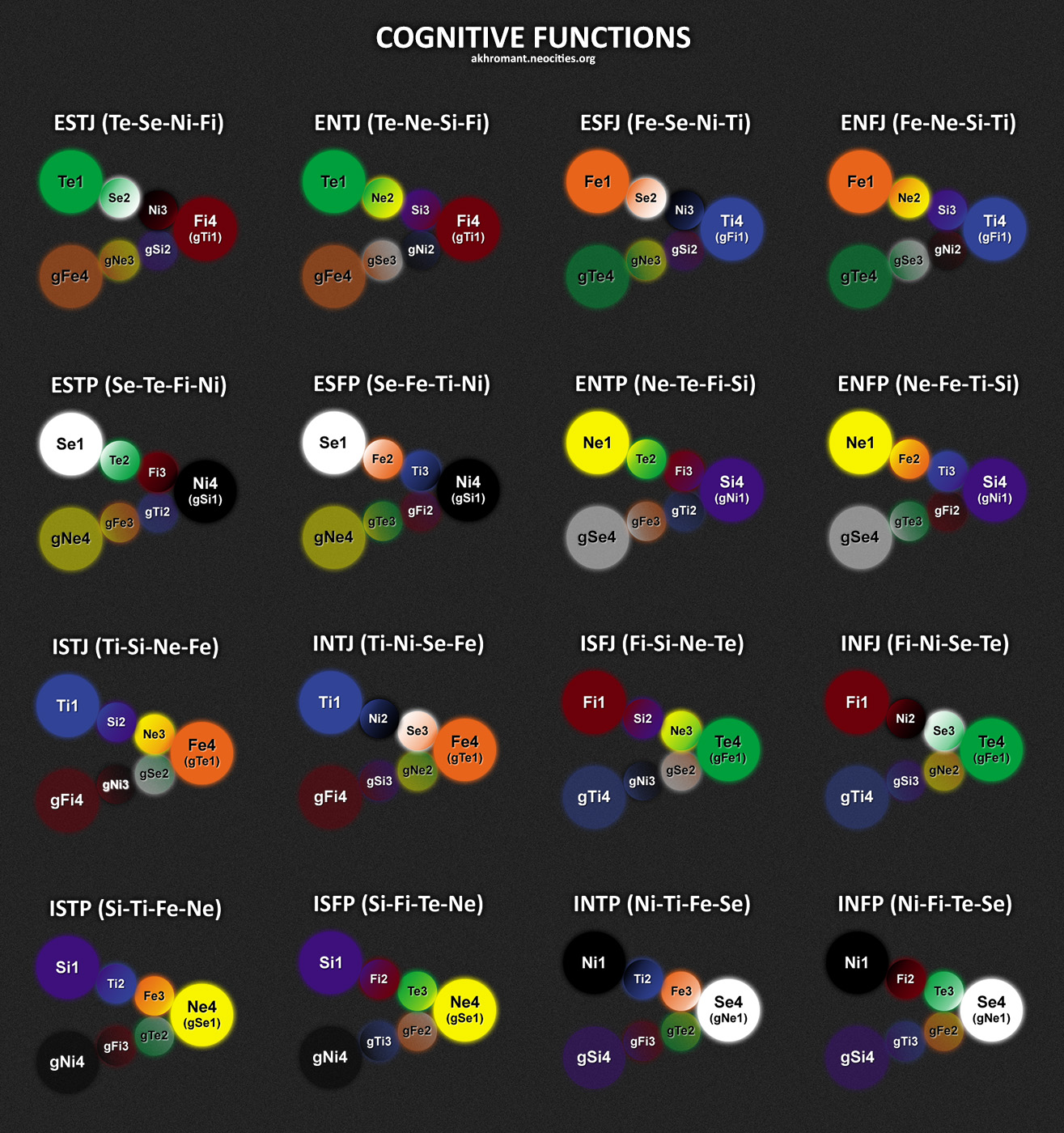
These diagrams are the 16 specific variants of the general one in post #24, made with the colors of post #27. Like I said in #24 (another post that you should read if you haven't yet), the layout is just an abstraction of an average state. The functions are not perfectly distinct circles floating around like bubbles, this is only an approximate reference to talk about them. I hope that's clear. Conscious functions are those on the left half (black text for extraverts, white for introverts), and the unconscious ones are on the right half (text color inverted). The 4 proper functions of each type are above, and the 4 ghosts are below (G1 is "behind" X4). Dominant functions are bigger, auxiliaries are smaller. The color/light of the dominants extends to their corresponding auxiliaries to denote their particular interrelation, the way the auxiliary is derived from, depends on and follows the dominant (serving or magnifying it). This can be seen quite clearly in X1>X2, X4>X3 and G4>G3. G1>G2 can be harder to see because G1 is eclipsed by X4, so there's only its reflection on the right upper side of G2. The colors of ghost functions are slightly faded to indicate their unreal quality.
This isn't very important, but the reflected colors show also how the auxiliaries are never perfectly "shared" between types, only dominants are. For example: both ETPs have Te2, but ESTP's has a touch of white and ENTP's a yellow one. (It's just a curiosity because in reality all functions crystallize differently in each individual, so not even the dominants are really "shared" with anyone).
4. LOCATIONS
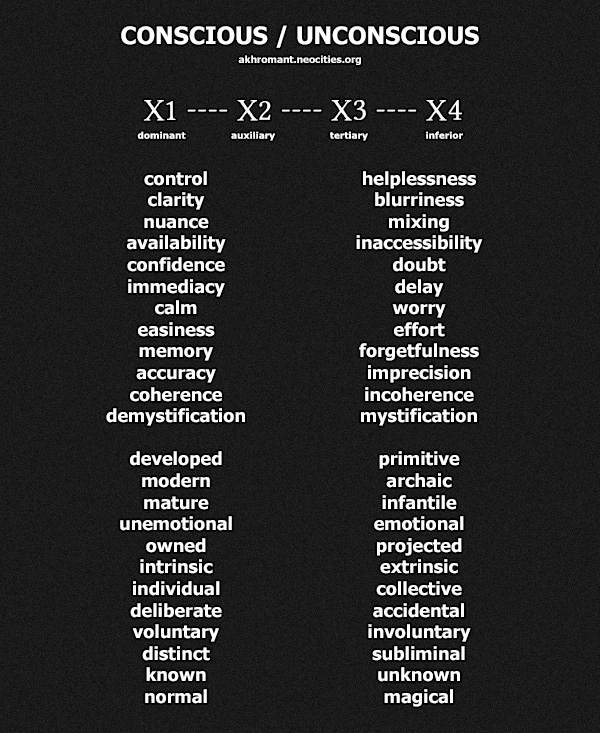
This image is a summary of the general characteristics that go from one extreme to the other along the conscious-unconscious line. Some of the unconscious (right column), especially the first set, are essentially synonymous with the effects of the separation between each proper function and its ghost. As their number grows, each X appears more difficult to grasp for our conscious mind because we start getting two increasingly disparate views of the same thing (X2/G2, G3/X3, G4/X4). The concept of time comes out of this perceived difference (more on this below).
The memory-forgetfulness line includes the fact that the more unconscious a function is, the more often we [have to] rediscover it. X2 is found and stays with us, so we can see how it changes (if it does). X3 and especially X4 are more easily forgotten ("lost") and they seem to change on their own, X3 sometimes, but X4 basically always, continually.
Another effect of the unconscious is an increased chance/range of projection (this is related to several lines: availability-inaccessibility, owned-projected, and intrinsic-extrinsic). The more a function is unconscious, the more we might look for it and/or expect it to be in another person, place, object, etc. Sometimes we know it's part of us but we would prefer or we simply act as if it came from someone or somewhere else, not only to save us the associated trouble but also because of our insecurities regarding those functions. That's why introverts might take/use some external components (Te, Fe, Se or Ne) just as they are, and extraverts might do the same with internal ones (Ti, Fi, Si or Ni).
In the next sections I'm going to include a series of keywords for every proper function location, expanding on the global description above. You'll see they are quite varied, and sometimes apparently contradictory, but that's because they refer to different angles of interpretation, different possibilities (for example the two directions of X↔G transference), different stages or states in the individual psychology of the person, etc. You can combine those keywords with the function ones and see what comes up. For example, for Ti1: created + theories, for Fe2: consecutive + agreements, etc. (The functions are the 'what', the locations are the 'how').
I'll also write something about the X-G [dis]connection in each location. The general idea is this (remember that X=proper and G=ghost):
✸ When the X is conscious, the greater, better, faster or more intense that function goes, the lesser, worse, slower or less intense its corresponding G becomes. This is the classic compensatory effect of the unconscious, of course, and even though it's more severe in X1-G1, it's often easier too see between X2-G2 because G1 is entirely unconscious and the auxiliaries aren't. The result is somehow surprising but actually logical: we don't really mind the X1//G1 separation because it's a given, but we notice and [might] care about it between X2//G2 because that ghostly auxiliary is closer to consciousness.
✸ When the X is unconscious things get complicated, and the ghosts can make it hard for us to focus on the Xs. That's partly because it implies spending more energy in order to attend to what's true for us, and probably expose ourselves to certain (apparent) inconveniences (like the very fact that our actual standpoint is X3 and not G3, for example, which demands a sort of courage). As I said in post #131, the point is not to deny the ghosts entirely, but to be conscious of the disparities and dismantle possible confusions.
Remember that different people might be centered on different functions and interrelations inside their own psychology, and this can change with time. Some follow their dominant and auxiliary, of course, but many are fascinated by their unconscious, sometimes all their lives, and their interests and work reflect that. Lots of people identify with their unconscious side, and believe they are the opposite of their true type, especially E→"I", but also S→"N", F→"T" and even T→"F". Be aware that one of the most difficult tasks when typing someone (including yourself) is getting this right.
X1 = DOMINANT
Keywords: clear, detailed, nuanced, demystified, self-evident, manifest, ever-present, created, unrestricted, unlimited, absolute, independent, discernible, controllable, manageable, personal, global identity.
This is the most important location. If you identify your X1 correctly you already know your X4, your G1, your G4, and 3 of your MBTI letters.
Jung called the dominant "prime power of conviction", but many people don't even recognize their own X1 as a function, because it's basically what life is for them. Jung himself pointed this out for ESPs, saying that sensation for them "is simply real life lived to the full". Many ESPs don't realize that their very focus on being conscious of everything is a manifestation of their dominant function: Se1. Many ENPs don't know that their peculiar interest in exploring all kinds of possibilities comes from their Ne1. Etc, etc. This is a very important issue, and it can cause lots of mistypes. There's a tendency to go directly to X3 or even X4 and think one of those is dominant (for example in these Puzzle mistypes), and that's assuming the person got at least one pair of functions right about him/herself, of course.
To avoid that, you have to try and step outside yourself. Don't focus just on one corner, on the things you like/think about, the words you use to describe yourself, or the people you admire, for example. You have to zoom out and look at everything you do, not just in your mind, but with your behavior, your very presence, your influence, etc, all day and night included, everyday, and you have to put that next to other people, always as if you were an impartial observer, and then compare and notice what stands out, what sort of constants are there, what makes others not-like-you, etc.
Sometimes if you can't do this the reason might be that you're not truly interested in knowing your inner self, and/or other people's, because both go hand in hand: you need to understand others to understand yourself (in the end, it's the same thing). You might be only looking for an excuse, for some kind of external "seal of approval" that others have to "obey", for a way to put yourself above the rest, etc. Psychological type is not about that. It's about you knowing yourself better. So there's a need for honest humility here, for appreciation of those things that others can do better than you, and for realizing that you can't control everything.
Your true dominant is related to the things you control best. And identifying it doesn't make you "less intelligent" or "worse" in any sense (quite the contrary). But holding on to some fabricated image of yourself does. Don't use your supposed type to build a persona that others will like or "respect", or ignore the facts of your existence among others to keep intact some imaginary "identity" that you prefer. Read post #120 and post #130, too.
X1↔G1: Time is not a factor here. We don't even have the concept of X1-G1 transmission because we simply don't care about G1. Some people might say they do, of course, but ultimately they don't. They might try to solve problems related to their G1, but they always do it from the standpoint of X1. Some ESPs (Se1), for example, are quick to explain their health problems and take [a lot of] medicine[s] to remedy them, or use some other external method[s], tool[s] or element[s] to "compensate" what they feel inside, which in many cases only makes the problem worse (or adds a different one). They have an extremely hard time approaching the issue from the other side. That's what we all do with our dominant.
X2 = AUXILIARY
Keywords: found, filtered, screened, derived, deduced, dependent, not personal, usable, advantageous, improvable/improved, manifold, diversified, ordered, consecutive, with "levels" or "paths", sequential, hierarchical, recursive, [pre-]determined, circumscribed, restricted, limited.
The auxiliary depends on the dominant. You can read about this in post #25 (point 3) and post #31 (point 2). What X2 can't do is go against X1. That's ultimately what this comes down to. The dominant is the limit and the "master" of the auxiliary. That dependence makes X2 adopt some kind of limits or "rules" for itself, and always be and evolve under them, never freely. It doesn't mean that we automatically go and change X2 because of X1, that's not what this is, many times we simply find X2 and make it work for the dominant. This interrelation means that X2 elements are always taken and interpreted in a way that X1 can "understand" them, in a way that obeys, serves, enhances and/or magnifies X1. If you picture the functions as lenses, X1 is the main one, and we can never look through X2 alone, we can only see it through X1, which is inescapable.
If you are much more or much less unsure about your S/N than your T/F you can use that doubt as a factor in the identification of your dominant (which includes J/P), because Judgers tend to have doubts about their S/N, and Perceivers about their T/F. It's not always like that, but it has to be mentioned. It's a manifestation of X2 and G3 being closer than X1 and G4.
X2↔G2: I talked about this in post #82. You know how to differentiate between the two (you're quite literally conscious of the difference), and you see the contrast very clearly. Sometimes you make a point out of the fact that they are not [and should not be] the same. Other times you just find that your behavior reflects that gap. You might try to make G2 more like X2, but you can also leave it, ignore it, and focus solely on X2, which then gets better but at the same time farther away from G2, which gets worse. (All this makes some people believe their auxiliary is their dominant). Part of the pulling away from G2 comes from that little reflection of G1's color in the diagrams: we know G2 has a master that's incompatible with us.
X3 = TERTIARY
Keywords: interesting, fascinating, sought, pursued, hoped-for, amassed, collected, disordered, chaotic, addictive, dangerous, mapped, experimental, reexamined, reworked, trials, disguises, but also distilled, artistic, concentrated in something both beautiful and meaningful, perhaps even sublime, like some kind of treasure, like a jewel.
The tertiary is sometimes seen as "the key to everything", because it is the bridge to the unconscious. Many people are obsessed with this function, and might even believe it's their dominant or auxiliary. That's part of the reason behind many Puzzle mistypes, for example. It's also at the center of Jung's concept of the "symbol" or "transcendent function".
One way to look at X3 is to take the specific and detailed order of X2 and think how an opposite could be, with the influence of the unconscious. Maybe the result can be pictured as something like the contrast between a regular army and guerrilla forces. The first is somehow "established" and always works well. The second might not be very efficient, but their victories are really inspiring. (Don't imagine them fighting each other, though: they are actually partners).
X3 depends on X4 (see post #35), but many times what we notice the most is its connection to G3. So I'll talk about that first.
X3↔G3: You need to read post #122 first. You like the idea of putting/taking G3 in[to] X3 form, in the most efficient way possible, looking for something special, something exceptional that you haven't found yet. This is a big part of X3's attraction. At the beginning you are probably not very skilled at this, and the result is often quite chaotic: the good things are difficult to distinguish from the not-so-good, it's all a bit of a mess. Then you try to improve, with some kind of (everchanging) attempts at learning, regulation and/or uniformity. But you realize that it's hard, never easy. Sometimes you even try to stop yourself, because you know this transference can be very addictive.
Something I didn't mention in post #122 (which is only one particular angle of analysis) is that sometimes we misinterpret X3 as if it was "only G3" or "actually just G3" because we don't want to face the consequences of that X3 being proper to us. In this case extraverts need courage to admit their subjectivity, and introverts their objectivity. So it's not that we are mistaken about X3, but about the fact that X3 is not G3.
A particular instance of X3 can only be accepted by the person's mind when it's also seen, validated, reflected or included in/as/by X4, that is: when it obeys X4's "rules", when it serves or magnifies it. This is the unconscious counterpart to the X1>X2 dependence. For example for INTJs: Se3 is only "valid/solid/real" when it follows Fe4, when it serves as a vehicle for Fe4, when Fe4 "recognizes it" or is helped by it, etc. This is another reason why we keep trying different X3s, of course. We don't automatically discard those X3s that don't work, sometimes we collect them or leave them hanging around "just in case", because we think we might find a use for them later. When enough time passes we often forget about some (or many) of them (after all, we are already in our unconscious side).
X4 = INFERIOR
Keywords: lost, separate, independent, unreachable, non-participable, missed, glimpsed, dreamed, kaleidoscopic, mixed, bewildering, all-or-nothing, trusted/suspected, loved/feared, coveted/forgotten, treasured/neglected, revered/condemned, sacred/demonic, heaven/hell.
The second half of those ·/· pairs is mainly applied to artificial, manipulated or "unnatural" forms of X4, while the first word goes with natural or "pure" examples of X4 (= archaic, age-old, primitive, infantile, etc).
You might have an inaccurate measurement of your inferior's elements, its parts, etc. You might fear or despise it, or something related to it, some form of it, etc. You need to make a great effort to focus on it. When there's a problem with your X4, it's always the worst kind of problem. Sometimes you wish you could live without your X4. But you can't do that. This is crucial. You have to learn how to live with it, how to integrate it in your life, in the best way possible. You have to do it, somehow. Otherwise, it will start working against you. And you won't know where the blows are coming from.
X4↔G4: You have to read post #131. It covers what this point is all about, and some general things about the functions. I'll add a few comments here. (Remember that there are lots and lots of possible variations inside all of this).
We don't want our consciousness to be interrupted, and G4 is the location that feels the most like an intrusion, so we try to block the X4→G4 transference (or at least keep it to a minimum) by not touching X4 at all. That's why the "default state" of G4 is basically being empty or absent. When/if we gather enough energy/will to interact with X4 we get mentally or physically "ready" for the expected G4 invasion, and we enter in the "all" mode of the inferior function. This manifests many times in a sudden chain of activities that involve X4, like an ENP (Si4) who tends to skip meals and never sleep but one day eats everything in the fridge and then sleeps for 20 hours.
The transference from X4 to G4 is often perceived and/or represented as an avalanche, an explosion, a flash, lightning, or some kind of disaster, because it's essentially a sudden discharge of energy, all at once. (In the tarot these manifestations or effects are symbolized by the Tower). In that sense this is the most demanding separation, obviously. It doesn't seem to provide any kind of "victory", not even the sporadic ones that we get in G3/X3. In general, it seems more like a question of avoiding severe defeats. But that's not the whole picture.
This separation leads some people to develop a sort of faith, belief, or trust in smooth/right outcomes regarding X4→G4, and/or in the ultimate goodness of it (this would be the Star in the tarot). In fact, for certain people that faith becomes the basis for their life mission, or for different kinds of religious, ritualistic or artistic practices (this might be more precisely in the Judgement card, though, the "inner calling"). Something similar might happen with X2→G2 for some people, but you can probably notice the difference because in that case the X function is not unreachable or mystified, and the activity looks less like faith and more like work. X3→G3 would be an intermediate point.
Another aspect of G4 comes from its ghostly quality. Our proper functions (X) are true for us, and our ghosts (G) are what we consider false, so, in a similar way as that of G3, but even more because G4 has a sort of independence, we can sometimes play with it and turn it around to make it appear as something different (inducing or accompanied by a change in G3), and that way demonstrate [to ourselves] that it's not truly determined or decisive, that when it comes to those two functions (G3+G4 without e/i) our authentic standpoint is actually in the other attitude (X3+X4), and that the conscious ghosts are only a [distorted] reflection of their proper sides. (This is part of the Moon and the Sun in the tarot, and it resembles how moonlight is actually reflected sunlight).
(Temperance includes the idea of undifferentiation, and the Devil includes differentiation and, of course, the ego. Judgement is related to the expansion of consciousness and the transcendent function, and the World is a symbol of the Self).


I've never made this kind of collages before, I get dizzy just by thinking about the possibilities, but this time I thought that maybe I could try limiting the scope to make it a little easier in that sense. So the idea ended up being a set of 9 pictures for each type that only used images that I already had in favorites, so it became less of an exhausting indefinite search and more of a game. The available collection included several thousands of pictures, but the collecting hadn't been made with typology in mind. So the result is, of course, quite peculiar (and probably a bit too personal). The boards are mostly about depicting a certain specific "vibe", perhaps a few traits but not many variants, and in general they follow the names of the types (from MBTI List 09). I could go on making alternative versions that would perhaps be more varied, but at this point I'm just too tired, so, yeah, this is it. I hope you like them :)
version without the text / temperament boards / function boards
This is an invite-only Discord server for people interested in the true Jungian typology (eeii/iiee). If you want to participate it's important that you're familiar with the terms that I use in this blog, including the glossary, the different tables and correlations, etc. These are some of the rules:
✸ The main rule of behavior in the server is basic human decency. All members must keep a harmonious and respectful attitude, following these rules and the indications of the Mods, and not treating others badly. Aggressive arguments are not allowed. This includes any discussion based on abrupt criticisms, accusations and/or comments aimed at hurting or intimidating other members, general combative, competitive, polemical or controversial approaches, and anything that disrupts peaceful, on-topic and balanced dialogue. (One example: talking about functions or types in any way that points to "good/bad", "better/worse", or making reckless statements about them. Another one: focusing on politically-charged interpretations of things). In case of infringement there will be warnings first, and then expulsion of the member. For any problem in this regard please notify the moderators. Thanks.
✸ The server is not a "debate club", an "arena", or a "free zone". We already have a basic framework and a common language, and we are trying to build something from there. We assume that every member is willing to learn, but some people treat this issue as a purely conceptual matter, a sort of "immaterial battleground" where they can have "fights" (and "win", or just "play"), disregarding the reality of the types and the actual knowledge that's being offered, and that's not how the server works. The only "enemy", the thing that needs to be "attacked", is the misconceptions that lots of people keep repeating outside (starting with the false "eiei/ieie" order and the distorted definitions of the functions). What we have here can be very difficult to understand, it might take a lot of time and effort, but if you can't recognize the basic ideas in practice, in yourself and other people, and your participation isn't constructive in a positive way (you insist on criticizing or diverting the topic, ignoring the terms that we use, mixing concepts, etc, instead of trying to see it/them better), then this is not your place.
✸ There is no "type ID" anywhere in the server, and we require that members don't include any kind of type identification in their profile. Part of the idea is to avoid all that roleplaying, "type pride", type division and infighting that's so prevalent in typology "communities". Another benefit is that it prevents the almost unavoidable self-mistypes from going public. So, whatever you think your type is, you'll have to keep it to yourself. If you add any form of type-identification you lose all your roles. A second type-ID infraction will get you kicked from the server, and a third one will get you banned. Your type is a very private and serious thing, and its main purpose is self-knowledge. You don't even have any obligation to reveal it in DMs, either (some people might ask for it without your best interests in mind, so be very careful who you disclose it to). All this applies to everyone in the server, obviously, so please no discussion about other users' types, either. Thanks.
✸ The focus of the server is self-knowledge. We encourage people to read Jung and all the information very carefully (remember to use the various search options, too), think things over (for as long as it's needed: days, months, years) and, for those interested, try to reach a self-typing by themselves, in private. One way of getting additional help in the typing process is asking questions in the server without any obvious personal connection, that is: without explicitly saying that the subject is you or your type. Another option is talking in private with members that have the Adviser role (note that there might not be any available, though). Even if it's reserved for some of those who have been doing this for some time and volunteer for it, the Adviser role is no guarantee of accuracy, and it doesn't imply any kind of commitment or "authority". They are only there to try and help you in your own self-discovery.
✸ No discussion about Socionics or other "typology systems". You can explain why/where they are wrong, although that's often common knowledge in the server. You also have to remember that the correct perspective is not about "systems" or "theories". What we talk about here is not a "system", but the reality of the functions and the types. This is not something "invented" by Jung or somebody else. This is something that you discover, like the number of protons in the atoms of the different elements. The fact that hydrogen has one proton and helium has two is not open to "alternatives", and if you invent a "system" where helium has only one proton (for example), you are simply lying to yourself and others. We use the MBTI letters and some other concepts because they have value if used in the right way (this is actually how the MBTI should be), adding different angles of description to the types, but that's not something that can be easily assumed about other things that you might find out there, because most people don't really understand what this is about.
✸ No discussion about enneagram, astrology, numerology, fortune-telling, divination, predictions, or anything like that. We don't cover Jungian topics like dream interpretation or synchronicity, either. No discussion about philosophy, religion or politics outside of their connection to type. Also, no talk about obscenities, violence, substance addiction or any kind of self-harm as a positive thing. Try to avoid typings that would give publicity to [suspected] criminals (especially if they are alive, violent and/or on the news), and in all cases try to keep the discussion on a detached neutral level, limiting it to the psychological aspects and staying away from the political ones and your personal preferences, likes and dislikes.
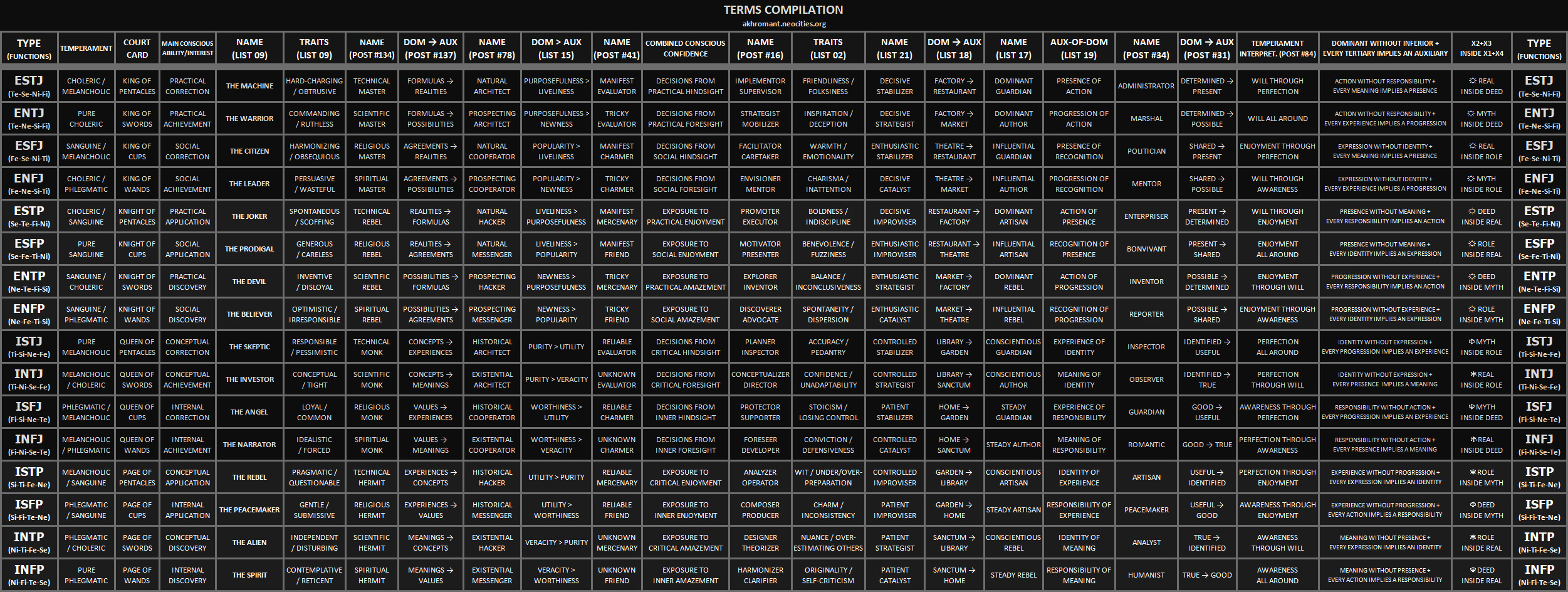
This is a compilation of terms and phrases used in the blog to describe the 16 psychological types and their functions. Some come from the tables, others from the lists, and others from normal text posts.

This is a series of 16 type profiles with descriptions that correspond to their temperament, taken from 2 different sources unrelated to MBTI, in more or less the same way as The Types And The Court Cards (III). The sources are: 1) The book "Spirit-Controlled Temperament" by Tim LaHaye (most temperament descriptions online are based on it), and 2) the temperament posts by Unwritten Grace. The result shows, in a broad sense, not only how the correlation works really well, but also, again, how the types have been known, in one form or another, for centuries (the four temperaments were developed by the Greek physician Hippocrates, who lived between 460 and 370 BC).
Of course, there are some weird things, the analysis is rather superficial (even cartoonish at times), and many type variants are absent, but this is just a general perspective, and I think it's quite effective as it is. The idea is to keep in mind that the profiles are not "full packages", because sometimes only a few things in the description apply to the person. This might be more common with the pure temperaments (C/C, S/S, M/M and P/P), because those are written as primary temperaments, trying to cover all the corresponding blends. (There's also the possibility of an unconscious focus, for example, which makes the typing more difficult in general). I've edited the texts a bit, mostly to make the reading easier and more cohesive, and to reduce the number of religious references. Still, don't take things like the mention of professions or daily-life specifics as something "established" or "verified". I've deleted some of that (which seemed mistaken or unnecessary), and I'm still not sure about some of what I've kept, so don't take it as advice for the types or anything like that, just as possibilities that would need to be checked.
Links:
➤ ESTJ (Te-Se-Ni-Fi): Choleric/Melancholic (C/M)
➤ ENTJ (Te-Ne-Si-Fi): Choleric/Choleric (C/C)
➤ ESFJ (Fe-Se-Ni-Ti): Sanguine/Melancholic (S/M)
➤ ENFJ (Fe-Ne-Si-Ti): Choleric/Phlegmatic (C/P)
➤ ESTP (Se-Te-Fi-Ni): Choleric/Sanguine (C/S)
➤ ESFP (Se-Fe-Ti-Ni): Sanguine/Sanguine (S/S)
➤ ENTP (Ne-Te-Fi-Si): Sanguine/Choleric (S/C)
➤ ENFP (Ne-Fe-Ti-Si): Sanguine/Phlegmatic (S/P)
➤ ISTJ (Ti-Si-Ne-Fe): Melancholic/Melancholic (M/M)
➤ INTJ (Ti-Ni-Se-Fe): Melancholic/Choleric (M/C)
➤ ISFJ (Fi-Si-Ne-Te): Phlegmatic/Melancholic (P/M)
➤ INFJ (Fi-Ni-Se-Te): Melancholic/Phlegmatic (M/P)
➤ ISTP (Si-Ti-Fe-Ne): Melancholic/Sanguine (M/S)
➤ ISFP (Si-Fi-Te-Ne): Phlegmatic/Sanguine (P/S)
➤ INTP (Ni-Ti-Fe-Se): Phlegmatic/Choleric (P/C)
➤ INFP (Ni-Fi-Te-Se): Phlegmatic/Phlegmatic (P/P)

I've had these Socionics-based drawings for a long time (the author is Konstantin Pertsev), but they were assigned quite weirdly in the original, so I've made some changes that hopefully make more sense or, at least, are a bit less strange. The 4-word composite corresponds to the letters of each type (it's a combination of MBTI List 16 and MBTI List 22), and the phrase below is a simplification of each type's temperament, with the primary in the first part and the secondary (if it's different) after "but try to".

The drawings in this table are from Ekaterina Filatova's book on Socionics (they are also on the covers of a series of books on each type). They are based on the photographs of real people that she took, although I'm not sure how accurate the typings were. The important thing is, as usual, the general disposition of the person, not the specific features. The 3 names included for each type have different sources. The global aspect below is a combination of the first and last letters (EJ/IJ/EP/IP) with the middle ones (ST/SF/NT/NF), and refers to something fundamental for each type.
1: Don't confuse popularity with correctness.
This is not about repeating incorrect things so that everybody understands. This is the opposite of that: saying what things truly are, even if nobody understands.
2: It's not about the sources.
Some people obsess over "sources" as if some couldn't lie and/or others couldn't be correct. That's a big problem of perspective, because truth doesn't work like that. Just because it's published in a famous book, for example, or posted all over the internet, doesn't mean it's correct. And just because you haven't heard it from anybody else, doesn't mean it isn't true. Some people seem to be trying to convince themselves of their own beliefs or something, because they can't see the thing on their own, so they are always "trusting" someone else. If you don't get some kind of meaningful impression about all this, some kind of "click" or vague understanding that makes you recognize it's all about something real, perhaps you should consider that it might not be for you.
3: The functions are fundamental aspects of reality.
A quote from Jung: "To sum up, we have considered four kinds of realities: (1) static reality that comes to us through sensation; (2) the dynamic reality revealed by intuition; (3) static images given us by thinking; (4) dynamic images sensed by feeling. I assume that the fact of the discovery of the four functions is equivalent to a statement about the world, that is, that the world has these four aspects of reality". And another one: "Only one part of the world, therefore, can be grasped by thinking, another part only by feeling, a third only through sensation, and so on. That is probably why there are different psychic functions; for, biologically, the psychic system can be understood only as a system of adaptation, just as eyes exist presumably because there is light".
4: The 16 types are not an invention.
They were there before Jung because they are a form of natural specialization. They are 16 human archetypes, reflected in things like the four temperaments or the tarot court cards. There are mild and extreme versions of every type, and millions of different people in each one. Everybody has a type, and all the variation, evolution, chaos and confusion occur inside it.
5: Having a type doesn't make you less unique.
Psychological type is a tool for self-knowledge. It doesn't constrict your uniqueness or deny your individuality, and the fact that you share a type with other people can be taken merely as sharing a specific psychic compass, not the same map, and even less the same terrain. Your type is not a character to play, either. It doesn't tell you what to do, but it might help you realize things about yourself.
6: The types aren't tags.
A psychological type is not something that you "apply" to a person. It's something that the person is. And when you are typing others, you don't do them any favors by saying they are "type X" instead of "type Y". The task is to find out what they really are because that's how all this can be helpful. Some people seem to think that a type is like a price tag, or a coat. It isn't. You don't decide or invent anything about psychological types, the same way that you don't choose the number of protons in the hydrogen atom, for example.
7: The rarity of your type is meaningless.
Because you didn't choose it, and you can't change it. Whatever "privilege" you think "rare" types have, they don't, because you can't live an alternative life as a different person, so any comparison that you might consider is simply a waste of time: you can't choose having a different type. You're stuck with what you are, and imagining alternatives is not only needlessly frustrating and depressing, but completely useless and stupid. I've said this before, and I'll say it again: the important thing about someone's type is not if it's rare, but if it's true.
8: There are no better/worse or superior/inferior types because they are all different.
When I say that there are no "better/worse" or "superior/inferior" types some people read that as "all types are equal". That's an extreme misreading, and a huge problem, because they are actually all different. That's the whole point. The types are the psychological equivalent of different animal species. Imagine a bird, a fish, and a cat, for example. They are all different, and if we make some kind of animal olympics we all know who is most likely to win at swimming: the fish. That doesn't mean the fish is "better" or "superior". If you don't understand that, you don't understand typology.
9: It's called "dominant" because it dominates the auxiliary, not you.
I think some people read "dominant function" and think it's something that "dominates" the person, when in reality it's the opposite: X1 is the function that you can control best (I wrote about this in post #135). What can "dominate" you is your unconscious (X3 and/or X4). That's where you can be fascinated and helpless (see post #140, for example). So with that misreading people are taking what they/others can't control as their "dominant" function, and the misconception- and mistyping-parade begins.
10: The famous eiei/ieie order is incorrect.
It distorts the definitions of the functions and causes lots of mistypes. In reality consciousness is one-sided, not extraverted and introverted at the same time. The E/I compensation occurs between conscious-unconscious, so for the extraverts the actual order of functions is eeii, and for introverts it's iiee, always with a judging dominant for Js and a perceiving one for Ps. It's not a simple "switch", though, there needs to be a reevaluation of the concepts because the real functions are different from their famous "definitions". Many people talk about "Te" but they are actually referring to traits associated to TJ, not about the real extraverted thinking. The same with "Si" and SJ-traits, etc. Some people know what the real functions are (more or less), but they still apply incorrect orders and/or confuse the locations, so they are basically mistyping everybody.
These are just some ideas related to the ghost functions (see point 4 here for an introduction). They might not apply to everyone, or continuosly, of course, but I think they are quite common. The names included are just one option. Related: post #87, post #140, post #82, post #122 and post #131.
There's the possibility, with all ghost functions, that some of their elements were something that the person was innocently and/or easily "in contact with" as a kid, but later [s]he "lost contact" with it or with that innocence or easiness. Some people might interpret those elements as something that exists before and/or after life, perhaps something that "awaits them" (and/or others).
G1 (UNCONSCIOUS DOMINANT GHOST): NON-FUNCTION
The basic idea here is: "whatever happens in/to G1, if anything at all, is only a mere consequence of X1". All the essence of this global function (T/F/S/N) belongs to X1, that's where the real identity/value/state/change is. That's why G1 is something unattractive and uninteresting for us, by default. Some people ignore it completely (probably through some version of "the only G1 is X4"), and those who attend to it in any way (because they perceive it as "wrong") often do that exclusively from the side of their X1, without considering the alternative (here X1←G1 can be nonexistent, opposed, or blocked), in a relentless and implacable way that might seem totally backwards or incongruous to the observer (X1//G1 is where the conscious//unconscious divide is more pronounced). This makes X1→G1 the most inefficient of the X→G transferences, even though it's the most controllable. Some people mix the two approaches (attending only to some aspects), but the main perspective is that G1 doesn't deserve our attention and we shouldn't even have to waste our time and energy on it.
G2 (UNCONSCIOUS AUXILIARY GHOST): GLIMPSE-FUNCTION
In contrast with G1, there's the (rare) possibility of brief moments or situations where we get to "take a look" at G2 as something consequential, something with a certain value in itself (the rest of the time it's eclipsed by X3). Some of those moments can have notable effects on the person. An example would be some ESFPs who were juvenile delinquents but, often after being caught (and getting a glimpse of ghostly Fi), reformed their lives and tried to be "good" in an externally-oriented way. Some people idealize G2, and some [of those] "prepare" for it (again in a seemingly contradictory way) by being extremely strict, restrictive and dutiful with their X2 (the "road"). This shows how the X2→G2 transference is controllable but quite inefficient: you need a lot of X2 to get some G2. The reverse, X2←G2, is usually avoided or resisted, rarely leaked, although it can also bring something with a surprising easiness and skill, especially in certain cases or moments/situations (it can even be an important part in the person's occupation).
G3 (CONSCIOUS AUXILIARY GHOST): SMOKE-FUNCTION
This is a conscious ghost, so the interest switches sides and this makes G3 have a sort of undeserved "priority" over its corresponding proper (X3) in our consciousness. G3 is many times a sort of toy or sandbox that's not important in itself because we know it eventually fades away (like smoke, or a sand castle), but might be interesting because, if arranged or taken/seen in a certain way, it can reflect or reveal something "beyond" itself that's actually useful or significant for us, a sort of "key": [its connection with] X3. Many people play with their G3 quite a lot but, like common physical toys, it tends to lose appeal over time, and in some cases it acquires a certain negative or even repulsive connotation. The G3→X3 transference is thus commonly checked, investigated and [re-]examined, and it can be addictive, but it can also be reduced or interrupted. The opposite, G3←X3, is quite efficient in comparison to X2→G2, although a bit uncontrollable: with a little X3 you get a lot of G3, even if it also requires a lot of ordering or deciphering afterwards.
G4 (CONSCIOUS DOMINANT GHOST): BUBBLE-FUNCTION
Keeping the toy analogy for the conscious ghosts, G4 can be seen as the one that takes the longest to lose its allure, because it always feels independent and exotic in some sense. Some people spend a lot of time kind of "caught up" in it, like someone under a spell, [tentatively] trying or just looking at a toy they are/feel not allowed to play with (or a colorful soap bubble floating out of reach), which can manifest in very different ways ("good/bad", etc). This particular fascination comes obviously from X4, which sends its "magical" or "fantastical" reflections to consciousness, and it also explains the love/hate and all/nothing aspects of X4. G4 can be very distracting, and it's the one that requires the most psychological maturity in order to prevent its potential undesirable effects. The G4→X4 transference can be unrecognized, ignored, or merely imagined. It requires a lot of effort, so it's many times delayed or abandoned, too (sometimes to the point of becoming only a wish). The opposite one, G4←X4, is the most efficient, but also the most uncontrollable (it definitely feels like it comes from "another world"): with only a tiny bit of X4 you get a huge amount of G4, usually as a rather convoluted or strange mix/mess, and sometimes in a shocking way, all at once.
Types #13X ← ✸ → Types #15X