
INDEX
ABOUT
FAQ
GLOSSARY
MBTI TYPINGS
MBTI RELATIONS
DISCORD
PHOTOS
STORIES
GENERAL
DIFFERENCES
TYPING
FUNCTIONS
TABLES
LISTS
WORKS
VARIOUS
NAMES
MORE
Anonymous said: Hello! INTP here. I wanted to know more about Fe3-Se4 and how they works. Could you give me an in depth explanation and description on how they manifest?
Hi! :) Your question is similar to the one in post #24a. I'd recommend reading that first, and also the last point in post #17 (5.3). Those are two places where I try to explain the problem with this kind of approaches. The thing is: I can't help you with that "in depth" because it probably means exhaustive or extensive. I'll try to help you help yourself instead.
1. LOOKING FOR MANIFESTATIONS
The functions operate at many different levels. Look at the blue circle in post post #17, for example. Those words cover all sorts of contexts and subjects, including localized responses and complete worldviews. Any attempt at describing manifestations is bound to be extremely limited and only [partially] true for a tiny fraction of the total number of people with a given type. On top of all that, you have the fact that there are millions of people with the same type, plus the added complexity that comes with the diverse degrees of function differentiation in each person (post #24). In the end we can only talk from a rather vague and indefinite perspective, because we can't possibly imagine all the details of the millions of variations.
This is not directed specifically at you, but people need to remember that I can't write everything here. This is not about me describing all the particulars of every function for every type in every possible situation, or writing a whole book on type characteristics for others to memorize and repeat as some kind of mantra. That's not how this works. You all have to think, a lot, think again, pause, wait, look, listen, try and discover things for yourselves. You have to do all the work, observing people, observing yourselves, from a distance, with the largest perspective that you can manage, finding those things that make us different and those that some share in some ways. You have to do it in your everyday life, and not only through screens or books, but through your own senses.
You have to be patient and don't try to get it all right in five minutes. This is very likely a question of years. And you have to remember that the important thing is not the precise definitions or the cataloging of manifestations in itself, but your own internal (not just conceptual) understanding of what the functions are really about. When that's somewhat clear you can start analyzing things for yourself and, before a certain supposed manifestation shared by enough members of a given type, try to infer its most likely origin. That would be the process of building your own knowledge.
2. SOME IDEAS
You can use the lists of sentences included in post #31 and post #35 as introductory guides, for example, and also what's written in point 6 of post #24. See if that thing you've noticed can be explained through all that. Pay attention to the ideas and motivations inside the person, not to the external actions or behavior. The functions are behind the visible, and they are always working, regardless of their potential manifestations.
✸ In the most immediate contexts (like the one in post #36, for example) X3-X4 should be interpreted within the not-completely-clear but often a bit clumsy, difficult, distorted, fantastical or emotional quality of the unconscious. X1-X2 doesn't have any of that: it's skillful, confident, demystified. The exact visible expression of this depends on the function, of course: it's not the same being confident with Fi than with Fe, etc.
✸ In larger contexts it's more difficult to say whether a manifestation comes from the conscious or the unconscious, because both bring elements that get mixed together inside the mind for that global result. You could say that X3-X4 is/works as the source of something curious for the person, something from slightly to absolutely interesting and strange. It's never easy or "mundane", but more like some kind of marvel that never loses its magic, or some kind of puzzle that needs to be solved. This is essentially a consequence of the interaction between consciousness and the unconscious.
3. AN EXAMPLE
I'll try to give you another example, making use of what I said in the previous answer about INTPs. This would be an intermediate context, slightly more general than particular. As usual, the best way to get an idea of how things work is by looking at more than one type, and the J/P pairs tend to be very useful in these cases, so we'll take INTP/INTJ.
Ok. You can think about this: where some INTPs' Fe3-Se4 could manifest as a captivating and somehow inexhaustible interest in, discussion, proposition and/or test of various social practices or systems (politics, "-isms", etc), with a focus on how each one protects different realities (and probably looking for the "best" one), a comparable INTJ's Se3-Fe4 would be more interested in finding out, collecting, trying or describing how different realities (architecture, art, tools, etc) protect and reflect the shared values of different peoples (perhaps looking for historical changes, for the most "universal", etc). From this perspective you could say that where INTPs think about revolution, INTJs do it more about evolution.
Does that make sense? Try reversing the functions and see what the previous paragraph might say about the Mirror types: ESFP/ESFJ. In a more localized context, I think some ESFPs are the embodiment of those "best social practices", that is: through their Se1-Fe2 they always try to bring gifts for everyone, involving them, making everything shared, like a party, etc. They just can't/won't bother with the specifics, with a way of keeping that for longer periods, etc. Some ESFJs take upon themselves the responsibility of making sure that the values around them are well represented through physical or aesthetic forms, confirming that those don't offend anyone, etc. (That's Se2 being conditioned by Fe1). They just leave the conceptual aspect aside, ignoring deeper implications, etc.
Anonymous said: Could you do a post about what particular learning styles could fit for the types? + Their possible learning advantages other types might find hard to do.
In general, the answer to your question would be the consequence of combining the different intelligences, talents, motivations and insights that each type tends to have. (I wrote about intelligence in post #05, talents in post #06, motivation in post #08 and insights in post #26). Taking the dichotomies as starting point, you can get yourself a quick and easy guide about the environment and subject characteristics that each type probably prefers and/or benefits more from when doing things, which includes studying/learning. A very good foundation is the image with the keywords in post post #20. Consider how many of those terms can be applied to activities. That's basically how it goes. Ok, these are some derived/additional ideas:
E → extensive: more>less (people, topics, etc), current/available subjects/objects, probably centered on the most recent/accepted data/tools.
I → intensive: less>more (people, topics, etc), general/historical subjects/objects, not necessarily the latest or the most famous/fashionable.
S → visual/auditory, physical, concretized>imagined, with forms and/or sensory elements/aids, focused on states and qualities.
N → symbolic, abstract, imagined>concretized, with words and/or things with meaning, focused on possibilities and improvements.
T → logical, factual, mechanical, about tasks and rules, precision>goodness.
F → ethical, moral, artistic, about behavior and values, goodness>precision.
J → purposeful, directed, methodical, ordered/hierarchical.
P → roaming, recursive, improvised, disordered/anarchic.
Oh, and you also have the education/vocation summary that Keirsey gave for his four groups, which is quite an acceptable complement in this context (and it matches what I just wrote above):
SJ: Commerce/Materiel
SP: Artcraft/Equipment
NT: Sciences/Systems
NF: Humanities/Personnel
The more letters that you and the learning activity have in common, the more "at home" and "productive" you'll probably feel, but also the less challenging it will be for you. This is important, because maybe you don't really get to learn anything if you don't put yourself in [slightly] unfamiliar conditions. If you stay inside some kind of "functional bubble", where you don't have to circumvent any obstacle, you might not even find your unknown side[s], and I think it's definitely better to be aware of all that. Some people do the opposite, on purpose, but there's also danger in pushing oneself too far. You need to figure out where you stand and how much you can and want to get.
In the end this is a complex issue, as usual, and it doesn't depend entirely on type, especially if you look really close. People with the same type have different learning capabilities (and opportunities), in different areas, even if you can see the broad similarities. I mean, we have to keep that in mind. There are ETJ (Te1) scientists but also ETJ artists, for example. Sometimes these variations happen because the person doesn't focus on his/her conscious side, but on the unconscious one, as under some kind of spell. But that's not the only reason, of course.
Anyway, as I wrote in post #12b and other posts: don't use your type to make "career" decisions. (And don't take this as a competition between the types, either. It should be precisely the opposite of that). Instead, think about what that "career" actually means. See if you are taking its value for granted. Look at the line you might be extending before yourself and away from where and what you really are. Because the priority is knowing yourself. My intention with the MBTI [and other] posts is to give people indications and tools for that. It's all about perception and awareness, not about action or direction. The moment you put yourself a goal, you already lost sight of what you were trying to see.
Anonymous said: You mentioned in a post: "Sometimes these variations [between individuals of the same type] happen because the person doesn't focus on his/her conscious side, but on the unconscious one, as under some kind of spell. But that's not the only reason, of course." I was wondering if you could expand on that more for the types, it seems important.
That's a reference to those occasions when the person is centered on X3 and/or X4 and that affects the kind of work or career that they choose. They are not necessarily "locked" into those functions, the context here is only about study or occupation, something that the person attends with a certain degree of dedication and effort.
As I wrote in post #24.5, the unconscious functions can appear through/with fantastical or emotional elements, they are not seen only for what they are, in a simple/clear way, so many "unconscious versions" of the types can be recognized for the various kinds of "artistic" approaches that they apply to their X3 and/or X4. They won't necessarily call what they do "artistic", of course, some take it as a totally serious thing, which can be a problem because, well, they aren't working with their most reliable side. What I mean with that term "artistic" tries to be the opposite of crisp, solid, unemotional, demystified, etc, which apply to X1 and X2.
I'll try to give you some examples.
- ENFPs who focus on Ti3<Si4 can be visual artists, for example, including people like Clive Barker, famous for showing all kinds of shocking graphic distortions related to living things (that's Si4→gSe4). As you can see, there is no problem when those things are recognized as fantastical, unreal, symbolic, etc. This is actually one of the things that Jung encouraged: "active imagination", because it can be useful for self-knowledge. The problems might appear if the person doesn't realize G4 is just a ghost. Ok. So, on the other hand, if ENFPs focus on Ne1>Fe2, they might be politicians or activists, for example. Totally different.
- The same with ENTPs. Musicians like Frank Zappa could be part of the artistic variant (Fi3<Si4), for example, and not very similar to all those ENTP software entrepreneurs who are all about Ne1>Te2.
- ENFJs who focus on Si3<Ti4 can be people like L. Ron Hubbard, trying to work with internal concepts and coming up with... well, you know, let's say doubtful systems that look much better in the fiction section. If they focus on Fe1>Ne2 instead they can be popular and motivational leaders.
- I don't know if you've heard of him, but a fitting example of an ESTP who's carried away by the unconscious would be DJ Arendee. He has a classic Se1>Te2 sporty side, of course, but if you look at his typology work as occupation you get a very different kind of ESTP.
- Two more: an INTP focused on the unconscious would be Andrew Eldritch (artist/musician), and an INTP focused on the conscious could be someone like Christopher Langan (scientist/theorist).

This is not about beauty or physical features. Remember: identical twins can have different psychological types. This is more like a very broad approximation to the most common or characteristic expression that each type tends to show while being photographed [in a formal setting], with an attempt at making them a bit more "internal" than realistic. There are countless possible variations inside these "cumulative" or "average" sketches, of course. The smiling/not-smiling thing, for example, is not a constant at all (some ENTPs would smile, some ESFPs won't, etc). Any notable change in hairstyle and/or facial hair makes people look totally different, and that's even less fixed. We all have good and bad days and [weird] "phases". Some people go through amazing transformations in life. Lots of things.
The drawings are from the Russian site socionics.org (which has its own Ips and Ijs switched, yes, just for a change). Apparently, they were made by Ekaterina Filatova, following her own photographs of people with different types. She probably found some commonalities and tried to represent them in some kind of referential "typical" portrait. I think the end result is quite good, especially if you forget the details and just get the "air" or "vibe". In fact, the drawings match really nicely with the different temperaments (they are included in the table, but you can also compare with the images in post #01a-post #01e, for example). If you are interested in the MBTI-Socionics correlation, take a look at the MBTI List 11.
Just like any other "visual" method, this table shouldn't be used for typing. At best, this could be an optional step at the end of the typing process, in which you want to confirm that there isn't any strange discrepancy. But I wouldn't go back and retype anyone just because the expressions don't match. I made the table because I think there's something to be seen there, something to be realized about both systems (MBTI/Socionics), about the functions, about stereotypes, and about how the global typology landscape really is.
Anonymous said: What do you think about the Enneagram ?
The enneagram is, at best, useless, and at worst clearly harmful. I read about it several years ago, but I wasn't impressed at all and thought it was basically nonsense. After taking a closer look again for this answer, well, let's say that, if the enneagram was a picture, one could almost see the author painting with a whip.
✸ 1. First of all, it's based on numerology. Numerology is the belief that numbers have meaning. And that belief is superstition. Numbers don't have any meaning at all. Numbers are abstractions: they are not actually real. And you can find any number in anything you want, because it's always you the one deciding where to start and when to stop. So, with that alone, right from the start, the enneagram presents itself as something completely meaningless.
✸ 2. Its origins are all about "esoteric knowledge", "supernatural phenomena", "communicating with the dead", "magic", "fortune-telling", and "secret societies". There are even mentions of things like "ecstatic state or trance", "influence of some spirit or angelic being", "contacting various higher beings", etc. Brrr... yeah, that would be the opposite of trustworthy.
✸ 3. The other main foundation of the enneagram is the classic insulting and stigmatizing "sin → atonement" method of manipulation. You know how it goes. It's more or less like this: "you are flawed" → "you need to do/be something different" → "we can help you with that (we have the secret remedy)" [→ "that would be 50 dollars"] [→ "oops, sorry, it turns out you're not actually ok yet" → "we still have the cure, though"] [etc]. Wrong. Cynically and criminally wrong. That's no way of helping anyone. Quite the contrary.
In the end, the motivation behind the enneagram is basically the cultist practice of building and justifying your own business/authority by making others feel bad about themselves. It's true that the real enemy is inside, but not in the automatic, mechanical and predictable sense of some random nonagon with only and exactly 9 inescapable problems. Come on. I guess seven wasn't glamorous enough. "Look, it says so right here, you have this vice, so you are a bad person, and you have this fear and this desire, so you are essentially a living tragedy". And everybody is there, somewhere, so there are no "good people" anywhere. That's only a myth, an illusion, right? The world is defined by the stigma that each person carries. And we are all branded. Yep, this picture has definitely some burned edges.
The enneagram is not the only system that claims to have a method for "becoming a better person". You can find lots of examples that tell you you must "strive to attain X characteristics", or whatever. Well, sorry, but there is no method for that. You don't need a type or a word or a line to know that anger can bring bad things to you. You don't need a number in a corner. The enemy might be inside, yes, but it's not a discrete or numerical enemy. It doesn't respond to any strategic or clever plan. In fact, that's part of the enemy itself: the idea that you can be smart enough to win. You can't. Because it's not about that kind of intelligence, and it's not about winning. There's no ["magic"] formula for the mind. That's all absolute nonsense. The only thing that might improve if you follow one is your attachment to it, and the power/influence (and/or bank account) of your "helper/guru/etc".
✸ 4. There is not the slightest statistical support for the enneagram's validity. I wouldn't wait for that, either. My recommendation is to abandon it entirely, and anything that looks like it.
✸ 5. As I put in the meme (back in March), many people that present themselves as "MBTI experts" use the enneagram as a way of justifying all their [mis]typings. The enneagram's descriptions are thrown over the [supposed] MBTI type, making it basically inconsequential because the enneagram is more direct and tempting, and much less nuanced than the MBTI, so the latter gets easily overridden by the former. It doesn't really matter whether you're actually an ENFJ or maybe an ISFP instead (or an ENFP, etc) if you're "definitely an Artisan Type 4" with all its wonderful creativity, right? Who cares, we all know your most secret defects already, we have you all figured out, forever, we can mock you and order you around and punish you and feel all righteous in the process because, you see, the higher beings told us.
Anonymous said: can you give a source on enneagram having a tie to numerology other than that they both have numbers? I agree the religious-y termanology is annoying, but why do you keep referencing cults and money? also why are you so strongly against the ideas of self examination and trying to improve yourself? I would definitely not call it less nuanced, unless you didn't do your research. base type, wing, instinctual variant, directions of growth and stress, tritype if you're into that..
You could have answered most of these questions yourself, just by looking around the blog and thinking for a few minutes before clicking on the Ask button.
Sources
The obsession with "sources" is a problem in itself. First of all, people tend to ask for them only when they don't like what they are hearing. If they already know about it, or they like it, suddenly there's no need for "sources", or for checking them. Otherwise, when they are requested, it's usually just a maneuver, part diversionary tactic and part [willful] ignorance. People start talking about the "validity" of those "sources", assuming that they can't find answers for themselves, and no longer discussing the thing.
Well, the source is me. I am telling you.
You need to drop that supposed inability to figure things out for yourself. Look at the enneagram. Can you see the 9? What is that? A number. The 9 is a number. It's not a natural ocurrence, a simple aftereffect or consequence, or some circumstantial curiosity. No, it's the foundation, and the name. If you replace or take away the number the enneagram doesn't exist. It's all based on the number 9. Someone thought the number 9 was so meaningful that it could describe everything [about the human mind]. That's numerology. They probably started making calculations and marvelling at the "perfection" that they had just found. "Wow, it's all there, look, I can't believe it." (Unfortunately, they did).
The world doesn't work like that. The idea that there is a number behind everything is just ridiculous and laughable. It's sad (and a bit revolting) to see so many people falling for that. In fact, this is the last time I answer a question about the enneagram. It's basically like trying to get me to talk about astrology: I won't do it, because it's no more than enabling dangerous delusions.
Cults And Money
I don't actually talk about cults, I make references to their characteristics, because I think it's obvious that they are a scandalously bad thing, and lots of people don't realize that many of the things that they do and take for granted in their everyday lives are essentially the same as being members of one. And I mention money because that's what motivates a lot of "[methods/systems for] helping people", not a true concern for the wellbeing of others. (You probably haven't read post #30).
Whenever a subject can easily take you beyond the "academic" sphere and into "deeper" things, acting as a bridge, like some "fringe" ideas about psychology do (thanks to their various degrees of mystery and "weirdness"), you are going to find groups of what's essentially believers or fanatics (who mystify and present things as more obscure, "powerful" and/or important than they actually are, and consider themselves "special" because they "know the secret"), and also interests that don't lie precisely on helping anyone. That is: cults and money. So expect more about that here. Yes. More warnings. Because that's what they are.
Some people don't like them, I know. Here on the screen the majority seem to come looking for a "safe space" instead. Some forced artificial environment where they can delude themselves in their own distorted/imagined "reality" [for a while]. That's not safety at all, of course. Quite the contrary.
Self-Examination
That thing you said is completely backwards because knowing oneself is precisely what I write about. (You probably haven't read post #42, either, or any previous example). Anyway, I think you just misunderstood something. I'm not saying people can't improve themselves. I'm just saying that many times what you need to do is stop lying to yourself [and others], especially with your particular image[s] or identification[s], and recognize yourself for what you truly are, which has been there all along.
Nuance
What you mention there is not nuance, but precisely the opposite of it: sophistication or design. You can go further and imagine, for example, a nuclear reactor, with all its detailed diagrams and numbers and formulas and directions and lines. Well, a nuclear reactor is not nuanced, at all. It's blunt and obtuse, and also amazingly precarious. I hope that you can see that. A cloud is nuanced.
Anonymous said: Hey, I'd like to learn more about myself/mbti in general, would you have some books to recommend me ? I'm scared if I choose authors others than Jung or Briggs it won't be reliable enough, what do you think ?
:) That's a beautiful question. With Jung you can read quite comfortably because he knew what he was talking about. I'd recommend taking a look at other chapters of Psychological Types (1921), and also at The Undiscovered Self (1957) and the section "The Problem Of Types" in Man And His Symbols (1964). And yes, you are right: starting with Jung's contemporaries, you have to be very careful, because most of them don't understand the functions as they really are, and some have certain types switched (usually I[N]Js ↔ I[N]Ps). Whenever you read or listen to people other than Jung you have to ignore whatever they write or say about the functions. And also, don't pay attention to the typings (of people or characters) that they might include in their descriptions, because they make lots of mistakes.
I actually don't recommend reading Myers. She was just starting with all this, and her approach is just not advisable (I mean: it's wrong). I only go back [sometimes] to the type descriptions of a few authors, not many, and not to the rest of their work (which I probably haven't even read), so that's the only thing that I could recommend. Not books then, but profiles. Still, type profiles are a very strange thing to make, because there are too many variants inside each type to cover them all in a few paragraphs. Even if you actually stick to people of only that particular type (already a remarkable feat that some authors don't achieve), you are going to leave a lot of examples out of it. So in the end all this is just a way of getting a very broad perspective of the type-landscape.
✸ David Keirsey has a few interesting things to say in the type descriptions and summaries of Please Understand Me II (1998), but there are also some weird things and definite mistakes, like the temperament correlations (the one I put in my first post is essentially the best you can find). His groups are ok, but only from a distant perspective. His Guardians, for example, are way too rigid and predictable, and his Rationals too cold and robotic. I think lots of SJs can be emotive and/or artistic, and many NTs can be intense and/or funny. (Edit: he might have switched some things between the INs, yes :/).
✸ The descriptions of Linda Berens and Dario Nardi (self-portraits and theme/relationships) are quite narrow in scope, but really accurate in some aspects. Apart from that, Nardi wrote a book trying to find correlations between the types and the zones of the brain but, although the intention looks good, there are lots of problems with it. The main one is that he uses the nonexistent e-i-e-i/i-e-i-e "function stacks", of course. That keeps him from finding anything truly relevant. Also, the brain is not a machine, so it's never "only this region does this thing": everything is more widespread than it seems, and some regions can "learn" how to do new things (we are not technology). In the end, they even admit that the brain activity of two people with the same type is identical only 5% of the times, and has nothing in common 15% of the times. That essentially should put the topic to rest.
✸ The type profiles of Sandra Krebs Hirsh and Jean Kummerow are quite good, too. (Remember: that's the only thing that I know about them, I'm not interested in anything else). I don't recall any specific problems because it's been a while since I read them thoroughly, but I think they are reliable.
✸ The previous are all on the "politically correct" side, that's why the descriptions of Ekaterina Filatova and Victor Gulenko are especially interesting and refreshing. They are both socionists, but if you follow the correlation in MBTI List 11 (that's the crucial step) and ignore the "theoretical" side (especially their "functions"), you can get some revealing indications. They are not free of errors, of course (including contradictions, people of different types mixed in the same profile, the fact that they obviously don't understand the dichotomies, and Gulenko's too-widely-applicable statements), but they can be quite helpful because they are not just about work, they are more down-to-earth, vivid and colorful.
✸ Apart from the types, and moving into the philosophical, if you really want to know yourself I can only recommend one author: Jiddu Krishnamurti. I'm sure there are more that can be helpful for other people, but after searching for years and years, after reading and listening to lots and lots of things, I haven't found anyone ever that came even remotely closer than him to describing things as they truly are. He is definitely and absolutely the only person that I can really and wholeheartedly recommend.
✸ Most of all, my advice is that you look inwardly at yourself. Try to examine your own being as if you didn't know what you are. Pay attention to the way you think, to what you think about, to the apparent source, the subject, the moment, the emotional component, the reason, the intention, the flow, the evolution. I'll probably write more about this, but in the end you know it's not the reading, because it's not the words. In the end it's an understanding without words.
Anonymous said: Hi I'm the shy anon that asked you questions about books ! Thanks for your answer I appreciate the effort you put in everything you write :). My question is : is it necessary to buy books when you seem to have a lot of knowledge and relevant things to point concerning mbti ? I just took a look about your index and it seems like you wrote tips to type ourself, and there isn't anything to theoretical (I don't like reading tons of pages without a clear method), which I'm sure I'll find in books.
Oh, thank you :) No, you don't need to buy anything. What I recommended in the other post is all easily found online and, except for Jung's, I advise against anything related to "theories" (that's precisely the part[s] that I ignore, on purpose). I only mentioned taking a look at those profiles because the descriptions have to match, somehow, somewhere, so if you read what each author writes about ESFPs, for example, you might see what's actually behind ESFPs. Not exclusively or necessarily everything the profiles say, but the general psychological background, maybe something about the interrelation of the functions, etc. It's just a way of starting to think about this by yourself. (There's an assumption here: that the profiles don't mix or exclude types, of course. Socionics in particular is quite sloppy in everything, so maybe certain descriptions are not exactly clean, I don't know).
One of the aims of my contribution here is explaining things in what can be hopefully considered "simpler terms", yes (and a lot of times it's not that they are just simpler, but truer). In fact, what I propose in those posts is not actually a method: it's more like an approach, in the sense that the type that you're trying to identify is already there, so it doesn't really matter what you do first, and there are no "absolute determinants" involved. I explained this in point 1 of post #21. Post #17a might be relevant to your question, too.
I'm going to publish a kind of current-typing-summary after this :)
Anonymous said: I asked Equinoctum the same question. I'd also love to know your opinion of cognitive function descriptions of Jung's students, specifically Van Der Hoop.
I talked about this in post #47. My honest response is that I don't even want/need to read what they wrote because I know what Jung meant (that's kind of the point of the blog). Some time ago I checked one of them and instantly found lots of problems and things that didn't fit, so I just stopped reading. I really don't like seeing how others misunderstand and misinterpret things, especially in "accredited" [and wide-reaching] media like an officially published book, for example. Too cringeworthy. Not my style.
Anyway. Sometimes, when people ask, like you, I get the eye roll ready, and oblige.
I hadn't read anything by Van Der Hoop, but I've taken a look. In short: he doesn't really understand the functions, especially the introverted ones. He basically repeats what Jung said (and repeats himself quite a lot), so he begins with a good foundation, and describes a few (mostly extraverted) aspects quite well, but then he starts distorting things with his own prejudices and misconceptions, implying serious gaps in perception and/or knowledge, and ends up showing how he doesn't really get what he's talking about.
His biggest and most glaring mistakes are, unsurprisingly but all the same disappointingly, about Fi and Ni. (◔_◔)
First he doesn't recognize or want to acknowledge the egocentric and cruel variants of Fi1 (IFJ), which he paints as an extremely one-sided "good function". If you keep reading you find that he probably thinks those kinds of people are "Ni1", which ends up being for him the classic embodiment of all sorts of evil in the world (I mean classic for those who don't understand the functions, of course). He gives only a pair of specific examples for the other functions, but when he reaches Ni then it's all filled with big names which, from the ones that I know, are very likely all mistypes, of course.
In fact, I'm thinking that he might be one of the (original?) "contributors" to several MBTI "classics", including the I(N)J↔I(N)P mistype.
So, yeah. You could say I was right about him without even knowing he existed, or that he'd written about typology. As I said several times before, most people think they understand Jung, but they don't. Meeting him or being his student doesn't prevent that.
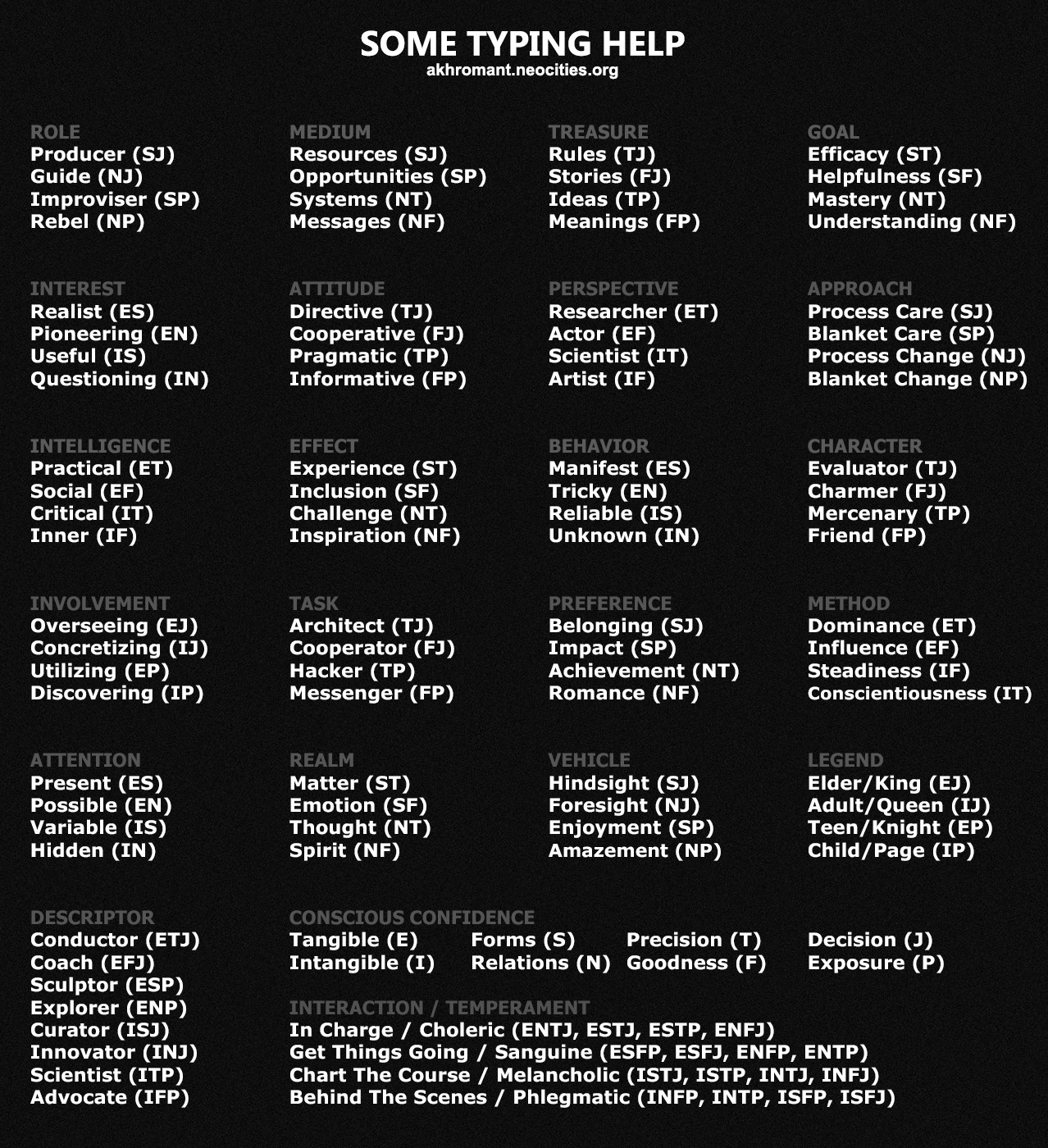
Except for the last two, the headings of the different blocks are just indications (well, the whole table is, in a sense): lots of them could be titled "role", "attitude", "medium" or "interest", for instance. Some sections come directly from previous posts (typing series, lists, tables, etc), for example the first four groups (post #20), Attitude (post #07), Intelligence (post #05), Legend/Involvement (post #01), Realm (post #16), and Method (MBTI List 10). Some have been slightly modified (hopefully for the better), and there are also four additions:
✸ Approach is just a way of underlining the resulting mix of ordered/unordered actions with states/possibilities. The words 'Process' and 'Blanket' are intended as adjectives, but could also work as verbs. 'Process' tries to reflect a conscious hierarchy or specific focal point, a continuity of applied preference[s]. 'Blanket' is about different versions of not-missing-anything, of considering, trying and/or including any/every-thing.
✸ Effect is about the usual influence or consequence of one's interaction with people from those 4 groups of types, or with their work. It might be slightly off for certain combinations of types or individuals, but I think it's there somewhere. It can be also a cause/result of activity for each type.
✸ Preference is something that the person probably likes, in a very broad sense, especially in comparison with the other three options. It comes from Keirsey's groups: Guardian, Artisan, Rational and Idealist. (More about those in post #16 and post #47, for example). Note that 'Impact' is not necessarily "shock" or "interference", but more like some kind of "weight" or relevance.
✸ Vehicle tries to condense the background source or motif of those types' activities. SJs tend to be somewhat classic, while NJs are often innovators. SPs live through what is there, and NPs imagine and marvel at things. SJ writers and filmmakers, for example, tend to express in their works a certain avoidance/fear of the future and its products, and/or love for/attachment to the past. NJs are, in a sense, the opposite: they push for changes, new relations, etc. It's not that they "predict" or even "like" all that is new, but that their minds are always looking ahead, and in some way, they go for it. And another thing: when someone is said to be "ahead of his/her time", [s]he's not automatically NJ: those can be SJs, SPs or NPs too, because that expression is historical, always a posteriori, and it only means that, some time later, a number of people [large enough to be noticed by the speaker] know/use what the speaker considers to be the same thing as that which the person knew/used before.
The conscious confidence section is an attempt at reducing the dichotomies to pairs of words. There are lots of different ways to do it, of course, this is just an example that tries to bring certain useful keywords to the summary. The title of this section is important and very specific, not so easily replaceable. Also, remember that 'Forms' includes the idea of [material] condition/state, while 'Relations' is about implications, ramifications, etc.
The temperament section is only about the primary temperament of each type. You can find the secondary temperaments in post #01, and in most of the MBTI tables that I've made.
Use / Words
You don't need to go through all the blocks, you can just take them as optional steps in the typing process, after reviewing other posts, if you want. Some are certainly more accurate than others. Combine them, read the lines of each group at random, think about the global ideas. The intention of the table is not about numbers or some kind of statistical result. Don't determine types that way. You can get a reading of the general direction, of course, but it works better if you pay attention to the psychological undercurrents that these divisions try to illustrate, and see if you can locate the place where the individual in question might belong, regardless of specific words.
In fact, one of the main problems with this kind of lists is that there are many words that have different meanings in their current/general use. Take the Perspective block, for example. Not many people would think of themselves as "researchers", partly because it doesn't sound "intellectual" enough. They most likely prefer "scientist", even if their true focus is on the actual objects, the observable facts, and what's currently accepted or happening. In the same way, the people who have an "actor" mindset tend to use other words for themselves, because that word alone doesn't transmit enough credibility. Many of them would say they are "artists" instead. That's one of the most overused words, by the way. Everybody seems to be an "artist", from pilots and conductors to mechanics and doctors, but they obviously aren't. Not even illustrators, filmmakers or musicians are always "artists" in the inner sense. Some are better described as visual/sound/sensory designers, arrangers, composers, duplicators, decorators, architects, artisans, stylists, etc. And of course, not every true artist uses a sensory medium to express him/herself.
Anyway, this is part of another [larger and known] topic, but I think it's evident that calling everything "X" only makes the word X meaningless. You can respect and admire something without saying it's "science" or "art", or some other supreme-sounding qualifier. Maybe it is talent, skill, dexterity, agility, knowledge, memory, cunning, technique, patience, steadiness, laboriousness, ingenuity, disinhibition, expressivity, spontaneity, boldness, desire, drive, ambition, etc, etc, or a combination of things.