
INDEX
ABOUT
FAQ
GLOSSARY
MBTI TYPINGS
MBTI RELATIONS
DISCORD
PHOTOS
STORIES
GENERAL
DIFFERENCES
TYPING
FUNCTIONS
TABLES
LISTS
WORKS
VARIOUS
NAMES
MORE
Anonymous said: Is the overvaluing of "productivity" harmful because it becomes its own end and puts those who are less productive (for reasons outside of their control) at a disadvantage? Or does the problem span further and more deeply than that?
The problem I mentioned in post #08 refers to the fact that many people interpret big numbers and statistics as something "good", when they simply aren't. Those who think there's a connection between economic calculations (or any kind of number) and actual benefits are completely mistaken. If there was one, you wouldn't be able to find activities that are both harmful and profitable. And man, aren't those the rule.
Look at the most lucrative business, look at the origin of the largest sums and flows of money. Look at what they are based on, what they try to maintain and exploit, and what they usually end up actively fomenting and directly provoking. You have to get down to the bottom of it, because if you stay on the surface you won't see the real problem. In this case the surface is, in part, the image (illusion) that both the seller and the buyer are trying to fabricate about what they are doing. This isn't exclusive to the so-called "private sector", of course. It includes what many people tell themselves [and then advertise] when they decide to "enter the job force" or the "marketplace" (whether it is working for the government or for a company, putting up a shop, etc), and what their clients try to convince themselves and others of, before and after they pay. Getting to the bottom of things is not easy, it requires attention and honesty, and of course, being open to the truth.
What you'll find behind the artful self-justifications, the "legality" or "custom", the apparent absence of personal responsibility because "I only work here" or "everybody is doing it", the marketing, the shining showcases, the "innovation", and essentially everything that stands for or tries to convey some supposed "acceptability", is that many "productive enterprises" or "industries" are actually running on and profiting from lies, ignorance, vices, fears, addictions, ill states and conflicts. And where there's profit (or the mere idea that something is "useful"), there's usually the interest in keeping and increasing it. That's why I sometimes say that money might not be the root of all evil, but evil is probably the root of [big] money.
The following are just a few examples, quite easy to spot, so you might get the idea: you have all sorts of drugs (including many of the "medical" ones), you have insurance and gambling (with many different forms), you have money itself, with banks and their practices, you have all kinds of weapons and everything related to "security" and war, you have countless ornaments, cosmetic products and services, etc.
But there are many more. Profitability tends to require some lack of understanding, some kind of desire/anxiety or psychological blindness. And part of the blame here lies on the idea of money (or "productivity", or whatever) being good, because it works as an enabler: if you facilitate bad things (even when it's only conceptually) you keep people from seeing their own efforts and/or their acts of consumption as wrong (misled, hurtful, unnecessary, etc). You keep people from actually noticing and solving their problems.
I'm not suggesting anything about regulations here, and I'm not implying anything about the supposed "essentials", either, especially energy, housing, food, transportation and communication. (The various "systems" and the ideas of [technological] "progress" would be topics for another time). I'm simply pointing out that the economy (of a country or in general) might be "amazing" only because everybody is afraid and sick, hating and fighting each other, making arms in the morning, getting high or drunk in the afternoon, and playing at the casino all evening, always with their precious jewelry on.
So, yeah. The problem is much deeper than that. Going back to your question, we can lose the 'over' in "overvaluing". Because the error here, the encompassing mistake, is trying to measure worth. Or doing it and taking that measurement for granted. That is: thinking that "more is better". It isn't, of course.
If it is a measure, it's not a value.
Confusing those is a huge distortion of what's good and bad. But it's virtually all over the world, and it has been for a very long time. That's part of the reason why it is so difficult to see as actually harmful: people have got way too used to it. The abstraction of measurement has an enormous power of attraction, and it leads millions of minds astray, making them blind to the truth, blind to themselves, and prone to all kinds of unfortunate decisions and habits. Money is the most famous of those measurements, of course, but there are others (especially now with the internet and all that).
As I explained in post #29, the quality of being good needs to be completely in the action itself. It can't be outside, so trying to displace it to an independent unit of measure is simply foolish.
Real value is not separated from the action. Real value can't be quantified, pictured, photographed, sculpted, or remembered. Real value can't be stored. And real value is not transmissible. It doesn't change in time, and it isn't comparable to other values. There is no formula for real value. There is no system, method or any kind of "proof" for it. And of course, real value is not ownable.
Real value is a quality, not a property. You can't represent it, get it, or have it. It only is or isn't.
Real value is the flower that grew from the ground, the whole flower there, in the forest, with its missing petals or its uneven color. It's not the one cut, uprooted, or transplanted somewhere else.
The moment you take it, it's not a real flower anymore.
The difference between Judging (J) and Perceiving (P) is one of the main problems in typology. It's very difficult to understand. In this post I'll try to explain what causes the confusion, and how this dichotomy starts to manifest itself through the dominant-auxiliary interrelation. I'd recommend reading [at least] the disclaimer in post #24 before continuing here. Oh, and before we begin, a warning: the following text includes even more specification of words than usual. And at the same time, none of this is ultimately about words. Yes. I'm still not sure why, but I just keep trying to describe the indescribable.
1. MAIN REASONS WHY J/P IS SO DIFFICULT TO IDENTIFY
✸ 1.1 - Almost all the "official" and famous or easily-accessed sources don't really know what J/P is. Aside from Jung, those who should understand it and explain it better tend to have a slanted view of the dichotomy, mostly because they use the nonexistent alternating "stacks" (post #19), and/or because they go by incorrect descriptions of the types, with some Js and Ps switched. This comes from the very beginning of the MBTI (post #25), and it's more prevalent among introverts.
✸ 1.2 - Another reason is the logical consequence of the previous point: the huge amount of J/P mistypes. Lots of judgers and perceivers are mixed under the same MBTI codes, adding another layer of confusion about all this, because their self-images and the words they use to describe themselves get distorted in all kinds of ways, and end up being basically meaningless.
✸ 1.3 - J/P is the most "internal" dimension, the hardest to see from the outside. In fact, that's exactly what Jung himself implied when he wrote things like this: (talking about the EJs) "In its totality, the life of this type is never dependent upon reasoning judgment alone; it is influenced in almost equal degree by unconscious irrationality. If observation is restricted to behaviour, without any concern for the domestic interior of the individual's consciousness, one may get an even stronger impression of the irrational and accidental character of certain unconscious manifestations in the individual's behaviour than of the reasonableness of his conscious purposes and motivations."
He's describing how J ("rationality") and P ("irrationality") get mixed up if all you do is look at what the person does, from the outside. That's because J/P is not actually about the "outside world" (post #25). This is one of the main reasons why so many people mistype [others] as the other J/P type: they focus too much on visible behavior, believing in diverse "signs" or "clues", without paying attention to the internal ideas and intentions of the person. I guess that's the best a lot of people can do, but it's not enough. It is at this point where it might be useful to [re]consider the possibility that not everyone has the same ability to understand the inner world of others, or even their own.
✸ 1.4 - The more or less "reliable" tools for distinguishing between judgers and perceivers (traits, keywords, etc) are the most difficult to understand and identify (post #14, post #20). They are usually centered on behavior and observable aspects, which are manifestations of all the functions combined (proper + ghosts), and other elements as well. And they often get confused because different people talk from different points of view, different scopes, ranges and angles, and apply the same words to different things (this happens with the other dichotomies too, of course, but here the problem is really hard to disentangle).
For example: some Js might say that they (or other Js) "procrastinate" and "improvise", that they "don't care" about lots of things, that they are "disorganized", "open to discoveries", etc. And all that might be true from their perspective, but not in the J/P dimension. Why? First of all, because with those sentences they might be talking about things related to their ghost functions (post #24): the generally ignored position (G4), the somehow interesting but in the end also unnecessary (G3/G2), or the non-function (G1), not to their proper and conscious functions (X1-X2), which is where J/P should be looked for. Alternatively, they might be referring to situations and activities mainly connected with X3 or X4, which are functions that sometimes we prefer simply not to touch. And finally, people have different occupations and jobs, and even if they (as Js) would like to control more things, their energy, time and resources are limited, so they [are forced to] leave certain elements to others. In fact, some Js might be seen as "easygoing" or "uninvolved" because, even though they want to accomplish certain things or want them to go in a certain way, they don't intend to carry out or implement the acts/changes themselves: they want others to do it.
Similarly, some Ps might be considered "demanding" or "concerned" because they want other people to stop being so closed, rigid or methodical, because they don't want anything to hinder/narrow the[ir] possibilities of X1-perception, etc. Others might be "organized" and "scheduled" but only where their ghost functions are involved, for example. They might take extra care when dealing with [certain] aspects related to their X3/X4, following or allowing some methods and procedures for the sake of accuracy or safety, etc. Maybe what happens with some Ps is that they have more free time than the average J, so they can focus their energies on a particular systematic/detailed work and, within that narrow field of view, be regarded (or consider/sell themselves) as "controlling" or "productive", for example.
✸ 1.5 - And another reason, which doesn't depend on language but might come from the previous points, is the fact that perceivers can adopt habits that resemble J-traits, and judgers can engage in behaviors that look like P-traits. This can make it really difficult for a third person to distinguish the rhythm (J/P) of a particular individual. I talked about this in post #14 (+a +b).
So we can't rely too much on what's written, or even reported. Descriptions and adjectives are, at best, only general guides, and often misleading. We need to get to the conscious frames of the person: X1-X2, especially in the context of this post.
2. THE DOMINANT-AUXILIARY RELATIONSHIP
This is where the real differences start: in the consciousness of people. The functions are like frames through which our minds perceive and make sense of the world (post #15). Our dominant (X1) is the most significant of those frames: it is what makes us J or P in the first place (post #25) and, if something doesn't "pass through" it, it can't reach our auxiliary (X2), but if it does, it goes there automatically. This also means that X1 is constantly reevaluating X2 (post #24). (At this point it's important to remember the essence of the functions (post #17/2)).
The relationship between X1 and X2 could be described by filling the blanks with verbs like these:
X1 ___ X2: considers, finds, figures out, learns, gets, determines, derives, deduces, tries, moves, directs, arranges, interprets, verifies, discards, elaborates, filters, refines, and limits.
X2 ___ X1: follows, supports, depends on, answers to, sticks to, complies with, comforms to, helps, assists, serves, obeys, feeds, reinforces, substantiates, fulfills, exalts, and concretizes.
That last verb is specially important: to concretize is to materialize, to make "real", in the sense of merging perception and judgment, and arriving at some kind of "conclusion" or "totality" (conceptual, logical, coherent, relevant, or simply meaningful). So all 16 types reach what you could call conscious "composites" of J+P, but they do it in different ways. And the main distinction is between judgers and perceivers, taken as two groups of types. In order to get a general idea about them, we can look at the second pair of J/P keywords included in post #20: J = Principled / P = Empirical. That's a reference to the source of their particular form of judgment, and tries to reflect whether it is essentially pre-existent/autonomous (J) or deduced/dependent (P).
- Js derive and interpret experiences (states and possibilities) (X2) from the standpoint of principles (X1) = they are principled. Their composites of meaning have judgment as a basis, and perception as an accessory.
- Ps derive and interpret principles (limits and harmonies) (X2) from the standpoint of experience (X1) = they are empirical. Their composites of meaning have perception as a basis, and judgment as an accessory.
Each one of the (8 Js + 8 Ps =) 16 psychological types has a unique configuration of those elements (and the rest of the functions, too). That's what makes them what they are.
While I was working on this post I tried to summarize the interconnection between each type's proper conscious functions in a single sentence, again (there's another angle in the MBTI List 06). The resulting collection needs several important disclaimers. First, although its materializations and effects vary in their connection to time, the X1-X2 relationship in itself is instantaneous: there's no interval between the dominant and the auxiliary. There's no measurable movement, it happens all at once in the mind (post #25). It's the relative supremacy of the frames that changes from one type to another: as I explained before, they are "placed" differently and produce different results.
Those 8 basic functions/frames and the adjectives that stand for them in the phrases below are:
Te (external difference): 'determined' is tangibly distinct, distinguishable.
Ti (internal difference): 'identified' is independent from the object.
Fe (external concordance): 'shared' is tangibly common, agreed or agreeable.
Fi (internal concordance): 'good' is independent from agreement.
Se (external presence): 'present' is tangibly real, perceptible by the senses.
Si (internal presence): 'useful' is independent from the current presence.
Ne (external absence): 'possible' is tangibly elective, eligible, followable.
Ni (internal absence): 'true' is independent from choice.
The other 6 are probably easier to understand, but you might be wondering how did I go from "known / internal presence" to "useful", and from "unknown / internal absence" to "true". Well, you can only use what you know, right? I think that's quite obvious. And there isn't anything truer than that which you don't know (or that very question in your mind: "what else is there?"). As I explained in post #26, this "true" is not about happenings, the news, or the past. It's not about experience or emotion, either. It's about eternal meanings, the real truth (not to be confused with Te-objective-facts or with the true/false contrast between the proper and ghost functions of a type, as explained in point 4 of post #24).
Most people don't use these exact words, of course, but that's what they are actually saying. They might call "good" to what is more properly useful or shared or determined, for example. Some might say present or possible things are "useful", when they really aren't, etc. This is all a very subtle matter of interpretation, but I think you get the idea.
A second (and a bit reiterative) disclaimer is that everything refers to the particular attitude of each given type: for the Es it's all about extraversion (related to the tangible world) and for the Is about introversion (related to the intangible). It doesn't mean that all extraverts work with physical objects, hands-on. It means that their consciousness thinks about/with/through that. So you can have, for example, "extraverted theoreticians", of course (there are lots of them out there). As I've just pointed out, something to keep in mind is that they might consider and talk about their thoughts as something "beyond the tangible", when they really aren't. The difference becomes specially noticeable when you listen to an introverted theoretician (especially if it's on the same topic). And similarly, not all introverts are "intellectuals", it's just that their conscious frames work through concepts and intangible things.
Anyway, here's an essential take on the dominant-auxiliary relationship of the 16 MBTI types:
ESTJ = Te-Se-Ni-Fi: To the extent that it's determined, it's present.
ESTP = Se-Te-Fi-Ni: To the extent that it's present, it's determined.
ENTJ = Te-Ne-Si-Fi: To the extent that it's determined, it's possible.
ENTP = Ne-Te-Fi-Si: To the extent that it's possible, it's determined.
ESFJ = Fe-Se-Ni-Ti: To the extent that it's shared, it's present.
ESFP = Se-Fe-Ti-Ni: To the extent that it's present, it's shared.
ENFJ = Fe-Ne-Si-Ti: To the extent that it's shared, it's possible.
ENFP = Ne-Fe-Ti-Si: To the extent that it's possible, it's shared.
ISTJ = Ti-Si-Ne-Fe: To the extent that it's identified, it's useful.
ISTP = Si-Ti-Fe-Ne: To the extent that it's useful, it's identified.
INTJ = Ti-Ni-Se-Fe: To the extent that it's identified, it's true.
INTP = Ni-Ti-Fe-Se: To the extent that it's true, it's identified.
ISFJ = Fi-Si-Ne-Te: To the extent that it's good, it's useful.
ISFP = Si-Fi-Te-Ne: To the extent that it's useful, it's good.
INFJ = Fi-Ni-Se-Te: To the extent that it's good, it's true.
INFP = Ni-Fi-Te-Se: To the extent that it's true, it's good.
There's an alternate way of looking at this in these two tables: The Types And The Court Cards (IV) (1) and The Types And The Court Cards (IV) (2). The nouns used there are included in the function block of the glossary.
As usual, this is meant to be taken as starting point for careful thinking about all these things, including the differences between the types, how they see themselves and what's around them, their misunderstandings, their probably unnecessary and meaningless arguments, etc.
There are more factors that contribute to observable J/P characteristics (especially the rest of the functions and their interrelation), but my intention with this post and these sentences is to focus on the essence of the conscious component. Many more things are left to say and discover, as always.
In this table I have included some items from previous lists (they are all linked here), and also a sentence that tries to describe the interrelation of each type's two proper conscious functions (X1-X2). You need to read at least post #31 to understand what this is all about, because it's not exactly what it seems.
The illustrations come from various tarot decks (there is another one in post #16, where the layout is also explained). This time they have been chosen for the images alone, not for the card they represent. Among other things, I tried to show how the extraverts' conscious minds tend to focus on some kind of external or circumstantial setting, while the introverts' refer to an internal or removed standpoint. 13 of them are from Marco Nizzoli's "Secret" and "Dream Enchantress" tarots. Then there are two cards from Anna Lazzarini's "Lo Scarabeo" (ESFP and ENFJ), and one from Luca Raimondo's "Olympus" tarot (ESTJ). (© All images belong to Lo Scarabeo S.r.l.).
Anonymous said: Hi! So, I'm confused. In the quiz, I understood infps were sensitive in the way they care a lot (maybe too much) for others, but even then they don't like others knowing they're sad, mad, or feeling anything negative as to not inconvenience others/because it makes them uncomfortable. I related with that 100%. But in this site their sensibility is portrayed in the way that they're actual annoying grown children? And I actually know an infp like that so now I'm confused? Which one is it?
Hi :)
I suppose by "this site" you mean tumblr in general (although it's not the only place where this happens, of course).
Your question seems to be about an incompatibility that you have found: either someone is quiet and reserved or [s]he's always bothering others and throwing tantrums. Right? But there's also an assumption there: that we can define or identify INFPs using one of those descriptions, as if INFPs were the only ones that can be one of the two things, and they were always like that. That assumption is closer to the actual problem than your confusion (which is actually a good thing, as it means you are observant).
It's better if we rephrase the question as "Which one of these general descriptions is more applicable to or proper for INFPs?" Then we can say: that image of INFPs as annoying and/or whining is just a misconception. What a lot of "typologists" do in this case is, as usual, a classification or labeling, not a typing. They see someone being expressively pleased/offended or "irrationally happy/angry" and they immediately catalogue him/her as an "INFP". They don't seem to realize that many people from different types can react in that way (especially if they are young), because no one has the monopoly on being excited, defensive, irritable, quarrelsome, etc.
Great part of this misconception comes from the mistaken idea that INFPs have "dominant Fi", and the obvious fact that most people don't know what real Fi is (that's why they sometimes do the same with "ISFPs"). Fi is an ordering (= judging, rational) sense of the mind, not a flighty display of anything. The "irrationality" of emotions is not a sign of any particular type or function. And their expression is just that: expressivity, not sensitivity. Being consistently expressive in everything could be, at best, a possible indicator of extraversion (but it's not definitive, of course). And it's conscious extraverted feeling (Fe) that's associated with things like "infantile thinking" + "hysteria".
In reality INFPs (Ni-Fi-Te-Se) are more like your first description: just like the other IFs, they don't tend to be emotionally expressive. All four IFs have conscious Fi, not Fe. There might be exceptions in behavior, as always, but the general idea behind Fi is that, unlike Fe, it doesn't show itself so easily. Some people have it all backwards, and think that "Fe" is the one that's always "harmonious" and unobtrusive, so it's very likely that they are actually mistyping many IFs as "EFs", and many EFs as "IFs". You probably know already that it's all filled with misinformation out there.
I don't think that person you know is an INFP.
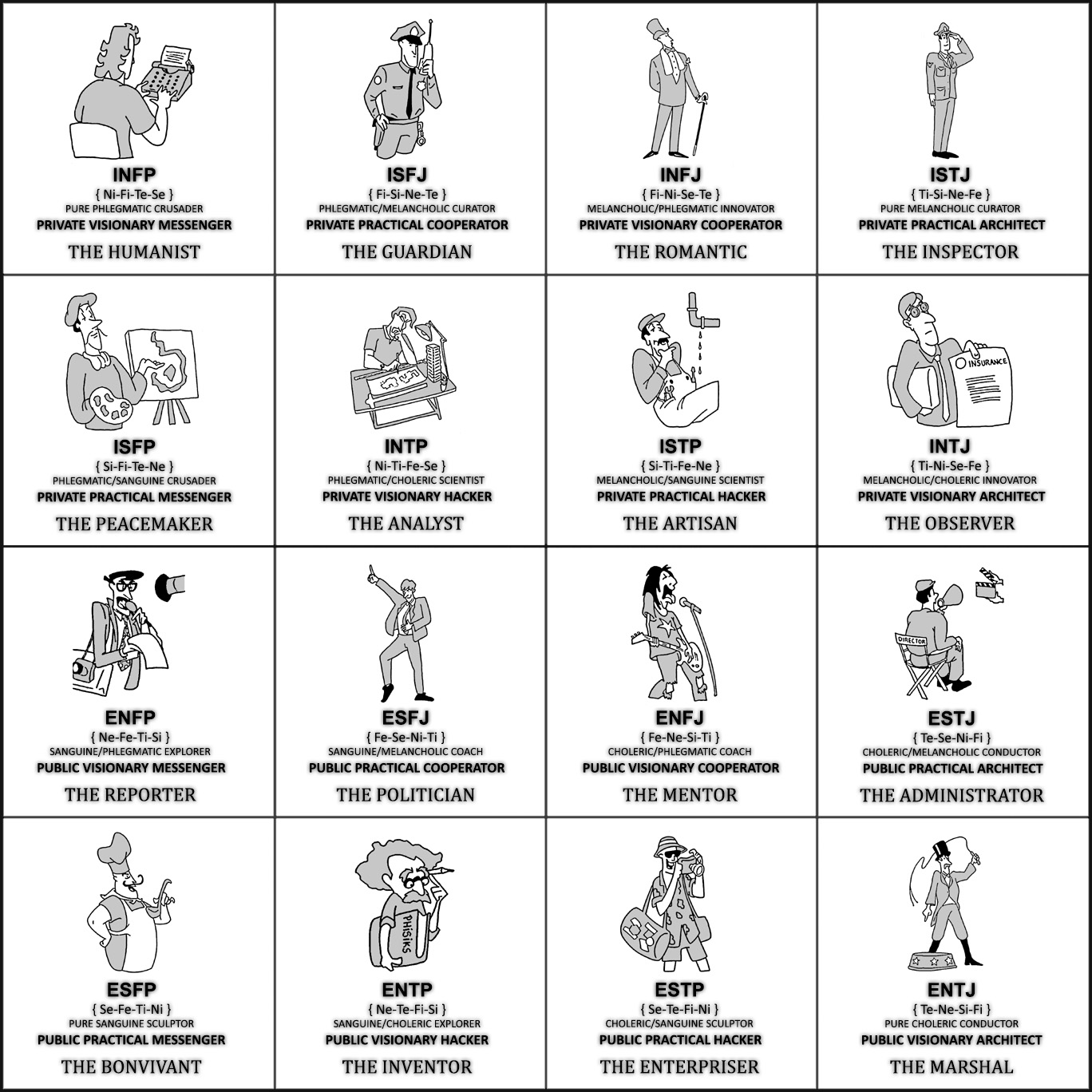
The contents in this table are from a mix of sources, as usual. The drawings come from the type profiles over at socionics.com, following the correlation explained in MBTI List 11. Notice how they change when you go from an introverted type to its extraverted counterpart, and vice versa (I think there's some kind of pattern there). The texts include each type's temperament combined with a broad role (from MBTI List 01), a new composite name that I made (consider above all the similarities within the Architects (TJ), Hackers (TP), Cooperators (FJ) and Messengers (FP)), and finally one of the main names given to each type by the socionists.
The unconscious is, by definition, something that eludes definite descriptions. It's just like everything I've been pointing out about the functions (for example with the underwater analogy), but even more so. The unconscious is unknown and indeterminate, like some dark eerie abyss that might feel frightening, but also contain treasures. Here is a preliminary scan.
When you move from the conscious to the unconscious some very strange things start to happen. In the context of the MBTI types, these could be among the most important:
✸ 1. The unconscious of people with the same psychological type manifests in very different ways for each one of them. It's crucial to remember this. The specific cognitive and visible effects of Ne3+Fe4 in one ISTJ might have very little or almost nothing in common with those of another ISTJ. On top of the fact that everybody is in a different state of function-differentiation, each person has lots of things that make him/her unique (including what I called "constellation" in post #17).
As I explained in point 5 of post #24, we need to avoid making assumptions about the unconscious in general, about what a particular person's unconscious is or brings, what it holds, how it might change, etc. The sooner we take conclusions and/or "predictions" for granted, the sooner we'll start making horrible mistakes. The very typing might be wrong in the first place, and the way some "typologists" approach this issue is essentially about stigmatizing and condemning people, not about help or understanding.
What's common to all manifestations can be described only at the most conceptual level. This is what I'm always trying to do with the types, of course, because giving specific details is usually more confusing than accurate. I also talked about this in post #24.5, as a general introduction focused on the individual positions. In this post I'll try to reach some kind of broad conclusion about the interrelations that happen between X3 (the "tertiary" function) and X4 (the "inferior" function).
✸ 2. The function in X3 is slightly more conscious than the one in X4, but it's only an auxiliary function, never standing only by itself, so its relationship with the inferior usually ends up acting as a source of different variations of both problems and creativity, in the sense that the person has a "better" grasp on something (X3) that needs to help/follow/fit another thing (X4) to which [s]he has even less conscious access.
2.1. One of the most common manifestations of this interrelation is that the person doesn't even try to focus on X3. The tertiary is left out of consciousness, basically like X4.
2.2. Despite this general resistance to attend to/work through X3, sometimes the person feels forced to do it because of changes in X4, which usually come from the outside (quite literally for the introverts, and interpreted as such by the extraverts). This is the basic dynamic of the inferior-tertiary relationship.
2.3. There's a pull or attraction there, inside the mind of the person, sometimes with a kind of "weight" that's almost noticeable from the outside (in various forms, of course). In some cases this attraction gets mistaken for skill or ability, and even though the person thinks that [s]he knows what [s]he's doing, the resulting activity or product has some fantastical and/or emotional aspect to it, and it's not like it's automatically wrong, but it surely carries elements that wouldn't bother other types at all (especially the Mirror).
This is essentially because the concept of "extent" is not so readily applicable to the unconscious as it was to consciousness. People can see/distinguish things and compare/check them with easiness and accuracy when it's about their X1 and X2, but they can't do it just as well with their X3 and X4. So, even though it might seem adequate, it's better not to directly bring here those sentences that I put at the end of post #31. We need new ones, and they need to imply lack of precision.
2.4. The previous point means that, if not ignored, attempts at seeing/interpreting X3 and working with it usually lead to various degrees of confusion, worry, waste of energy (results < investment), anger, exhaustion, etc. That's one of the main reasons for the unwillingness to focus on it in the first place, and also later/again. This is the general rule.
As an example, some people try many different versions, approaches and ideas related to their X3, in order to see which one supports [the new] X4 better. There's potential here for the creativity I mentioned earlier, but through all this trial and error the person might also get nervous, tired, etc. With effort and age, this kind of adjustment is supposed to get easier, and the person and others who know him/her might see this as some kind of "improvement". But it's important to notice that "easier for the person" doesn't imply any kind of compliance with standards, rules or expectations. It only means less emotional, less traumatic, etc. (It might still be weird, minimal, plain, approximate, uneven, etc).
✸ 3. Not everyone focuses on their conscious functions all the time, and not everyone does so in their main or professional activities, either. People can put their energies to work on different functional positions, and they can alternate between them, depending on their different [assumed] roles, the company, the circumstances, the current topic, etc. In a given moment some are all about their X1, some include their X2, others are trying their best or can't help but be currently occupied with their X3-X4, etc. This diversity is one of the factors that contribute to the different "flavors" in various "disciplines" and "fields of work", for example.
✸ 4. Ok. Now, if I try to come up with more sentences like before, I need to start with some additional disclaimers, too, on top of everything I've just described above. All the words retain the broad meanings I explained in post #31: you need to read it first if you want to understand this, because they are not what you probably think they are. The same happens with the description I gave there about what it means to be dominant (X4 here) or auxiliary (X3 here).
The verbs chosen to reflect the functions in the following list are just very limited examples, of course. I tried to approximate the essence of the frames, but that's extremely difficult because the functions are not actions (they are senses) and here they are not even [completely] conscious, so you have to take what's written below only as a vague indication. Remember that our proper functions are all working all the time, and they apply to all sorts of spheres, ranges and scopes.
The blanks stand for the resistance I mentioned in point 2. Some of the words that could be put there would be: difficult, hard, cumbersome, tiring, costly, tough, a problem, a drag, and dangerous. The key is that "wrong" or "bad" are not valid words there. We know X3-for-X4 is something good/right, even necessary, but we also know it's never easy. (What's wrong/bad for everyone is the idea of X4-for-X3, and even worse X4-for-any-other-thing). That last word "dangerous" includes, among other things, the [unconscious] awareness that we can get somehow "trapped", "addicted to", or carried away by X3/X4 if we start filling the blanks with overly positive and confident words like "easy", for example. In any case, the more X3 is conscious, the less problems we have here, of course.
The last element in each sentence (X4) is somehow felt/perceived, not absent/ignored at all, but it's the most unconscious, so it's all in one, and it's very difficult to apply the auxiliary element (X3) to it.
ESTJ (Te-Se-Ni-Fi): It's ____ to be aware in a way that fits/follows what is good.
ESTP (Se-Te-Fi-Ni): It's ____ to value in a way that fits/follows what is true.
ENTJ (Te-Ne-Si-Fi): It's ____ to utilize in a way that fits/follows what is good.
ENTP (Ne-Te-Fi-Si): It's ____ to value in a way that fits/follows what is useful.
ESFJ (Fe-Se-Ni-Ti): It's ____ to be aware in a way that fits/follows what is identified.
ESFP (Se-Fe-Ti-Ni): It's ____ to identify in a way that fits/follows what is true.
ENFJ (Fe-Ne-Si-Ti): It's ____ to utilize in a way that fits/follows what is identified.
ENFP (Ne-Fe-Ti-Si): It's ____ to identify in a way that fits/follows what is useful.
ISTJ (Ti-Si-Ne-Fe): It's ____ to change in a way that fits/follows what is shared.
ISTP (Si-Ti-Fe-Ne): It's ____ to share/agree in a way that fits/follows what is possible.
INTJ (Ti-Ni-Se-Fe): It's ____ to be/present in a way that fits/follows what is shared.
INTP (Ni-Ti-Fe-Se): It's ____ to share/agree in a way that fits/follows what is present.
ISFJ (Fi-Si-Ne-Te): It's ____ to change in a way that fits/follows what is determined.
ISFP (Si-Fi-Te-Ne): It's ____ to determine in a way that fits/follows what is possible.
INFJ (Fi-Ni-Se-Te): It's ____ to be/present in a way that fits/follows what is determined.
INFP (Ni-Fi-Te-Se): It's ____ to determine in a way that fits/follows what is present.
I'll give an example of how some of these can manifest in a coming (post #36).
(More about the tertiary function here).
Anonymous said: Hi! I have read your posts on the different types and was surprised to see the INFPs having Ni and Se among their frames. Could you elaborate on this please? How do the INFPs approach the world with such processes? Thank you!
Hi :)
I didn't answer this before because I was already working on the previous texts about the functions (post #31 and post #35). Hopefully they cover some of the aspects that you expected as a way of elaborating on the topic (post #26 fits there, too). There are lots of things to discover, understand and explain about the functions, and I need to do it almost from scratch because everything that's out there is simply wrong, so this takes a lot of time.
It's very difficult to talk about just one type, instead of putting them all in perspective at once, which is what I try to do here, in general (a global approach is also more informative). Among other things, people tend to assume that anything you say about a particular type applies to everyone with that type, and that can only be done at the most conceptual level, not at the "juicy" one that most people want to hear. Those "juicy" bits tend to be, for the most part, either about individual cases (sometimes more exception than norm, and that's supposing they are not mistypes), or romanticized/idealized portraits (sometimes outright fabricated and misleading). That's why I often use what many probably call "abstract" words and sentences.
With that in mind, and having described the general landscape in the previous posts (the lists can be interpreted as "world-approaches"), I'll try to give you a simple example of type contrasts that might help you see what I meant with the list in post #35, which is surely the most perplexing. Then you have to keep thinking about these things yourself :)
Ok. INFPs have Te3-Se4, and INFJs have Se3-Te4. This means that, where an INFP would change his/her clothes to fit changes in his/her body, an INFJ is more likely to change his/her own body in order to fit in a particular dress/suit, for example. Both mindsets are manifestations of X3-for-X4. As the body of an INFP changes in time, [s]he doesn't notice right away and, even though that's what [s]he wants to do (eventually), it's difficult and tiring for him/her to find fitting clothes. An INFJ is the other way around: [s]he might not see the different "body requirements" of various pieces of clothing, but [s]he gets/keeps them anyway and, even though that's what [s]he eventually wants to [and will] do, it's hard for him/her to feel "adequate" right away, maybe even to put on a diet (or to gain weight, etc), so as to fit in them. You can already see here who is more prone to have eating disorders, for example, or to resort to cosmetic surgery.
Something similar happens with INTPs and INTJs. The Fe3-Se4 of INTPs doesn't care too much about the [in]appropriateness of [their] presence. As adults, some of them might try to change the external values in order to protect the realities that they see are not being protected (this is part of the reason why, especially at this level, they are more confrontational than INFPs). INTJs, on the other hand, have Se3-Fe4, and this makes them avoid social disruptions, preferring to adapt themselves or other realities to the current values, even though they might find it difficult sometimes, due to their Fe4 (this could be an explanation for certain episodes of "emotionalism").
This applies to other areas in which aesthetics is a factor, and it's part of the contrasting way in which Js and Ps approach this subject: Js are usually more serious about it, more complex, sophisticated, "appropriate", calculated, etc, while Ps are more relaxed, plain, "weird", aimless, forgetful, etc. This is essentially because Sensation is always an auxiliary for Js (=conditioned), and a dominant for Ps (=unconditioned).
Anonymous said: Are there other things than the psychological types that you would like to write about?
Yes, of course :) I've already answered a few questions and mentioned some things that go beyond the types but, as you can see for instance in post #26 and post #29, when it comes to "deep" topics, in the end they all tend to hinge on or go back to the different psychologies of people.
One of the main conclusions of knowing about the types is the realization that you literally can't change anyone's mind. You can inform them, or correct their knowledge (with things like "2+2 is 4" or "We went last Saturday, not last Monday"), you can distract/confuse them, etc, and they probably can understand and repeat what you say conceptually, but they can't get the actual insights behind the words if they don't share your type, and you can't make them perceive contents or follow judgments other than the ones their own type provides. That is: you can't take people out of their own psychological realm or dimension.
Whatever I publish here, those who can actually understand it don't need to hear it from me or anybody else (they can reach it by themselves), and those who can't, well, they can't, so they won't. People don't get what I'm really trying to say, but what they interpret from what they hear me saying. In that context, everything is in the eye (=mind-type) of the beholder (and "a word to the wise is enough", etc). Thus, when you think about it, the only reasonable thing seems to be describing those different ways of interpretation, the mere statement that we are not the same, together with a simple attitude of trying to make each person's type and uniqueness clearer to him/herself [and others].
That's the general idea regarding the most "serious" subjects. One of the crucial tasks here is to try and determine to what extent a particular issue depends on type and to what extent it is truly universal. That's a really difficult task. Maybe it's not even feasible. I don't know. I just know what I don't want to do. I don't want to give written ammunition for others to misinterpret, twist and use for their own purposes, which are almost for certain the opposite of what I mean. Usually the distortion aims at some kind of self-justification or self-delusion. That's what most people expect to find on the screen. They don't come here to be challenged, but to reinforce their wishes and fears. And this becomes just another drug. (Look, I think we've found one of the things that would go in the large-universal-component box).
Anyway, as you can read in the about page (from the very beginning), there are other ideas that might find their way here, yes. It's just that the types ended up being more important or expandable than what I thought when I started. For some of those ideas I use other approaches, more personal, random and/or expressive, like the photographs or the comics, for example. That's not writing, but some topics are better presented in non-verbal form. In a sense, I've already been talking about them :)
Anonymous said: the posts on this blog are interesting but why don't you make your own system instead of saying mbti is fake
Here we go again.
MBTI isn't fake, what's fake is the e-i-e-i/i-e-i-e "function stacks" that most people take for granted. You really need to understand the difference. In fact, that's the whole point. When you do, you might be able to answer your own question. Read post #13, post #19, post #25 and post #01f [again]. Read also any other thing that you find interesting. Do it carefully. Follow the links. Think about it. Let a day pass. Or two. Or a week. Read again. Then, with all that in mind, come back here.
Oh, you're back? Ok. Remember your question? Right. The short answer is: I'm not the one that's using words incorrectly.
What people call "extraverted thinking" is not extraverted thinking.
What people call "extraverted feeling" is not extraverted feeling.
What people call "extraverted sensation" is not extraverted sensation.
What people call "extraverted intuition" is not extraverted intuition.
What people call "introverted thinking" is not introverted thinking.
What people call "introverted feeling" is not introverted feeling.
What people call "introverted sensation" is not introverted sensation.
What people call "introverted intuition" is not introverted intuition.
That's the answer.
For a longer one you can imagine something like this: someone with a very good microscope discovers the atom and its components, and he calls them protons, neutrons and electrons. Then a different person in a different country reads the scientific paper but she only has an average microscope, so when she looks she sees a molecule and, believing that's an atom, starts calling the different atoms "protons", "neutrons" and "electrons". Everybody ends up doing the same because somehow it's her description that gets famous and people don't bother checking the original paper, or they do, but their microscopes are also average. Then one day I look through my own microscope and see the problem. I start a blog and explain everything there, calling the protons protons, the neutrons neutrons, and the electrons electrons. I also find that the error has been known for at least 30 years. And then some people come along and tell me I should use other words.
Well, sorry. That's not going to happen. The whole point here is that the system is wrong. That's precisely the point and that's precisely the motivation behind the posts. Leaving the system alone is exactly and absolutely what I'm not going to do.
And there's no need for any new thing. What most people call "functions" is just an incorrect way of talking about behavioral traits already reflected by certain pairs of MBTI letters, so they are already there, in the 4-letter codes that we all know. There's no need for anything else. What needs to happen is that people stop using the original terms described by Jung (which are about cognition, not behavior), and start using what they are actually talking about:
They need to say "TJ[-traits]" instead of "extraverted thinking" or "Te".
They need to say "FJ[-traits]" instead of "extraverted feeling" or "Fe".
They need to say "SP[-traits]" instead of "extraverted sensation" or "Se".
They need to say "NP[-traits]" instead of "extraverted intuition" or "Ne".
They need to say "TP[-traits]" instead of "introverted thinking" or "Ti".
They need to say "FP[-traits]" instead of "introverted feeling" or "Fi".
They need to say "SJ[-traits]" instead of "introverted sensation" or "Si".
And they need to say "NJ[-traits]" instead of "introverted intuition" or "Ni".
Those who want to use the names and acronyms of the functions need to forget about the alternating stacks, completely, and start using the arrangements I have been repeating since my very first post. That's basically it.
There's another angle to your question, I know. You are pointing at obstacles that go against the spread of ideas. But see, that's missing the point, too. I think the people who make this kind of suggestions don't get how serious the issue is. Most of them probably take all "systems" as mere "opinions", or even products/trademarks, as if the functions could be "invented" and "promoted", like shampoo. They think the only thing that matters is how popular a "brand" is, how well it sells, etc. That is, again, the market-mindset speaking, not an open and intelligent one.
I don't know if you/others have realized it yet but this is not about building an audience or making a profit. From that perspective, there's an even shorter answer:
I DON'T CARE.
This is about telling the truth.
Anonymous said: hey there, i'm an infp, but i am an isfp in this system. I think the majority of infps in mbti are isfp here, and it explains the difference between infp and isfp, where the si feeling is much more scientific/nuanced, while the isfp with ni feelings are more metaphorical. but i think that isfp here (corresponding most to infp in mbti) is is fi-si, not si-fi, and isfp should be fi-ni here. ISTJ should be si-fi, they are led by stability but have a great deal of principle and are highly emotional.
(*ノ_<*) No, no, no. You don't understand. You have to forget everything you know about "functions" and types, because it's all wrong. You have to start from scratch.
You've probably just seen the eeii/iiee arrangements, but I'm pretty sure you haven't taken a look at the rest. You jumped straight to the ask page. So you have to ignore what you just did, and instead do everything properly.
They aren't going to read it, but what follows is for anybody that's in your same situation, someone that stumbles upon an eeii/iiee post for the first time and thinks "[meh,] new model", or something like that.
1. The first thing you need to do is forget that multi-model perspective of typology. The right approach is not about "systems", and what I write here is not an "alternative" (or just "another MBTI blog"). This is the reality about the cognitive functions and the dichotomies. The rest are wrong. Any e-i-e-i/i-e-i-e "stack", or any model that says J's dominant is perceiving and P's is judging, is not a "different system", it's just WRONG. What you and most people call "MBTI" does both, so it's wrong. Socionics does a version of that, so it's also WRONG. And your... "suggestions" are full of the second error, so they are wrong, too.
The types and the functions are just like any other thing that can be discovered: you either get them right, or you don't. It's not a question of different "models", "theories" or "opinions". All of that is irrelevant. The only relevant thing is what is true. The real types and the real functions are what they are, they are not "inventions", and the only "differences" are in how well different people recognize and understand them.
So it's not that you are "different types in different systems". You are only one type. When someone starts talking with all those "systems" acrobatics they are just trying to "save" what they think they know, making excuses and reinterpretations for anything that doesn't fit, so that they don't have to discard their own "knowledge". Well, that's precisely what they/you have to do. All of it, to the trashcan. *right click* *delete* *confirm*
You need to stop reading and repeating that kind of nonsense, and you have to understand what this is really about.
2. I could recommend starting with Jung's Chapter X, but that's probably best left for later. In this case, I think it's better if you start with post #38. It's a fitting summary of the right perspective in this matter, with a chemistry analogy that explains it. Here is another one, expanding on the previous point:
The hydrogen atom has one proton. If you look and see two protons and you call that "hydrogen" you are wrong. Because it's helium. Hydrogen is not helium. Helium is not hydrogen. In the context of psychological types, you can be hydrogen or helium, but not both at the same time (not even one and then the other). And if you have a system where hydrogen is called "helium" you are doing science wrong. Obviously.
You don't get to choose the number of protons of a particular element. So you don't get to choose the functions of any type. You have to understand what they really are, how they are arranged and why, and then you have to see which types have them. Because, again: there are no systems. There's only the real cognitive functions and the right way to express/match them with the letters. Anything else is incorrect.
3. Ok. Let's assume you've read post #38. Then you have to read these other important posts, preferably in order: post #01, post #13, post #19, post #24, post #25, post #31, post #58, post #59 and post #87. You have to do it carefully, and probably several times. Then you can go to the index page and read some more, following the links, etc.
4. A few days later, when you're done, you have to type yourself, and everybody else, again. After that, you have to keep reading, thinking, and checking things.
5. Around 5 years later, if you still care and remember anything about this topic, you have to type everybody again, including yourself.
That's more or less the plan.
And I'm not joking.
This has also been explained before, with several posts of thousands of words. First you need to read post #17a. Then the two posts linked in the 4th paragraph there (post #15 and post #17). In those texts you'll see that, apart from their essence, the more you try to set a word/term for the functions, the more you start leaving things out or putting too much in. The functions are vague and strange, and they are not synonymous with things like "memory" or "emotion", which is what many people want them to be. After those three posts go to post #31 and post #35, where you have some more angles (also post #87).
The main interpretation is looking at the functions as the senses of the mind: internal filters, strainers or sieves that interpret the world and tell us about it. The same way that sight doesn't perceive sound, Se doesn't perceive ("lets through") Si, or Ne, or any of the other components or "dimensions" that correspond to the rest of the functions. From here you can try different things.
For example: you can picture the introverted functions as the independent and universal or encompassing factor/side of the extraverted ones, which depend on the physical reality of objects. If Te tells you about the details of a flower, Ti would be more about the abstract concept of flower. If Fe values the flower in concordance with what's being agreed at that moment around you, Fi has a proper and very clear idea of its value. If Se perceives the flower as it is now, Si sees how it was and how it's probably going to be, mixing all its "aspects" together. If Ne looks for things that can be done with or learned about the flower, Ni ponders and finds its meaning, the truth behind the flower.
The functions place themselves in different ways for each type. One of the most important differences is that in Js' consciousness there's an unconditioned judging function (Te, Fe, Ti or Fi), and in Ps' there's an unconditioned perceiving function (Se, Ne, Si or Ni). That's what's called "dominant" function. The auxiliary is conditioned by the dominant, and it always has its same attitude (e-e or i-i) and its opposite rhythm (J-P or P-J). If you look around the blog you can find thousands of words explaining this, too.
Anonymous said: "The same way that sight doesn't perceive sound, Se doesn't perceive ("lets through") Si, or Ne, or any of the other components or "dimensions" of cognition that correspond to the rest of the functions." How is this contrasted to Se implying Ni/Ni implying Se
E↔I implication is a very different level: if Ni exists, then Se also exists. If Fe exists, then Ti also exists. Etc. But those mutually implied functions don't "filter" the same thing at all, so it's not about what they tell us. It's just that the two things are connected, opposites but connected, in a really interesting way.
Try this: if you look straight ahead you can't see what's behind you, right? But it's there, and it's totally different from what's in front of you. It has to be. That would be the "perceive" level. Now, the fact that you can look both ways (theoretically), the fact that there's a "line" with two directions, and that you need "behind" to be able to look "ahead" (and vice versa), that's the "implication" one.
A type is the particular orientation of a person on those "roads", the fact that we can't really "turn around". For each connected pair of proper functions, we have one that's conscious ("ahead"), and the other, the implied one, is unconscious ("behind"). If extraversion is in front of you, introversion is at your back (so you are an extravert), and vice versa.