
INDEX
ABOUT
FAQ
GLOSSARY
MBTI TYPINGS
MBTI RELATIONS
DISCORD
PHOTOS
STORIES
GENERAL
DIFFERENCES
TYPING
FUNCTIONS
TABLES
LISTS
WORKS
VARIOUS
NAMES
MORE
Types #15X ← ✸ → Types #17X
This is just an attempt at representing the conceptual distance between a given type and the others, using the names of the relations in the static page. The image above is the general one, and then there is a specific one for each type (see below).
The horizontal axis measures the number of letters that both types share. The vertical axis looks at the similarity in their functions. Several factors are included there. Having functions in common is closer than not having them. Having the same function in the same place is closer than having it in a different place, and this works also with the conscious/unconscious sides. Even if the function is not the same, having a shared function essence (T/F/S/N) is closer than having a different one. And then having the same general dominant>auxiliary situation is closer than having it reversed, even if it only applies to global essences.
The result is clearly just a broad generalization. As I explain in the relations page, lots of other things can bring people of different types together, or set them apart even if they are conceptually similar. Each particular case is different, and there is a lot of variation inside the same type, to the point of having Equals who don't get along at all, lifelong couples who are Contraries, etc.
EXTRAVERTS:


INTROVERTS:


I know the Parallel might seem the closest from a certain perspective, because it has your dominant, but sharing all the conscious and unconscious functions like you do with your Crossed is a pretty big deal. The Parallel has a different auxiliary, so the conclusions they come to might be very different from yours. Still, it's the second closest, of course. The Mirror has the same functions and the same Dom>Aux arrangement, that's also a pretty big deal in closeness. The Distant is the most different if you take the two factors here: letters and functions. Everything is different there, except for E/I. The Contrary is a bit closer because the proper functions are all the same even if that last (first) letter isn't.
Perhaps the physical space in the graphs is a bit exaggerated, but I think the general idea is well represented. You can see how the type's own quadrant is relatively close, while the opposite one is up there and the other two are mixed in the middle.


As a complement to the first set of term-cards, these include a few more basic ideas and points of reference for each type. There are two main blocks: one related to function locations, and another one about type relations. There are also some things taken from several MBTI Tables. The images are the court cards of the Aquarian Tarot, by David Palladini.
 |
 |
 |
 |
 |
 |
 |
 |
 |
 |
 |
 |
 |
 |
 |
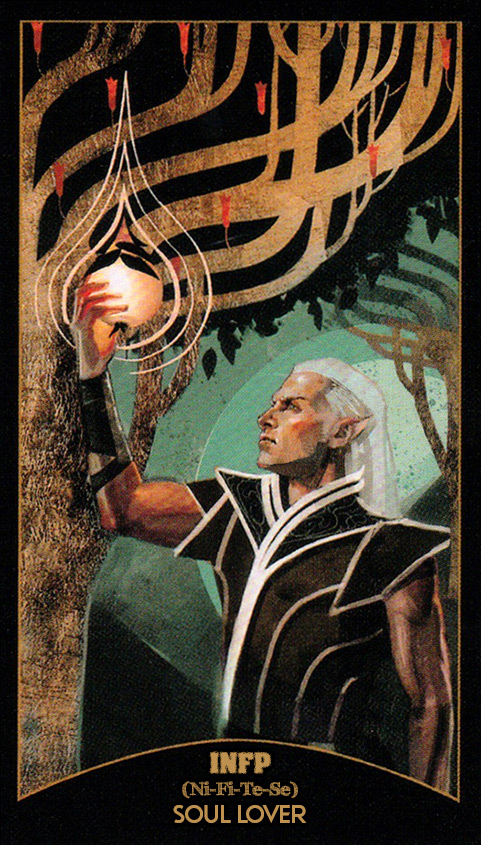 |
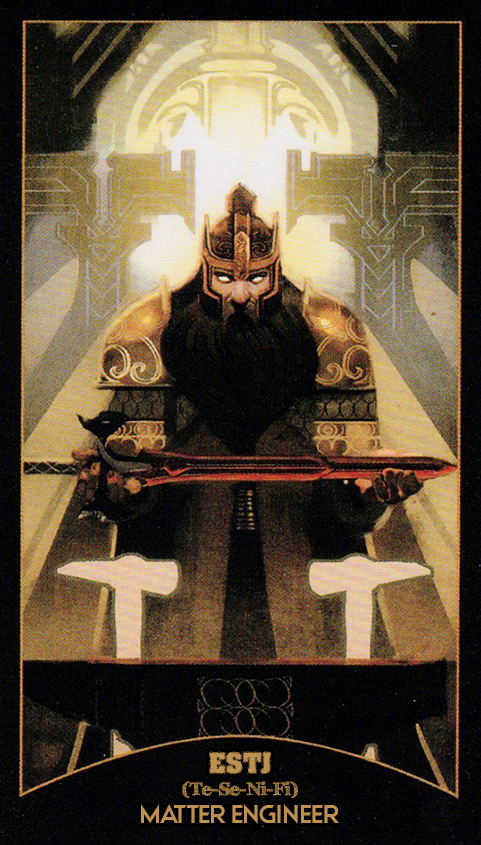
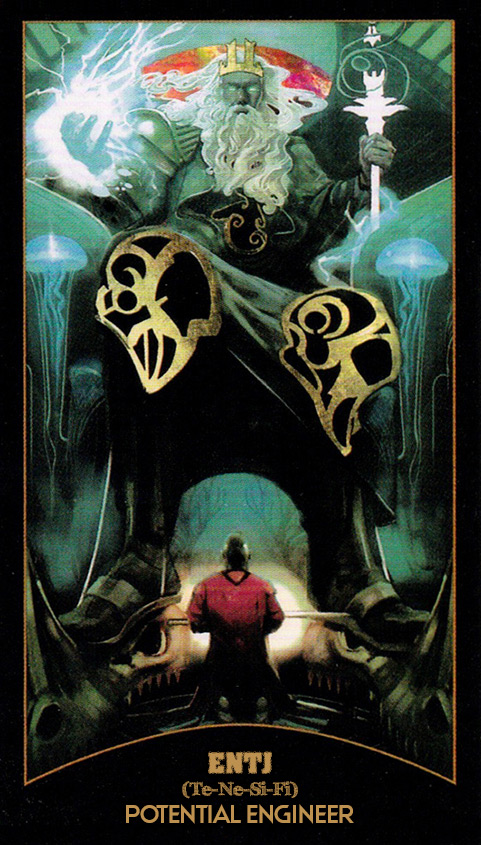
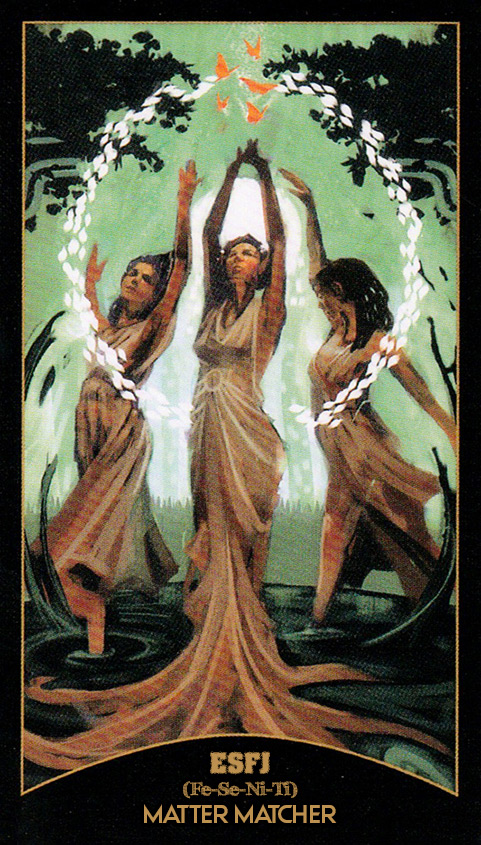
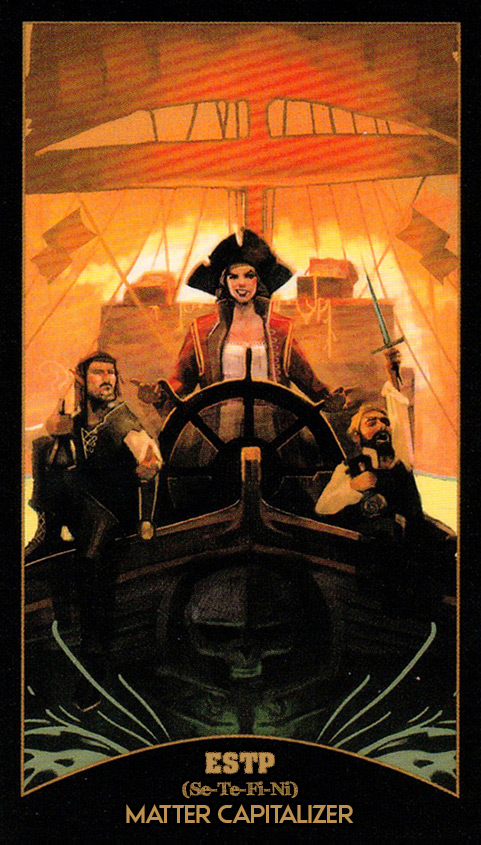
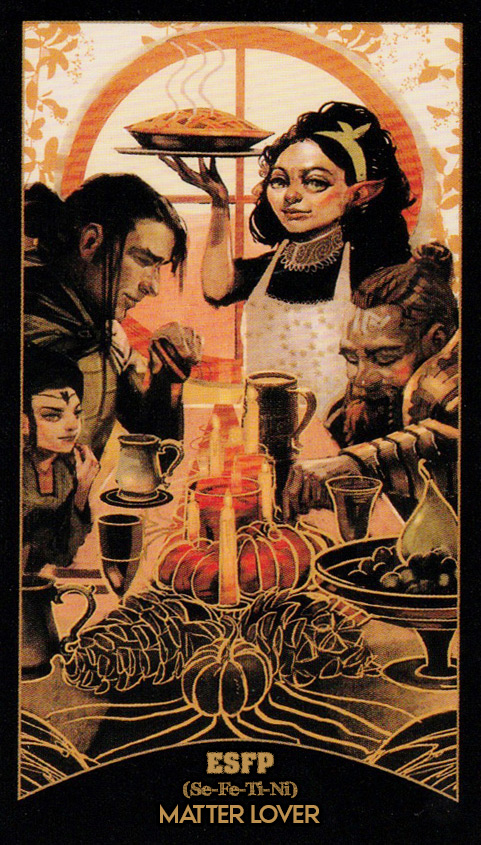
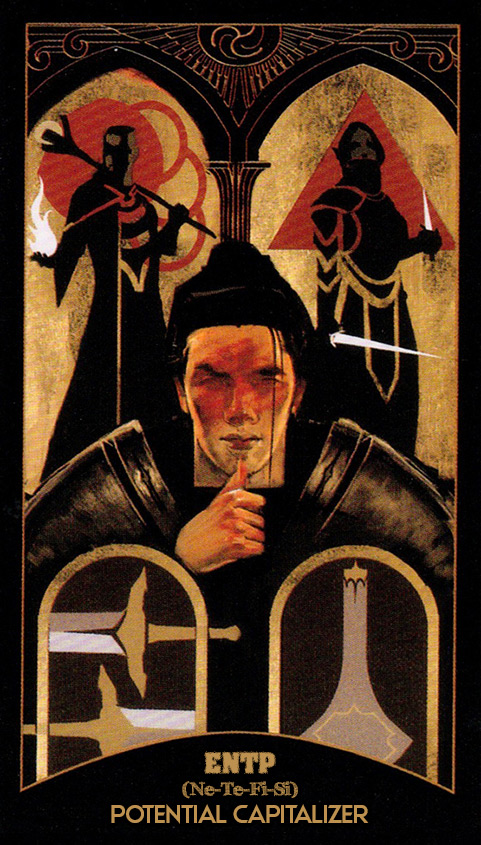
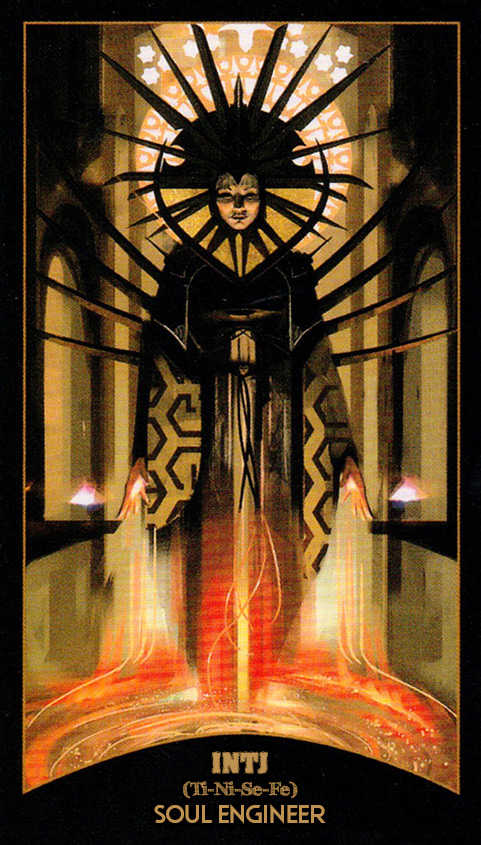
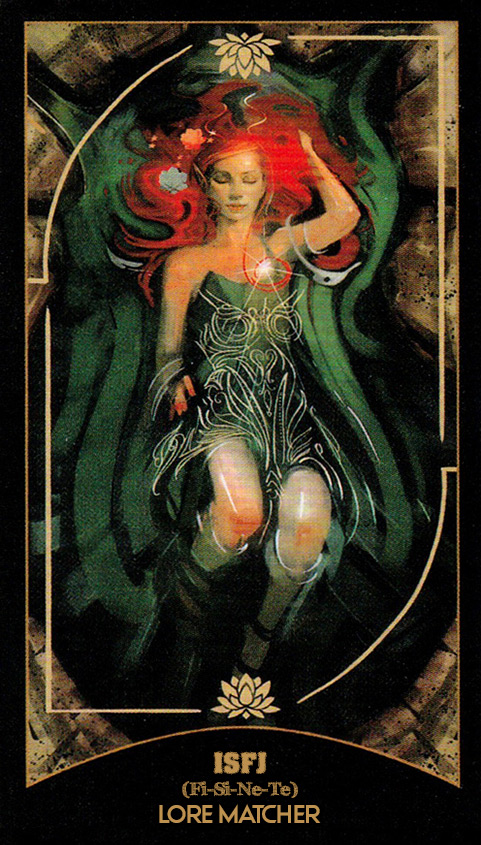
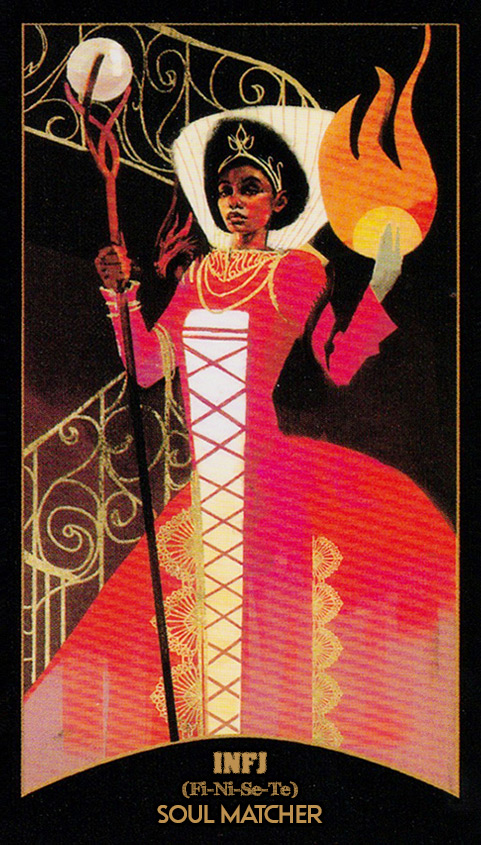
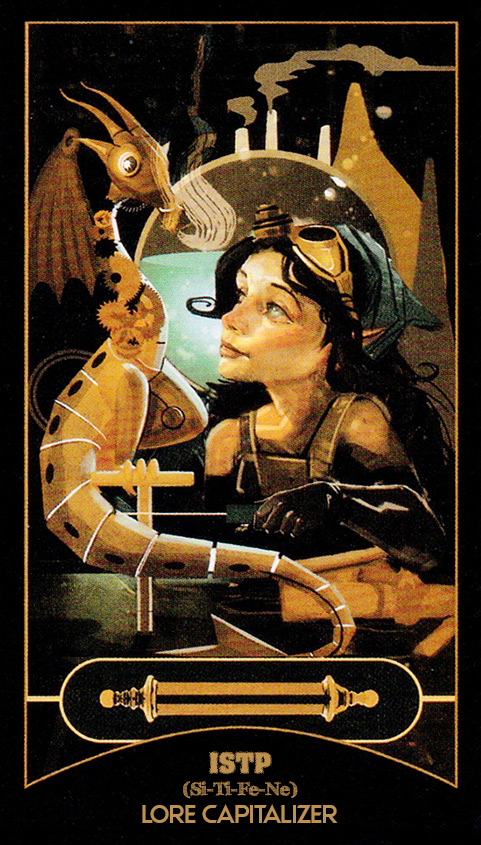
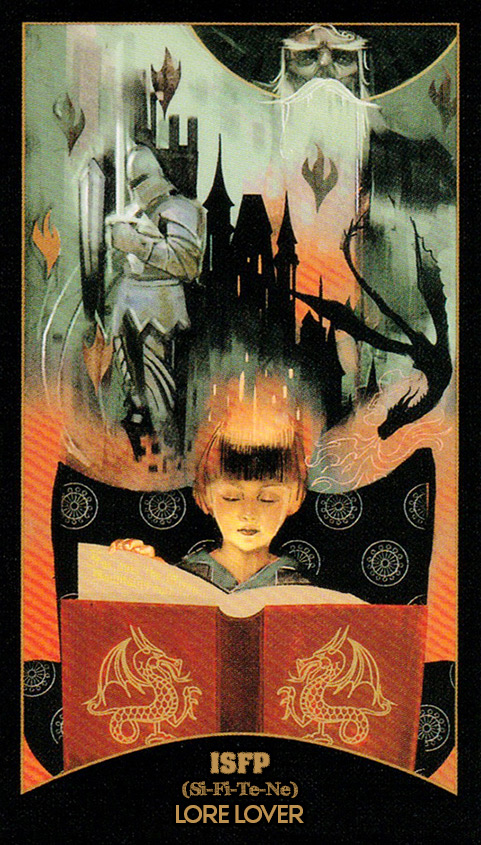
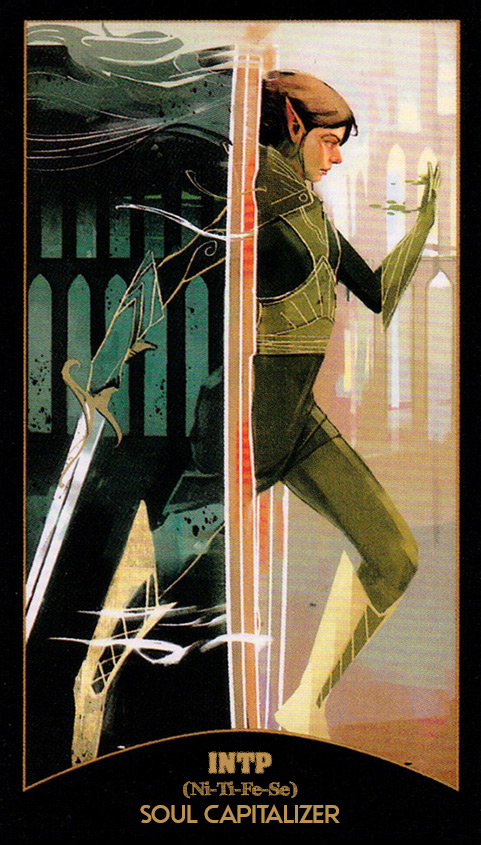
I think these new names are good descriptions of the types' essences, showing in a concise way what each type is about (for reference: post #140, 'conscious' column in the second image). They are based on the combination of the first two letters (attitude + perception) followed by another that includes the last two (judgment + rhythm). You can see for example how Potential vs Lore is related to the external vs the internal + N/S, or how the Capitalizer/Matcher contrast points to task/people + P/J.
The idea of Engineer (TJ) includes definition, organization, specialization, development, etc. Capitalizer (TP) includes capture, benefit, utility, exploitation, etc. Matcher (FJ) includes evaluation, compatibility, association, coordination, etc. And Lover (FP) includes search, communication, liking, joy, etc. (If you want more letter-group keywords you can check for example this post).
The original images are from the Dungeons & Dragons Tarot, by Fred Gissubel (I made a few small edits). Some of them correspond to the type's court card, but most of them don't, because I focused primarily on the composite name in order to choose relevant illustrations. Some work better than others, of course. The authors of the deck made some weird changes trying to adapt the cards to the game, and they ended up losing part of their meaning and being a bit limited, but I guess the result here is ok for the most part.
 |
 |
 |
 |
 |
 |
 |
 |
 |
 |
 |
 |
 |
 |
 |
 |
This is another way of looking at the functions, using the famous yin-yang symbol. The white/light side would be consciousness, the black/dark would be the unconscious, and the small circles would be the ghost functions. The dotted sinuous line goes through the four proper functions of each type, following the general path in which consciousness extends itself, or "the course of the process of differentiation".
The original image (the drawing without the text) comes from Jolande Jacobi's book The Psychology Of C. G. Jung (1942). She explains that it is "a happy and perhaps not merely coincidental analogy to the relative value and direction of the functional processes". She also describes X3 as "a sort of mediator with the unconscious", which matches the ideas of "bridge" or "key".
The words "father/son" and "daughter/mother" are just one way in which those function locations might appear in dreams. They don't refer to actual people (you have X2+X3 even if you don't have children, obviously), but more to archetypal ideas of order+control+directness etc, for father+son, and the opposite for daughter+mother (see point 4 in post #140). I think another way of looking at them could be King>Knight · Princess<Queen. And then there's the more linear way, from older/current/modern to younger/archaic/primitive, so I can also imagine something like a representation through landscape, for example city>building · house<forest, or maybe land>road · island<sea/underwater.
These 16 graphs point quite clearly to a sense of wholeness of the psyche, to the idea of conscious-unconscious balance, to the way the ghosts can be seen as reflections of "the other side" and also a bit like intruders, etc. The white/black illustration of the general C/U dichotomy matches the colors that I assigned to Se+Ni in post #27, and looks nicely appropriate for the ESs as classic "normal/standard" perspectives, and the INs as the "strange/inverted" ones.


I've made these just like the typeboards in post #141. The following post has the function boards.


I've made these just like the typeboards in post #141. The previous post has the temperament boards.
This is a list of the most important factors behind mistypes. Some ideas have already been mentioned before. The main standpoint is self-typing, but they also have an effect when typing others. You can read it as a list of things that you should discard/eliminate. I tried to place them (loosely) from most "external" to more "internal". The idea is that even if the most external don't have an effect, there's still the internal ones. But it's basically all at the same time.
1. SOCIAL PERCEPTION
This includes how some types, letters and "functions" are publicly seen as "better/worse" than others. This is a really big factor, in a sense perhaps the most important. I talked about this in several posts, for example here. It might not be easy, but you have to forget/ignore the common ideas that get repeated about the different types, especially any hierarchy of value, "coolness", or interest.
Knowing your true type can't be a problem, a source of inferiority, embarrassment, guilt or shame. If it is, that's because of misconceptions, of the false images that people share about the types, and/or a sort of worry or fear of what others might think if you publicly identify as "X" instead of "Y". Neither the individual nor the things [s]he says/does get "smarter" or "cooler" after identifying as a certain type, for example. All types have amazing people in them, and there are no "superior" types.
You can't change your type, so it's not a question of being "happy" or "sad" with it. If you feel as if you "like" or "dislike" your type then it's not your type what you're actually thinking about. You're probably thinking about a false stereotype, an image, a persona, state, or character in some kind of play, or a different type. You're looking at something that you're creating or imagining, not at the reality of [your] psychology. If you see a problem in your type, for example, then the solution is in it, too (and maybe it's not even a problem in the first place, but other things make it appear so).
2. MARKET MENTALITY
Even if they don't care about point 1, many people seem to want a sort of unique personalized license plate based on typology, something that makes them "more valuable" ("because different", somehow), which goes directly against what a type is = being similar to several millions of people + a way to understand yourself and others, not to sell or put yourself above others. I'm pretty sure that's the motivation behind those 345363 subtypes, and the way people combine all the "systems" in a multi-typologies code, looking for some "special combination" that no one else has.
You don't need a type for that. You are already unique, and anyone that interacts with you should know that because it's true for everybody. This approach goes directly against what a type is: something that you share with a lot of people.
Part of the issue here is taking typology as a sort of "objective system" to explain away personal problems, insecurities, etc. There's a difference between using type to know yourself and using it as an anesthetic for the mind, where you get some external "compensation" that keeps you from realizing what you really are, from accepting your responsibility, from accepting a fact or situation, etc. That's how a [mis]type can end up being seen as a sort of "official seal" that allows the person to demand obedience or some kind of special treatment.
Something similar happens at the other extreme with all those "typologists" who take the types as a catalog of problems, because they never question the person's goal (getting a date, a job/promotion, "success" in whatever, etc), that's somehow always "good", and what the type represents is the "obstacle" that you need to "overcome" in order to "achieve" that thing. Apart from the doubtful assumptions included (and the nonsensical "advice" that follows), this view can generate mistypes if the person is trying to believe in, fabricate and/or present a distorted but "attractive" image of him/herself.
3. TESTS
Tests are basically mistyping everybody. It's not only because they are based on faulty understandings (obviously), but because the method in itself is unreliable.
Tests are too quick and too shallow. They don't really promote careful observation, and they can't really go deep enough. Also, it's often quite easy to deduce what is being measured in each question, so the answers lose their effectiveness. Sometimes the problem is the opposite, and you have to guess what the words mean, with a lot of room for misinterpretation. Some people make the assumption that if you manage to change the result of a test then that's because your type has changed (it doesn't). And when tests are shared in public there's also the possibility that the whole thing turns into a sort of competition (see if you can get "more N", or "more Ti"), adding another layer of distortion.
When someone is taking a test is not uncommon to enter a slanted mindset and/or start overthinking things. Some people end up typing their state or their persona, how they feel, the image that they have about themselves, how they want to be seen, what is expected from them, etc.
On top of all that, one of the biggest problems is that tests create a false sense of "objectivity". Results are taken as "definite proof", like a sort of perfectly "neutral" confirmation, and you can't really leave that to a series of questions, no matter how well designed they are.
So, yeah, don't take tests, and ignore any kind of "results" that might come from them. Not only "MBTI" ones, but also for example Big Five ones because they come with things like the way they assign "High Openness" to all kinds of types (Ss and Ns), but people think that always indicates "intuitive" (it doesn't).
4. INCORRECT DEFINITIONS
This is a problem not only when it comes to what a "type" or a "function" is, but even what "psychology" is [for], and including everything else inside that. (Some of those interpretations are distorted by the market mentality). Lots of posts in the blog are about this. And we already know that there are no "systems", there's only your psychological type, the functions that make it what it is, and the four letters to express it. I'll add a few paragraphs here about misleading ideas regarding psychology/typology in general.
- There are people that don't take types seriously. I talked about this before. They enter the typology world just to have something in common with others, some excuse to "communicate", share memes, etc. For them, it's just another pastime, and they often forget about it as soon as something more interesting comes along. This shallowness can lead to lots of mistypes.
- There's also a certain fear of certainty in some people. It includes different variations of "there isn't anything fixed/unchangeable", "I can be whatever I want", etc, which go against the possibility that someone might actually know what the real functions are, what the real types are, and what somebody's type is. It's a bit like fear of knowledge or awareness of facts. These people are usually very fond of "opinions", "sources", "points", "arguments" and endless discussions, but not of conclusions or universal concepts that apply always everywhere.
- Many people don't [want to] realize that psychology is something that they have, in a particular way (type) that's not the same as others', and that they can't "escape" it. They think they can "compartmentalize" or "control" their type, that it's maybe only "part" of what they think or do, or just a superficial thing that they can manage (like a "toolbox", for example), or a switch that they can "turn off" if they want. Many "MBTI channels" and bloggers are like this. Some think psychological type is the same as mental or emotional state, others think it's the words or the "internal dialogue" that goes through your mind, others think it's only about observable behavior (including job/occupation), others say it's like a set of skills so in the end you can "learn" all of them, etc. That's all wrong. And perhaps their misuse is just a symptom of their desire to change those aspects (in themselves or others).
Other mistakes at this point would be: using the nonexistent eiei/ieie order with (more or less) the correct function definitions (post #58, post #136, post #158), using the correct eeii/iiee order with incorrect function definitions, mistaking feeling dominants for "perceivers" (post #59), mistaking depression for "introversion", mistaking introversion for "intuition" (post #108), mistaking thinking for "intuition" (also post #108), mistaking emotions or other things for certain temperaments, etc.
5. LIMITED SET/EXPERIENCE
Even with correct definitions, being familiar with only a limited group of types in real life, but thinking that you already know all of them, can be a cause of mistypes. A small set of examples can make you assign separate concepts to people who are actually more or less the same. (This is similar to the way some people think that they can find all 16 types in any movie/show, for example). You have to try and get a more realistic perspective of the whole landscape of functions, dichotomies and related concepts and keywords, populated by all kinds of different people (not only those that you might be familiar with), before you can locate yourself or someone else in it.
Something that doesn't help in this case is how, after all these years of widespread misconceptions, the images of what the types are have been blurred and distorted in a way that gives a false sense of scale and an extremely short-sighted view of the typological terrain. You can check the typings list to get a better idea of what kind of people are actually in each type.
You can find a rather extreme version of this factor in some apparently clueless "typologists" who can only talk about things like "growth" and "improvement" from the point of view of their own psychology. You would assume they are talking about everybody, because this is literally about all the types, but in reality they are only talking about themselves.
6. TYPING MISTAKES
Between this point and the next one we cover all those things that make a typing difficult in the most technical sense. People can be extremely complicated, and each case is different, so of course sometimes we are going to make mistakes because of misinterpretations, lack of precise understanding, etc. I'm not going to talk about specific problems, just include a couple of notes.
There are certain characteristics that aren't functions and can confuse typings, for example:
✸ energy (some introverts are more energetic than some extraverts)
✸ willpower (when it's low it might get mistaken for "introversion" or "P", for example)
✸ culture/education (the contrasts here generate very different variants inside the same type)
✸ specific interests (sometimes people are all about their unconscious, or a ghost function)
✸ psychological state (feeling good or bad can be mistaken for "E/I", or "sanguine/melancholic", etc)
✸ personal history/situation (just because someone isn't famous or successful doesn't mean [s]he's not an extravert, for example)
There's also the problem of applying a limited perspective to the person being typed, that is: looking only at particular details or aspects (blowing them out of proportion) and ignoring the rest. In a sense, typing is a bit like drawing when you're looking for realism. One of the main pieces of advice that teachers often give is that it's a bad habit to start drawing details right away. It's better to zoom out and get the general outline first, trying to see/understand the image as a whole. (This is especially true when you are a beginner).
7. UNCONSCIOUS CONFUSION
A lot of people interested in types are confused by their unconscious, in one way or another. Many simply because they are young and their functions are not differentiated enough (this constitutes a large part of the "community"), but also because of things like depression, so even with good tools that aren't tests (which are obviously lacking out there), they can't really help but mistype themselves quite a lot. A common example is the extravert who feels like "an introvert" (you find many more of those than introverts saying they are "extraverts").
Jung mentions how "it is often very difficult to find out whether a person belongs to one type or the other, especially in regard to oneself. In respect of one's own personality one's judgment is as a rule extraordinarily clouded. This subjective clouding of judgment is particularly common because in every pronounced type there is a special tendency to compensate the one-sidedness of that type, a tendency which is biologically purposive since it strives constantly to maintain the psychic equilibrium". And Von Franz also said: "One of the great difficulties in defining one's own or another person's type occurs when people have already reached the stage of being bored with their main function and their main attitude. They very often assure you with absolute sincerity that they belong to the type opposite from what they really are". "This comes from the fact that the inferior function subjectively feels itself to be (...) the most important, most genuine attitude".
Something else that should be taken into account is that, in the context of type, some people (especially EFs) are very susceptible to believe they are whatever they read. An unconscious sense of identity (Ti3 or Ti4) can make them relate to anything, especially if it's explained in abstract terms (hard to avoid in this topic), or if it intensifies the distortions of previous points (like presenting a type as "special"). This is similar to the effect that makes many of them believe in things like zodiac signs (just a reminder that people born at the same time are not more equal than people selected at random, in case you still had doubts about that).
8. IMPATIENCE
Many mistypes occur simply because the person doing the typing doesn't have enough information, but believes otherwise. Jumping to conclusions too early is just a common error in any kind of research. Inside this factor there's sometimes a certain degree of vanity and/or laziness.
Even if they don't use tests, many people want a quick answer nonetheless. They might think they know themselves already (sometimes in a way that leads them to ignore the fact that they don't really understand the concepts related to type), and/or don't want to spend the time looking at themselves or the person being typed, or checking from different angles, which is needed to be sure.
I know it's tempting to try typing shortcuts, like "visual identification" (actually one of the most misleading things that you can do), "aesthetic", music taste, handwriting, etc, but this topic is very slippery and diffuse, very elusive and complicated, even deceptive. So it doesn't work like that. There are no shortcuts. You have to go slowly, look at everything (letters, functions, locations, temperaments, relations, etc), and make sure that everything fits. And you have to give it time. You have to be careful and patient, and hold off your conclusions for a while. Be open to recheck things later, and remember that a correct typing can take years.
Some people only start seeing themselves clearly when they are already in their 30s or even later (assuming they are looking at these things), but they also might be going through internal changes or have problems that make them more confused/confusing. There is no "fixed path" in this.
If you are researching and reading about someone that's not present, it's better to check different sources (from different authors) and read in depth about them. Don't just go by the first summary that you find. Some sources contain unrealistic or even fabricated descriptions of the person, perhaps trying to create a particular image of him/her. They might focus on certain aspects and ignore others, giving a false sense of [dis]proportion. Try to get a complete overview, and avoid leaving gaps where crucial aspects might be found later. You might know a lot about the subject's work, for example, but lack a realistic account of his/her behavior, relationships, etc.
In any case, remember that the type, whichever it is, won't go anywhere, and that it's better to doubt it than to infer the wrong one.

This is an attempt at depicting all the types using only Gerald Brom's illustrations. He draws lots of isolated figures, with sci-fi and fantasy themes, so I thought I could give it a try. Some work better than others, but I think it's not too bad in general.
Apart from the images themselves, some choices have been additionally inspired by the original titles, or at least they help because they match quite well. For example ESTP is "The Harlequin", INFJ is "Web Of Charms", INTJ is "Soul Forge", INFP is "Soul Searcher", ISFP is "The Harper", ENFP is "Lucky", ENTJ is "Last Crusade", ISTP is "Gunslinger", and ISTJ is "The Spy" (it's a bit like Cobb in Inception). With INTP I was thinking about someone like Rorschach from Watchmen, a sort of Unknown Mercenary.

This is an attempt at doing something similar to what I did with Gerald Brom, but this time using Michael Whelan's work. I tried to avoid too many repetitions, looking for other aspects of the types. The result might feel a bit less consistent in comparison, because Whelan's images are much more varied, and they tend to include other elements apart from the character, especially when they are book illustrations. I don't know if the associations match in any way the possible types of the people in those stories, or the original intention behind the pictures. I didn't chose them following any reference like that.
Some time ago I wrote that acknowledging the existence of psychological types is (or at least should be) the end of philosophy.
This is what Jung said: "I always think of psychology as encompassing the whole of the psyche, and that includes philosophy and theology and many other things besides. For underlying all philosophies and all religions are the facts of the human soul, which may ultimately be the arbiters of truth and error".
If you want to have a more holistic and complete view of the world (mind, reality, etc) you need to include the actual facts of psychological type (not popMBTI or enneagram or whatever) in your reasoning and scope. If you don't know about the true types and include them in your "philosophy" or "world view" or "perspective", you are (at best) only talking about yourself. You might do it with a lot of originality and detail and complexity, but in the end it's just about you. (This is what most people do).
And yes, you are the world, but in the context of talking about literally everything, you are just one world. Ultimately, a person can't have a philosophy that's outside his/her own particular type. The types are a sort of 16 meta-philosophies, meta-theologies, etc. One of the main reasons why I like typology is precisely because it shows you minds/worlds outside your own. People in general have a very serious, unfortunate and harmful lack of awareness of intrinsic differences. There's a worryingly huge amount of "intellectuals", "experts" and "leaders" (for example, but also "common" people) who are actually convinced that everybody thinks or can/must think like them. They really seem incapable of even imagining other general configurations, and take any departure as "deviation" in a negative sense. Maybe that's one of the obstacles for the actual understanding of the real types and for the various ways in which the whole topic/practice is misdirected.
I think in a way (as one of the consequences), the overarching fact of types should make people a bit more humble, again not denying themselves, but recognizing and being aware of others' reality and value. Like Jung said: "It is my conviction that a basis for the settlement of conflicting views would be found in the recognition of different types of attitude, a recognition not only of the existence of such types, but also of the fact that every man is so imprisoned in his type that he is simply incapable of fully understanding another standpoint. Failing a recognition of this exacting demand, a violation of the other standpoint is practically inevitable. But just as the contending parties in a court of law refrain from direct violence and submit their claims to the justice of the law and the impartiality of the judge, so each type, conscious of his own partiality, should refrain from heaping abuse, suspicion, and indignity upon his opponent".
Types #15X ← ✸ → Types #17X