INDEX
ABOUT
FAQ
GLOSSARY
MBTI TYPINGS
MBTI RELATIONS
DISCORD
PHOTOS
STORIES
GENERAL
DIFFERENCES
TYPING
FUNCTIONS
TABLES
LISTS
WORKS
VARIOUS
NAMES
MORE
Types #14X ← ✸ → Types #16X
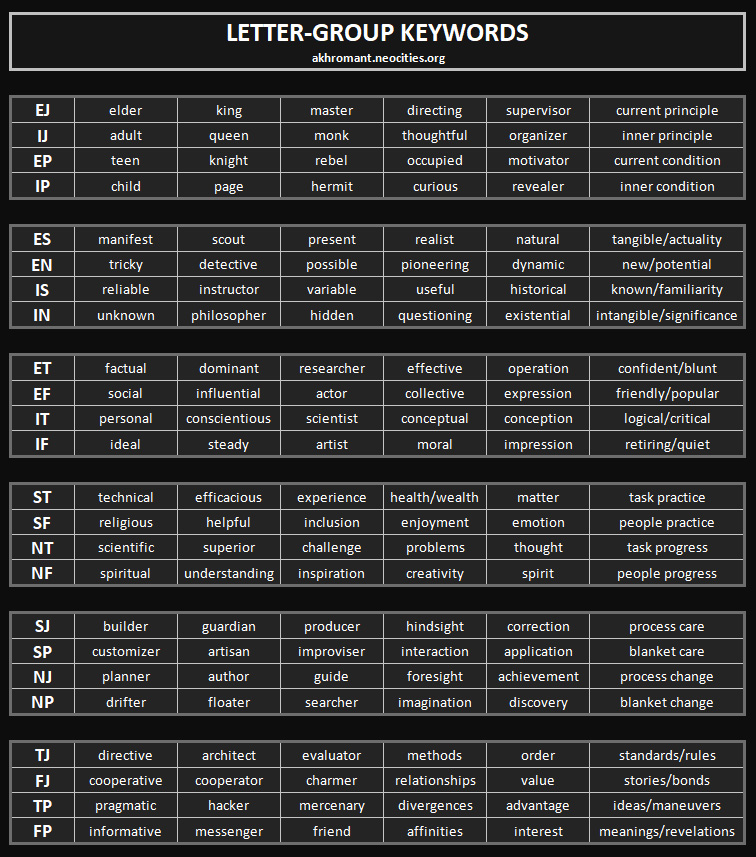
This table is based on the one from post #84, with a few changes and additions (still, that one has even more things, so check it out as well). I'm not going to explain what the keywords try to reflect. Some have been covered in other posts, but in the end you'll have to think about them for yourself. As usual, remember that they refer to the general idea of the groups, not to every possible variation or individual within that group, and also that they are mostly figurative, so don't take them as rules, or literally. They don't work like that.
The letters and the functions are two different levels of analysis. Both are meaningful and important, and both have to fit. Some things are better explained with the letters, and others with the functions.
For reference, I'm going to include the functional foundation of the 8 isolated letters and the 24 two-letter combinations (following the order of the table above):
E = extraverted dominant + auxiliary / introverted tertiary + inferior
I = introverted dominant + auxiliary / extraverted tertiary + inferior
S = conscious sensation / unconscious intuition
N = conscious intuition / unconscious sensation
T = conscious thinking / unconscious feeling
F = conscious feeling / unconscious thinking
J = rational dominant + inferior / irrational auxiliary + tertiary
P = irrational dominant + inferior / rational auxiliary + tertiary
EJ = extraverted rational dominant + extraverted irrational auxiliary / introverted irrational tertiary + introverted rational inferior
IJ = introverted rational dominant + introverted irrational auxiliary / extraverted irrational tertiary + extraverted rational inferior
EP = extraverted irrational dominant + extraverted rational auxiliary / introverted rational tertiary + introverted irrational inferior
IP = introverted irrational dominant + introverted rational auxiliary / extraverted rational tertiary + extraverted irrational inferior
ES = conscious Se / unconscious Ni
EN = conscious Ne / unconscious Si
IS = conscious Si / unconscious Ne
IN = conscious Ni / unconscious Se
ET = conscious Te / unconscious Fi
EF = conscious Fe / unconscious Ti
IT = conscious Ti / unconscious Fe
IF = conscious Fi / unconscious Te
ST = conscious sensation + thinking / unconscious intuition + feeling
SF = conscious sensation + feeling / unconscious intuition + thinking
NT = conscious intuition + thinking / unconscious sensation + feeling
NF = conscious intuition + feeling / unconscious sensation + thinking
SJ = auxiliary sensation / tertiary intuition
SP = dominant sensation / inferior intuition
NJ = auxiliary intuition / tertiary sensation
NP = dominant intuition / inferior sensation
TJ = dominant thinking / inferior feeling
FJ = dominant feeling / inferior thinking
TP = auxiliary thinking / tertiary feeling
FP = auxiliary feeling / tertiary thinking
Picture a car or a musical instrument, and consider what happens when you learn to drive, or to play the guitar. At first everything is a complex strange mess, you don't know what you're even looking at, how to even hold the thing, etc. Then you learn the names of the different parts, what each one is for (their function), how to use them, how they interact, etc. Then you start driving or playing, probably not very well at first, but then better and better. Later, with enough talent/experience, you reach a moment where you don't even have to think about the parts, or your movements, or the things that you're doing. It's all automatic. You forget about the names and all the rest. You have "reintegrated" the components and you don't even "see" them anymore. The car/instrument is one again, but instead of being a convoluted riddle it's something that works effortlessly: a whole.
That's what we are supposed to do with our minds, too. At first we are basically unconscious of everything, confusing things and being mostly lost in there. Then we notice the various components, and we study them (type can help here, although I really doubt this works as it should when someone follows false premises like the nonexistent "eiei/ieie" order, wrong definitions of the functions, etc). And finally, we start reintegrating everything. You can think of the types as different models of car-minds or instrument-minds, and each person driving or playing theirs in their own particular way. In this context, accurate typology knowledge would be like a sort of generic user manual, with perhaps too many things that don't apply to your specific item, yes, and looking also (rather suspiciously) like it's being reverse-engineered 😅
Note that the "transcendent function" is not a function like Te, Fe, etc. It's something different that encompasses all of them and happens in all the types. Jung defines it "not as a basic function but as a complex function made up of other functions".
In the tarot, the first mostly undefined "mess" is included in the Temperance card. Differentiation is part of the Devil, and the transcendent function is symbolized in Judgement, which leads to the wholeness of the World.
Jung: "The transcendent function does not proceed without aim and purpose, but leads to the revelation of the essential man. It is in the first place a purely natural process, which may in some cases pursue its course without the knowledge or assistance of the individual, and can sometimes forcibly accomplish itself in the face of opposition. The meaning and purpose of the process is the realization, in all its aspects, of the personality originally hidden away in the embryonic germ-plasm; the production and unfolding of the original, potential wholeness".

Images from The Celtic Tarot by Courtney Davis.

Images from The Essential Tarot by Chloé Zarka Grinsnir.
The only valid (because true) function order is e-e-i-i for extraverts and i-i-e-e for introverts. Whatever you want to express about Jungian typology you have to do it within that basic arrangement and the corresponding ghost functions (see the table in point 3 of post #140), otherwise you are inventing a way for the mind to work that's inconsistent with how it actually works.
I've talked quite a lot about how the famous "e-i-e-i/i-e-i-e" order is incorrect. In this post I'm going to explain why two other "alternatives" are also wrong.
1. Denoting an "undifferentiated auxiliary" with a single function-letter is incorrect.
Writing things like "Ne-f", "Ti-s" or "EN(T)" leaves the door open for the false eiei/ieie order, so it indicates that the person doesn't really know how the functions work. That kind of reading ignores extremely fundamental things that Jung wrote, and it lacks a true understanding of what it all means and how it shows in practice, in real people, including what consciousness is, and how the functions interact with each other. It's just too short-sighted.
Undifferentiated doesn't mean "without an attitude". It means unclear, apparently mixed with other things, etc. Just because you can't tell who's there in the fog waving to you, doesn't mean it's not a definite individual that's not somebody else. There's already a concrete fact there, which is not "undecided", and it can't change. You're just having a hard time identifying it. That's what happens with the functions, too.
Jung wrote that the auxiliary is "invariably present in consciousness". It's not just "sometimes", but invariably. Now, if it's auxiliary to an extraverted dominant (that is: if the person is an extravert) then that auxiliary is also extraverted, and if it's auxiliary to an introverted one, then it's introverted. It can't be any other way because the whole point is that consciousness is one-sided, not extraverted and introverted at the same time (or "alternatively"). This is an absolutely universal characteristic that most people don't seem to understand. Two quotes from Jung: "This automatic phenomenon is an essential cause of the onesidedness of conscious orientation", and: "If you take an extravert you will find his unconscious has an introverted quality, because all the extraverted qualities are played out in his consciousness and the introverted are left in the unconscious; therefore it has introverted qualities, and with the functions it is the same". You can find many other examples of this in his work, because that's just the reality of the mind.
2. There is no e-e-e-i/i-i-i-e or e-i-i-i/i-e-e-e order, either.
No one can be "Ne-Fi-Ti-Si" or "Ne-Fe-Te-Si", for example, because the functions always go in their classic i-e pairs (FiTe, TiFe, SiNe and NiSe), so if someone has proper Fi they also have proper Te, not Ti, and that Fi can't be the auxiliary of Ne, and that Te can't be unconscious in an extraverted person. With the "-Fe-Te-" example it's the same: it has to be -Fe-Ti-. There's only Ne-Fe-Ti-Si, which is ENFP. For a Ti-dom with auxiliary sensation the only possible combination is Ti-Si-Ne-Fe, which is ISTJ. Etc, etc.
So, yeah. It's always e-e-i-i or i-i-e-e.
If someone can't distinguish the attitude of a function, if at times it seems extraverted and others introverted, that's because the mind is very complex and we have a thing called ghost functions (the other side of our true functions: e↔i) working both in consciousness and the unconscious, that can seem or be taken as "consistent" or consequential, and confuse us. The difference between proper and ghost, and the effects that it causes, is very often the context in which Jung mentions that a given function is "relatively" or "partly" [un]conscious. So, again: it doesn't mean the functions are "undetermined", they just look or feel that way.
One of the reasons why people make a mess of things is because Jung doesn't seem to stick to a specific order and talks many times as if the functions could "move" or "change", or someone could start as one type and then "become" another, etc. When he does that he's referring to the focus or "immersion" of the person in different function sides/locations or interrelations, not to any "movement" or "change of type". If someone's type could change so easily and so many times, then the very idea of type would be rather useless and meaningless. It would be basically like describing psychological states. This is something that many people want, not what the reality of type is. Many people want it to be something they can "rearrange" or "operate" as if the mind was a construction set. It isn't. It has one of 16 basic "shapes" or dispositions, and all the weirdness and obstacles and insights and wholeness are inside it.
I've talked about the transcendent function before, for example in post #24d and post #151 (recommended reading), but some other things that I've written are also about it, even if I didn't mention it explicitly. It's a complicated issue, and I'm still trying to get the details right. This post includes some of what I've been thinking about lately.
The transcendent function, or at least part of it, is that peculiar self-knowledge that comes from those occasions where our X3 or X4 get reflected in a distorted and/or amplified way in G3 or G4. When we discover the strange nature of our ghosts and we (finally) learn from those weird transferences we start making decisions that are not based on our ego alone, but that include the whole of our psychology. These are the kind of "indirect" or "roundabout" decisions that might seem a bit doubtful from an immediate perspective, and/or from what we've been used to until now, because they are not exclusively conscious, that is: they include a sort of "trust" in or acknowledgment of factors/elements that are not (= don't seem) reliable, present, or currently evident.
There's something in these choices and decisions like the feeling that "this might not make sense now/in theory, but it will later/in practice", although we have to be very careful here because that idea is sometimes used to justify harmful actions and behaviors. It's not what one person says to another (to make them obey, for example), and it's definitely not an excuse for doing whatever you want, even if you pretend otherwise. It doesn't feel like any kind of "trick" or "advantage", quite the contrary. It's more like an internal realization of the way your mind works in spite of your wishes: "I know it sounds strange, and if someone asks I might not be able to explain it convincingly, or even to myself, but I know I have to do it this way instead, even if I don't want to, or care".
Those decisions imply the awareness of the fact that we (= person's ego + other people) are not the only "power", "force" or "will" at play, that we don't really know everything, that we don't/can't really "decide" in the way we normally take for granted. There's a sort of "psychological surrender" in them, although this is another expression that might be misleading (it's just hard to explain).
The transcendent function makes you rediscover yourself, it makes you check your assumptions and self-deceptions, and recognize that you have to take into account things that you'd rather ignore, forget, or take/receive unfiltered [from others]. It signals the need for your attention to (and perhaps what might feel like an "intrusion" in or an "abandonment" of) certain aspects that you might prefer leaving altogether [as they are/to chance/others], and/or "suffering" as they come. For extraverts these aspects are internal, and for introverts they are external. That's why Jung relates the transcendent function to the emergence of a new attitude.
The subsequent change in behavior might include an increase or decrease of the unconscious contribution in the person's life, because the transcendent function is all about balance and wholeness, and some people might have been too immersed in their X3-X4, while others might have been too separated from them. The result is often a (perhaps complicated) combination of "more of Y" and "less of Z", whatever that is. It can include many different things, and it's different for each individual.
EXAMPLES
An introverted example would be an extremely private and isolated ITJ (Ti1) who, after a particular social event, feels less bad about himself because that specific instance of Fe4 has brought a refreshed gFi4 to his consciousness. He might need to repeat the "experiment" a few times, probably failing in some occasions, but the idea is that in the end he learns what kind of people, situations and/or ways of involvement are good for him. Then for example, when presented with the opportunity to go to a gathering, the automatic ego-centered "No way" response will be kept on hold for a few seconds, because the transcendent function will remind him that not all Fe is bad for him, and even if it doesn't look like that at first, some of it can be really good. We can also imagine the opposite case: an ITJ who has been too social and needs to cut ties with problematic "friends".
A comparable extraverted case could be a very dutiful and involved ETJ (Te1) who feels others are against him (gFe4). If he somehow reconnects with a sense of self-worth (Fi4), perhaps through the rekindling (or acknowledgment) of an old personal interest or close relationship, he might get a truer view of himself and an indirect way of refreshing his gFe4. A possible opposite could be an ETJ that's too Fi4-narcissistic. Another thing related to this would be what I think is a common ESTJ storyline: an (upright) ESTJ discovers the falsehood or meaninglessness of civilized but treacherous or simply unreliable external values (gFe4), and goes through a "descent" into Fi4 (often including some form of savagery, primitiveness, or heart-searching) that makes them [re]discover a perhaps simpler/"crude" but better (because true) sense of what's good and bad. Movie examples of this could be Ben-Hur, Gladiator, or even When Marnie Was There.
REAR-VIEW
Finally, as another car metaphor, you could think of the transcendent function as the process by which we learn how to interpret correctly what we see reflected in the rear view mirror, and how to apply it in order to drive ourselves better, that is: be more balanced and less extreme. That mirror would be G3 and G4, and the reality that it reflects would be X3 and X4 (this also fits perfectly with the G[4]-X[4] = Moon-Sun symbolism). This psychological "echo" can tell us how we are misusing our unconscious proper functions (too much, too little, etc), even though sometimes it looks quite distorted and unreal, so it might need some kind of translation or interpretation (this is where the ghost analogy works so well).
Some people are immersed in their unconscious, so I guess you could say they are not even driving (at least not forward) because their heads are turned around all the time. Others, perhaps "too conscious", might not be used to it, but when we are driving we can actually turn around and look behind with our own eyes, at least for a few seconds, right? That's a good way to check what the mirrors are or should be doing. Even the famous phrase fits here: "Objects in the mirror are closer than they appear".

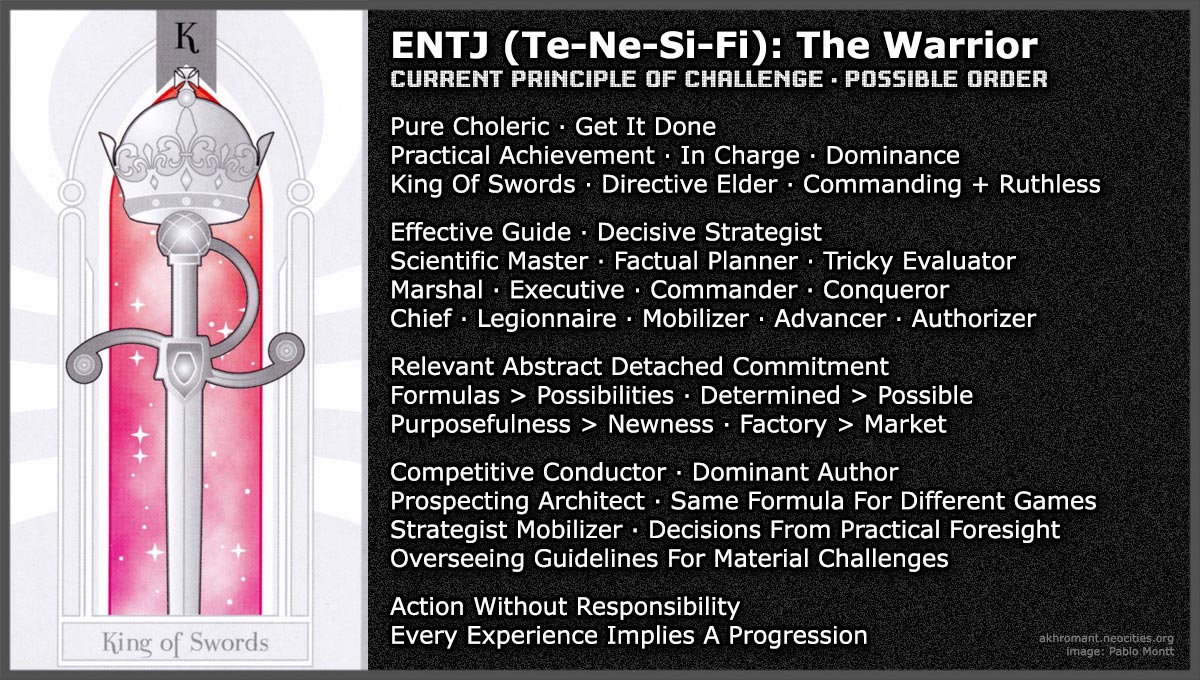
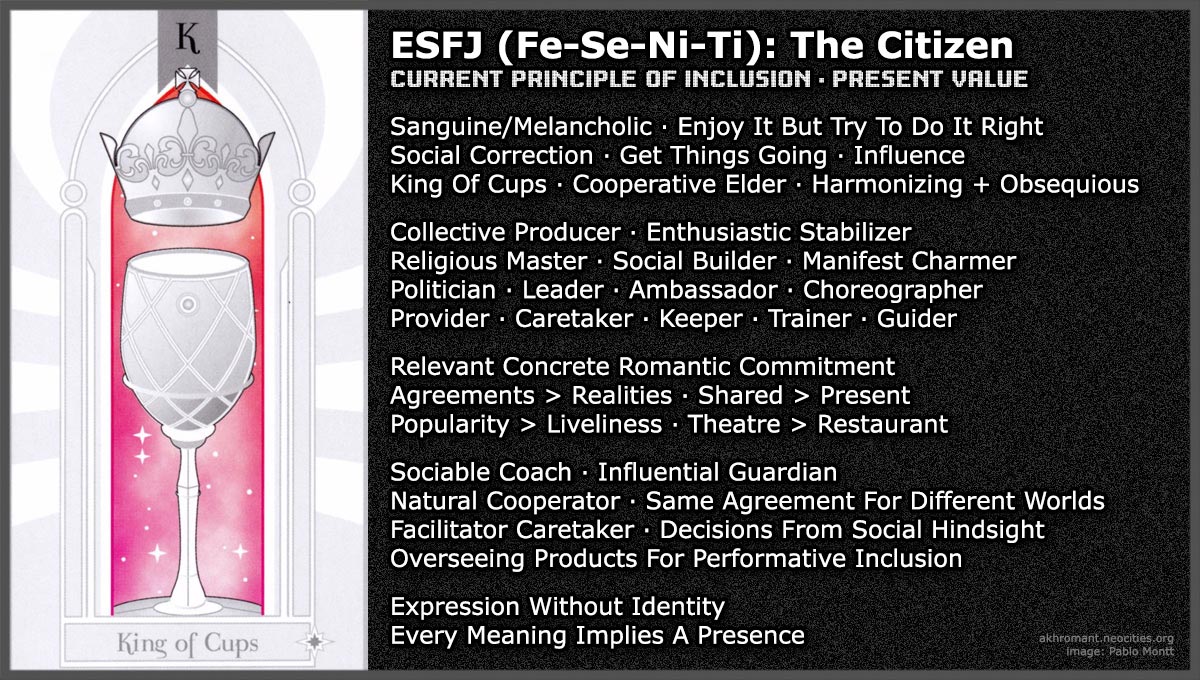

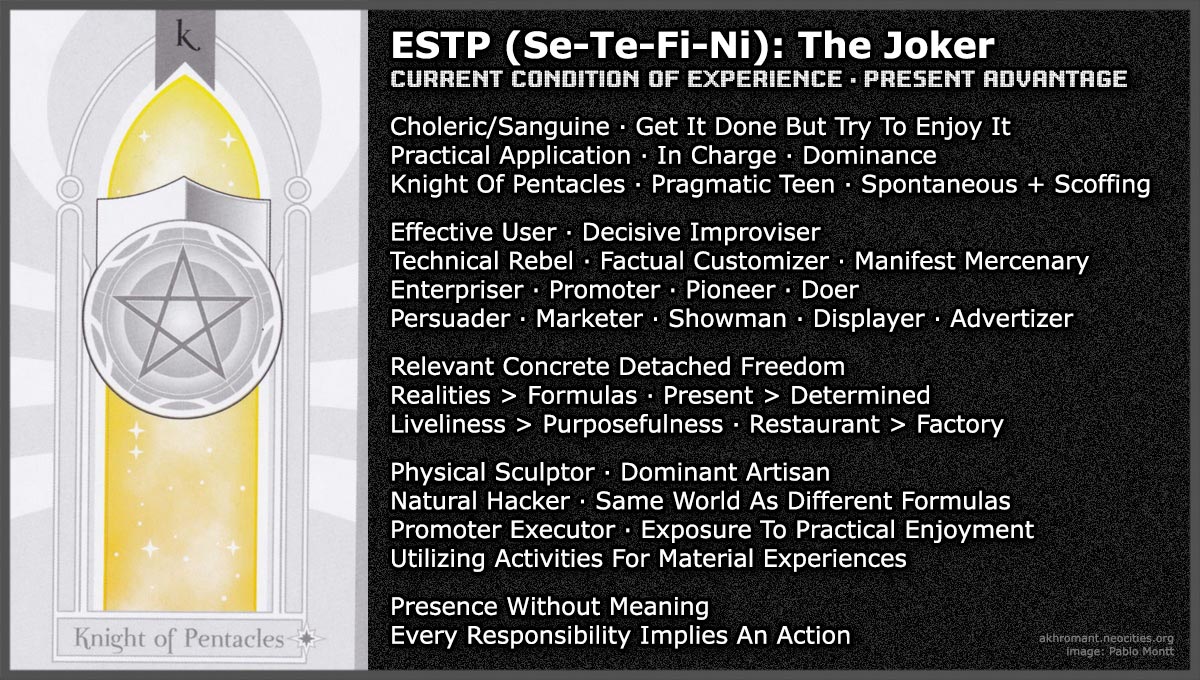

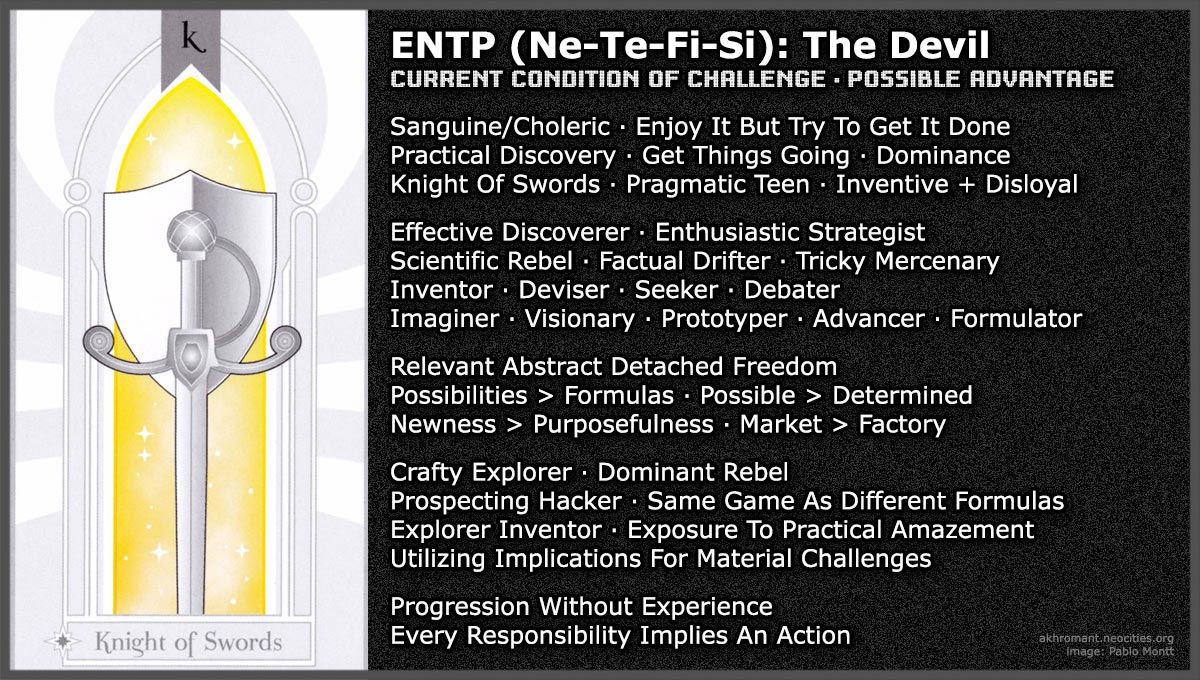


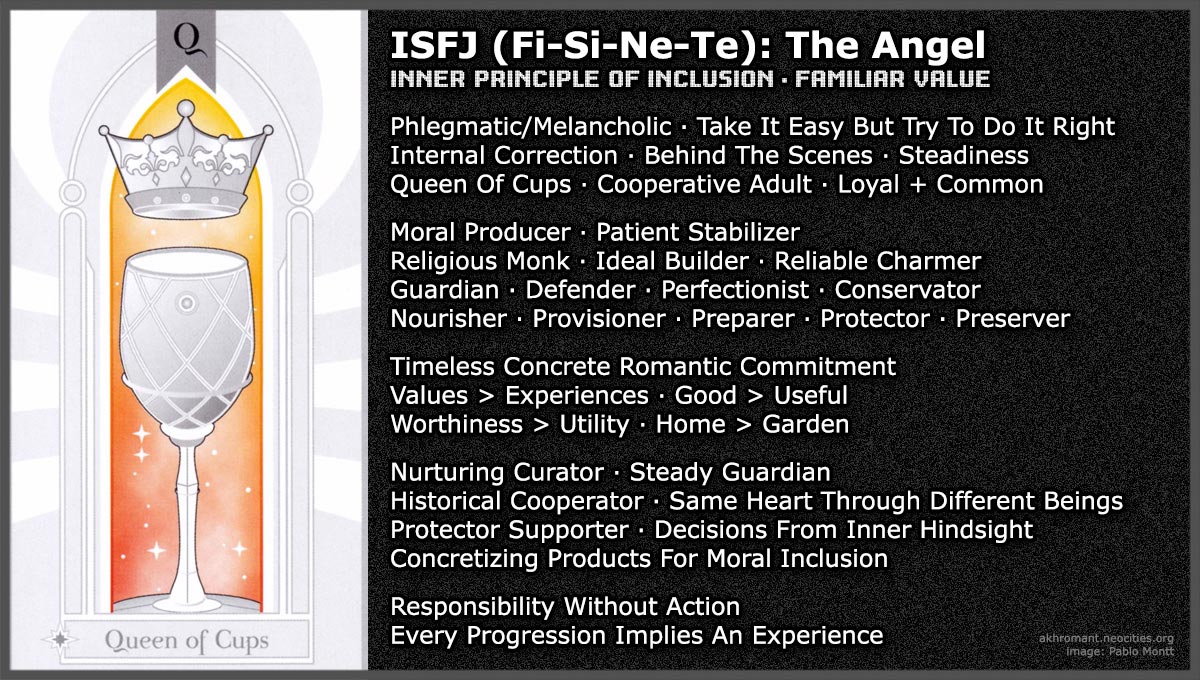
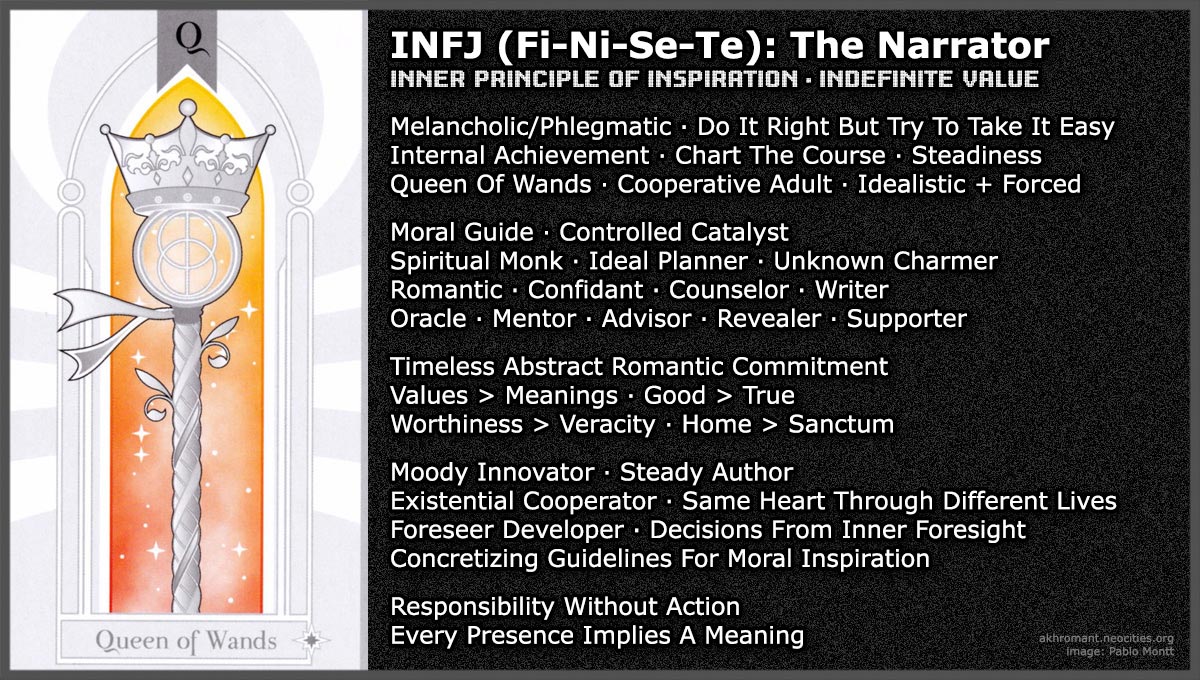


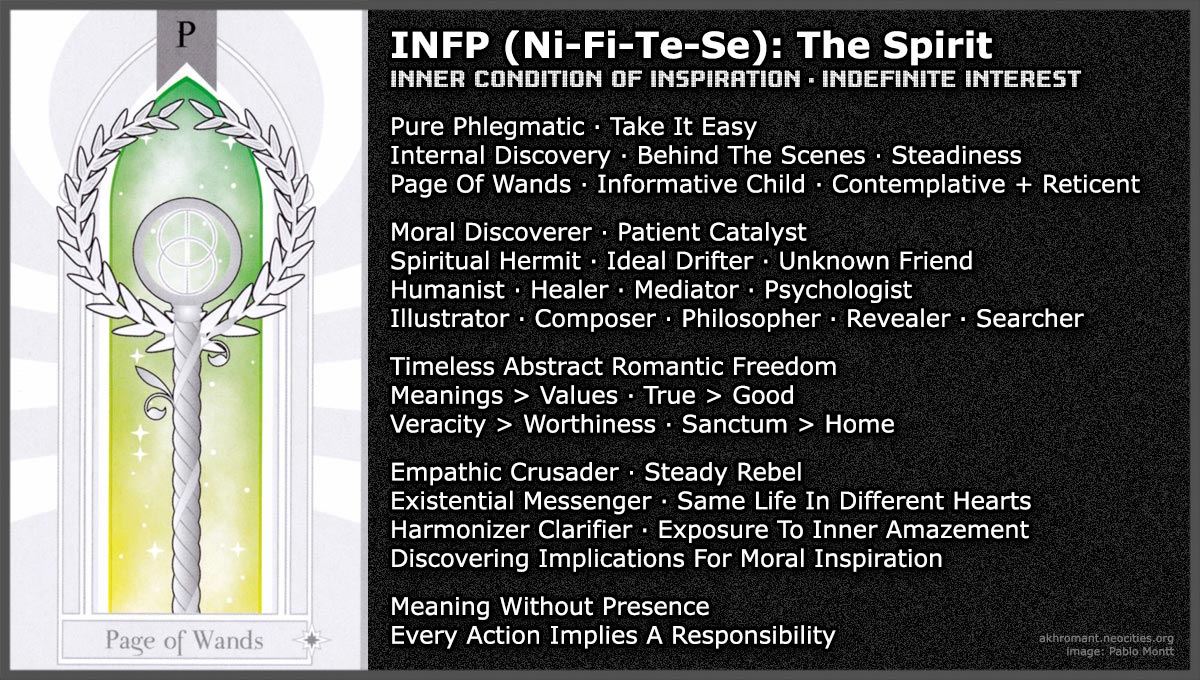
These cards include some important terms used in the blog. Most of the corresponding posts are somewhere in the MBTI Lists or the MBTI Tables. I've only added a few names for some types, and a disposition+soul-age combination. (You can also check post #143 for a general term compilation). The images come from the Essential Tarot by Pablo Montt.
Lots of people mistype others or are themselves mistyped as their Foreign type. Foreign types are those that only share their two middle letters: ST, SF, NT or NF. Going from one to the other the change is either EJ↔IP or EP↔IJ. The most common mistypes here are, as usual, from extravert to "introvert", especially EFJ→"IFP" and EFP→"IFJ", although there are also mistakes in the opposite direction (for example mistyping Nietzsche, a very clear INTP, as "ENTJ").
This particular mistype tendency is caused by the famous but false "eiei/ieie" order, together with the widespread misunderstanding (or ignorance) of what E/I and J/P really are. Some people are able to identify their true auxiliary and tertiary functions (X2+X3), and the general essence of their dominant function (T/F/S/N) but, following that incorrect order, they mistake the attitude (e/i) of their dominant and end up mistyping themselves (or others) as their Foreign type. And then for NTs and NFs there's also their common secondary temperament adding to the problem.
In comparison with the Puzzle, [some of] these mistypes might be harder to notice because, on top of the pair of shared letters, the two conscious essences are correct and in order, and the second and third functions are the same. For instance: ENFPs have Intuition first and then Feeling, just like the nonexistent "N+F" of the false "INFJs", then that Feeling is extraverted, the tertiary that goes with it is also the expected Ti, of course, and finally both types are NF.
I'm going to talk briefly about the most common. (Remember that this is only a specific tendency, there are mistypes in all directions). If you want examples of people to compare you can check the MBTI typings page.
1. "INFJs" WHO ARE ACTUALLY ENFPs (Ne-Fe-Ti-Si)
These are often people interested in psychology, human potential and relationships in general. They tend to have a rather enthusiastic attitude and a positive view of all types, together with a movement and/or an expressive ability that don't really match INFJs. This all adds to the auxiliary-Fe confusion. Many times they are some kind of performer or public speaker, and don't tend to have problems being active part in, or the center of, [various] groups of people. They can even be popular activists or politicians.
INFJs don't share ENFPs' optimism, and their whole manner is much more private and limited. They are controlled instead of excited, and in general the comparison between these types results in a cold vs warm contrast.
2. "ISFJs" WHO ARE ACTUALLY ESFPs (Se-Fe-Ti-Ni)
The "caring ISFJ mother/nurse" image, the one that worries a lot about the wellbeing of others and shows it right in the moment with all kinds of chores, foods, gifts, jokes and activities, fits ESFP much better than ISFJ. ISFJ can be service-oriented, too, but not in the overly open, accepting and extensive way of ESFPs. They are not as expressive or emotional, and their humor tends to be rather black (melancholic, not sanguine).
For ESFPs, taking care of people comes from their Se1. You have this quote from Jung, for example: "His love is unquestionably rooted in the physical attractions of its object. If normal, he is conspicuously well adjusted to reality. That is his ideal, and it even makes him considerate of others".
ESFP is the "normal" or "average person" stereotype (not in numbers but in general image), and that contributes to the confusion and the lack of resistance to the mistype.
3. "ISFPs" WHO ARE ACTUALLY ESFJs (Fe-Se-Ni-Ti)
This mistype is based on the unfortunately common misconception that many people have about Fe vs Fi being "distant vs dramatic", which is basically the opposite of the truth. It also contains the classic mistake of labeling feeling dominant types as "perceivers".
The "extravagant ISFP artist" image is actually about a certain ESFJ variant. That's the expressive type that's more likely to use theatricality and all kinds of striking sensory elements in public works and performances. ISFP (Si-Fi-Te-Ne) is a much calmer type, with a less show-oriented focus that doesn't tend to employ so many things or people, either. It's also someone that tends to shy away from being a clear center of attention, especially when there is a group of which they are only one of the members.
Some ESFJs who turn to their unconscious go through phases of feeling bad ("depressed") and "alone", and some even look for that on purpose, trying to reach their "true identity" (Ti4), as a way of compensating their over-identification with the group (Fe1). All this makes them think they are "introverts". If they have some artistic inclination and then read how ISFPs are often artists they probably mistype as one (or are mistyped by others).
4. "INFPs" WHO ARE ACTUALLY ENFJs (Fe-Ne-Si-Ti)
This mistype is the N-version of the previous one: it's also based on the common misconception that many people have about Fe vs Fi, on top of mistaking an F-dominant as a "P" type.
INFPs are not expressive or emotional, and they don't have ENFJs' drive/ambition, reach, intensity or capacity for anger. They are not charismatic group leaders or really good performers in general.
The "brooding, grandiose and potentially tragic INFP" image that many people have is actually about some ENFJs. Just like ESFJs, ENFJs can get into "down" "solitary" phases/modes when they focus on their unconscious, and that might look/feel like "introversion". The "imaginative" or "visionary" quality in this confusion comes mainly from ENFJs' Si3, combined with the fact that they are externally phlegmatic (NF). And the "brooding" or "intense" part is their primary choleric temperament, which INFPs simply don't have.
Both types can be artistic, but the differences in perspective, scale, topics, etc, should be quite evident. IPs are usually working on their own, while EJs are looking for/directing groups, studying or overseeing large projects, etc.
5. "INTJs" WHO ARE ACTUALLY ENTPs (Ne-Te-Fi-Si)
This is the T-version of the first point.
The more "intellectual" variants of ENTP might be one of the incorrect "INTJ" images that many people have. They probably see an enterprising person directing others and being quite clearly about getting things done, probably in a manner not like the traditional or familiar one (but "original" or "innovative"), and think that's an "INTJ".
INTJs are not enthusiastic, they don't necessarily look for newness, in fact they are often suspicious of that, usually more pessimistic about the future (gNe2) than optimistic. They don't rush into things, and don't tend to show themselves openly or easily. INTJs are very careful with their words and, just like I mentioned in point 2, their humor often has a melancholic tone (closer to the idea of "black humor", quite literally the concept originally associated with that temperament), not sanguine like ENTPs'.
ENTPs are the ones that don't mind frequent disorganization, chaos, risk, and gambling. They don't tend to bite their tongue, and can actually escalate tense situations [into dangerous or even violent ones].
 |
 |
 |
 |
 |
 |
 |
 |
 |
 |
 |
 |
 |
 |
 |
 |
This is just something funny that people do sometimes, but of course they always use the wrong order of functions, so all those jokes and t-shirts are actually wrong. The correct ones would be like the images above. You just have to imagine that flerovium's abbreviation is Fi instead of "Fl" 😅
Types #14X ← ✸ → Types #16X