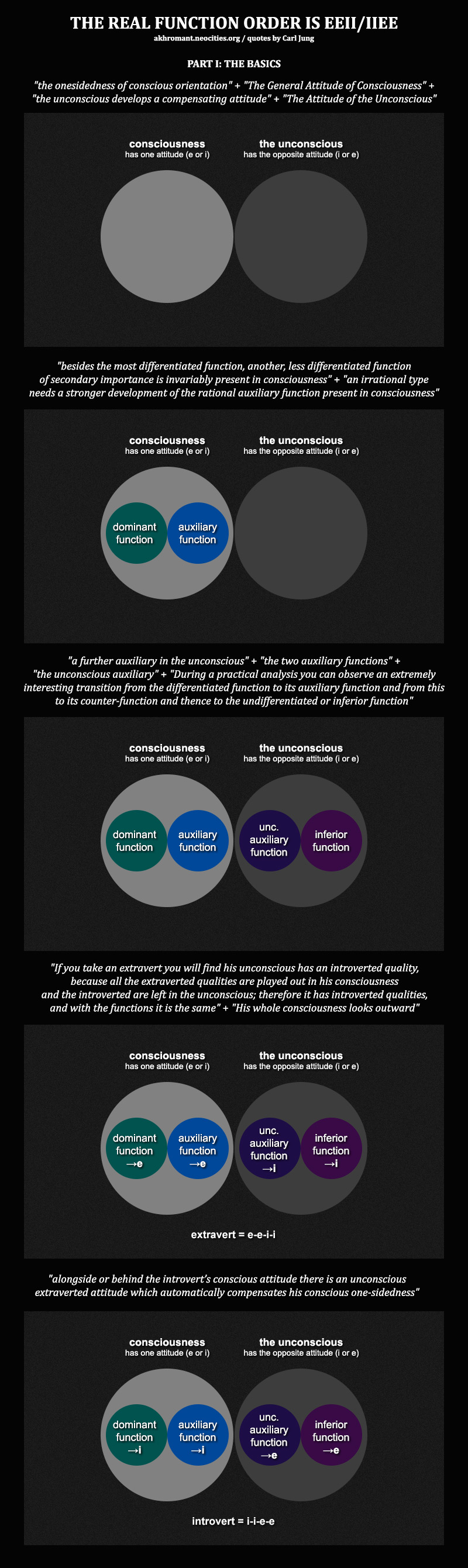
INDEX
ABOUT
FAQ
GLOSSARY
MBTI TYPINGS
MBTI RELATIONS
DISCORD
PHOTOS
STORIES
GENERAL
DIFFERENCES
TYPING
FUNCTIONS
TABLES
LISTS
WORKS
VARIOUS
NAMES
MORE
Types #16X ← ✸ → Types #18X
The first 10 fragments are in post #148.
11. The typology problem lies in the fabrications and the faulty readings and misunderstandings of the various sources, the psychological landscape and the individual psychology in itself. The global result is an absolute mess, with all kinds of errors, distortions and incongruences on all sides. The famous "eiei/ieie" is one of the main ones, of course, and that's something both MBTI and Socionics share. You have to remember that this is not about systems, and the only "should" here is about describing reality as it is. People have so many different definitions of things that one supposed "type" can actually include people from several real ones, or two "different types" can actually be about two variants of the same one (just to mention these possibilities). I know many people want to "salvage" things that they know from different "systems", but the problems here are too deep for that, you really need to start (basically) from scratch because it's the whole foundation that's wrong. The good/correct "building" is going to have doors and windows like the faulty/incorrect ones (for example: you're going to have type relations), but that's not an indication of how sound it is.
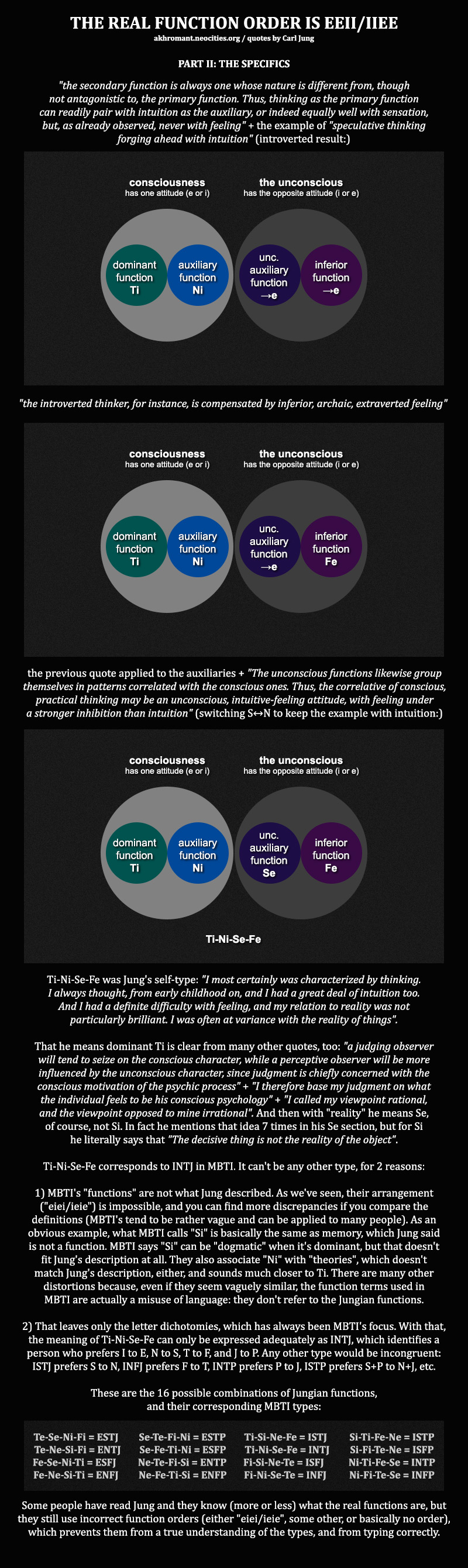
12. In case you need some eeii/iiee quotes from Jung, on top of all the times he says "attitude of consciousness" in singular (never "attitudes"), you have for example these: 1) "It is useful, however, to distinguish between conscious and unconscious, since the presence of two attitudes is extremely frequent, the one conscious and the other unconscious. Which means to say that the conscious has a preparedness of contents different from that of the unconscious". 2) "This automatic phenomenon is an essential cause of the onesidedness of conscious orientation". 3) "If you take an extravert you will find his unconscious has an introverted quality, because all the extraverted qualities are played out in his consciousness and the introverted are left in the unconscious; therefore it has introverted qualities, and with the functions it is the same". Combine that with "another, less differentiated function of secondary importance is invariably present in consciousness", and you arrive to e-e-i-i for extraverts and i-i-e-e for introverts.
13. Using specific names incorrectly is not "harmless". This is an excuse that some people invent to justify typology misconceptions that they don't want to solve. If everybody starts identifying as "X" the name X loses its meaning, and the same with the functions, types, etc. If everybody starts calling trees "rocks", the word rock loses its meaning. True human communication is already too much of a rare miracle, it doesn't need more meaningless words. If you are honestly interested in typology you should recognize the gravity and seriousness of the situation, learn about the true functions and types, use language correctly, and help others use it correctly, too. Because that situation is basically like finding out that almost all architects are building houses and skyscrapers with erroneous ideas/facts in mind.
14. Taking a supposedly "universal" (and quantifiable) idea of "intelligence" as the "superior" and basically only valuable human trait is a problem that adds to the many other problems in typology. Acting like that and not knowing what the real types actually are makes many people in "typology communities" think that only Ns are intelligent, and mistype anyone that they consider intelligent as an "N" type (usually "IN"). They don't know that there are people from all types in the top 2% IQ, for example. A lot of people use the types as characters (personas) to play and labels to present themselves as "intelligent", so in MBTI circles you won't find many Ss identifying as such, because the shared image would make them appear "inferior". That's an unfortunate thing that goes against self-knowledge and turns typology into the opposite of what it should be.
15. Some people keep obsessing over the difference between "functions" and "types", as if it was something crucial that somehow "changes everything". News flash: it's all the same thing. You can lose yourself in all kinds of concepts and abstractions, but in practice there's no difference between functions and types. Both mean the same: you can't have functions without types, or types without functions. Insisting on that point only complicates things, and Jung's work doesn't need more of that (quite the contrary). That kind of over-distinction actually ends up being just an attempt at sounding clever, perhaps with the idea of writing "like Jung". But it's meaningless. You have a dominant function, and that's your main type (Ti1→ITJ, for example). Done. The number of functions is not the cause of all the problems. The cause is that people don't understand what they are. I explained the 4 basic essences years ago, and how they exist as fundamental psychic coordinates, but then you have to work with the resulting 8 because that's what you find in people. In the real world, which is the consciousness of humans, each of those 4 functions acquires an introverted or extraverted character because that's what consciousness does: it focuses on one side only. The other side goes to the unconscious. This is Typology 101.
16. As I've said before, I don't like tests at all, but if someone makes an MBTI test that's correctly designed, people with a judging dominant get J, and people with a perceiving one get P (this wasn't the case with the "official" one in the beginning, but they fixed it later). That's how everything fits and how things make sense. If the test deviates from that then it's time to redesign it, because a test is like any other instrument that needs calibration. A manifestation of this is how MBTI's Judging is related to conscientiousness. That's there because all 8 Judgers have a judging dominant, and that can be Te, Fe, Ti or Fi. Js are more conscientious because Sensation is always an auxiliary function for them (either conscious or unconscious). It's always conditioned by something else, not free or independent, so it's much more difficult (probably impossible) to find a Judger who ignores physical order/use/purpose to the level that Ps can. It doesn't matter what kind of values or rules they have as Js. Whatever they are, they are judgments, and apply to sensation, so they are, by definition, more conscientious than Ps.
17. As an alternate take on the E/I dichotomy, you can think about this. Extraverted content combines two factors: 1) It's located in and/or references space/time (the time can be a second but also millions of years). And 2) It can be experienced by any number of people as essentially the same thing. Introverted content lacks at least one of the two factors. If the element in question is located somewhere in space/time, then it isn't experienced by anyone but the subject. If many people can reach it then it doesn't depend on space/time. And it might lack both.
18. The problem with some of Jung's explanations is that actual archetypes are not images. They don't have a visual component, shape or form, and they are not perceived by sensation, but by intuition. Sensation might perceive a representation of an archetype, but not the archetype itself. He mixes that because he tends to talk about Ni in terms of gSi. He even admits that "my definition of intuition is somewhat makeshift, and in fact a declaration of scientific bankruptcy". Sometimes he gives signs of the true archetypes, though. For example: "inner processes" whose "innermost nature is inaccessible to experience", "The archetype is a tendency to form such representations of a motif" (the tendency, not the representation), "The forms of archetypes are to a considerable extent exchangeable", the archetypes "represent the laws governing the course of all experienceable things" (laws are not images), the archetype is "the noumenon of the image" (not the image), etc. There's also his mention of "the inner and eternal meaning of events" in the description of Ni1 (INPs), and this quote: "in order to determine the meaning of an object, space-time relationships are necessary. It is the fourth faculty of consciousness, intuition, which makes possible, at least approximately, the determination of space-time relationships".
19. Imagination is not intuition (it's not a function). When Jung uses the word "image" in relation to Ni he's talking about ghostly Si and trying to explain it that way because gSi always accompanies proper Ni at its same level, even though it's not the same thing (remember the previous quotes about meaning, how he had problems identifying his own X2, and how he also mentions "image" in relation to thinking and feeling). In fact, the difference between sensation and intuition is much easier than most people make it seem: if something has a form, shape, color, sound, smell, texture, temperature, length, duration, weight or any graphical/physical dimension/quality, then it's an element of sensation, not intuition (other aspects of the thing come through other functions). Anything that has a positive presence, either objective or subjective (like visions and dreams) is obviously perceived through sensation, not intuition. It can't be any other way. It seems this is something too basic/true for some people to understand (some of them might be mistyped "INs" who are actually Ss, but others are simply confused and unaware of how their own mind works). The elements of intuition don't have a presence. If it's present in any way, then it's not about intuition. Intuition is literally the opposite of presence. Again, Typology 101.
20. The X4(G1) total eclipse ("X4 is the only G1", from point 4 in post #24) could be seen as something like this: imagine you go to the store to buy apples (G1), but you get there and there are no apples, just oranges (X4). You either buy the oranges or come back home empty-handed. If you take some oranges and then someone asks you what happened you'd say "oranges were the only apples".
21. Individuation is not "doing what you want". It's getting to your own perception and judgment about everything, and that includes removing any contamination coming from the unconscious or from other people (your parents, friends, fashion, society, etc). Your ideas, memories and reactions about particular things might be mixed with or even replaced by the evaluations and ideas of others, and part of the process here is to erase/clean all of that and basically have ([re]gain/redeem) your own mind, your own psychology, your own soul. At the same time, Jung also wrote: "the process of individuation must lead to more intense and broader collective relationships and not to isolation". "Individuation is always to some extent opposed to collective norms", but "the individual standpoint is not antagonistic to it, but only differently oriented". In function terms, individuation is "an extension of the sphere of consciousness".
If you see a group of people pointing at trees and saying "that's a rock", you obviously don't repeat their mistake, but you also don't throw up your hands in frustration and invent two new words, one for rock and another for tree. You might think that second option is clever, but it's actually stupid, and it only helps the destruction of meaning and language. What you do is you use the word rock to describe rocks, and the word tree for trees. It's very easy. You don't make concessions, excuses or translations, you just call rocks rocks and trees trees.
It's the same with typology. Extraversion (E), Introversion (I), Sensation (S), Intuition (N), Thinking (T), Feeling (F), Judging (J), Perceiving (P), Extraverted Thinking (Te), Extraverted Feeling (Fe), Extraverted Sensation (S), Extraverted Intuition (Ne), Introverted Thinking (Ti), Introverted Feeling (Fi), Introverted Sensation (Si) and Introverted Intuition (Ni) are not only words but real things, like rocks and trees. So there's one correct way of calling them, and many incorrect ones. This is the correct one:
ESTJ = Te-Se-Ni-Fi
ENTJ = Te-Ne-Si-Fi
ESFJ = Fe-Se-Ni-Ti
ENFJ = Fe-Ne-Si-Ti
ESTP = Se-Te-Fi-Ni
ESFP = Se-Fe-Ti-Ni
ENTP = Ne-Te-Fi-Si
ENFP = Ne-Fe-Ti-Si
ISTJ = Ti-Si-Ne-Fe
INTJ = Ti-Ni-Se-Fe
ISFJ = Fi-Si-Ne-Te
INFJ = Fi-Ni-Se-Te
ISTP = Si-Ti-Fe-Ne
ISFP = Si-Fi-Te-Ne
INTP = Ni-Ti-Fe-Se
INFP = Ni-Fi-Te-Se
If you write anything other than that, you are using the words incorrectly. If you rearrange it with the nonexistent "eiei/ieie" order (for example) you are using them incorrectly. If you use anything other than the four letters INTJ for Ti-Ni-Se-Fe you are using them incorrectly, too (this includes needless, misleading and short-sighted variations like "INTj", "INTX", "Ti-n" or "IT(N)"). Etc, etc. Consciousness is one-sided, so both dominant and auxiliary are in the same attitude (e-e/i-i). The unconscious has the other attitude. People with dominant Ti or Fi are Judgers, because they share traits with the people who have dominant Te or Fe. Those traits are what Judging (J) means. The people who are not Judgers are Perceivers (P). The same happens with E/I, S/N and T/F.
Those terms come from Jung's writings and MBTI dichotomies, so that's something you need to understand first, of course. (Some related posts: post #13, post #154, post #150 and post #58). You don't have to invent any weird way of naming the types, you just have to use the letters and functions correctly. The 16 types are like chemical elements, they are always there and they have a fixed "composition". You don't need to rename oxygen or gold with some "ingenious" terminology, you just have to understand what oxygen and gold actually are, what they are made of, etc.
Oxygen is a thing, not an invention. Gold is a thing, not some imaginary concept. The 16 psychological types, with their correct letters and functions, are the same. Some things are Ne, and others aren't. And every letter stands for something.
The four letter dichotomies are needed and extremely important because they carry very useful information. This is about correcting what people are doing wrong, and they are using the letters and the functions wrong. So we have to write ISFJ (Fi-Si-Ne-Te) every time, because an Fi1 is a judging type, not a perceiving one, Ne can't be the auxiliary of Fi, etc. It might be almost impossible, but getting people to use J/P and the other terms correctly is actually easier than getting them to not use them at all.
This is not "MBTI vs Jung", there is a way of coming from Jung and using/adding MBTI stuff accurately (and other angles like temperament, court cards, etc). It's not about any "orthodoxy", either. We are simply describing what is there, in reality. This is about what's real, and about making communication a little less meaningless. We don't need to talk about anything, but the thing is that words can be helpful and useful, they can be meaningful if they are used correctly, and people aren't doing that. The terms are twisted and falsified and that only brings confusion and problems. It keeps people ignorant and mistaken about themselves and others, and goes definitely against building any kind of shared knowledge about the mind.
Some people talk about "discoveries" here. But you don't discover that oxygen has anything other than 8 protons. You can't. If you find an element with 9 protons then you're looking at fluorine, not oxygen. You can't find that the atomic nucleus is made of electrons, either. There are things to discover about the types, but that's something you add to their name and basic structure. If you see 9 protons you don't rename fluorine "oxygen" and make both words (and everything else) meaningless.
The difference is of course that many people can't see the typological equivalent to protons or electrons. And some of those have personal/monetary interests in keeping others in the dark about that (and the reality of types), leading them to follow their shiny new "system". It's as if oxygen or gold were just abstract ideas that you could "find" or "put" anywhere you wanted. Gold is a particularly appropriate analogy here, because on top of all the other problems and distortions many people also have in mind hierarchies of what they consider "types" and "functions", and they actually look at typology like someone who thinks gold is "better" than oxygen. Yeah, good luck with that.
So maybe you have been using those words incorrectly, for years now. What keeps you from using them right? Well, if you are reading this I'll assume you already know about the blog, so it's not lack of information. Instead, it's mostly an inability to see what this is really about (not just the psychological facts, how the mind works, but also the seriousness of the matter, which is not a simple question of nomenclature), often mixed with and worsened by inexperience and bad habits (some things in post #166 are related to this). Two common obstacles would be:
1) The "systems" perspective. You basically think all of those are valid. You don't mind that "ISTP" or "Ti" means one thing in "system A" and another thing in "system B". In fact you probably like the mental gymnastics and how "smart" and "complex" you sound when you explain that to the newbies. You might even think that there is no real/objective function order, or Ti, or J/P, or whatever ("INFJ" is just a way of saying "Ni"+"Fe"+"Ti"+"Se", right? The letters don't mean anything). So it's basically a mental buffet, it's just the concepts and what different people do with them. Well, it isn't.
2) The extent of the misconceptions. There are lots of books, organizations and websites based on them, so you think they must be doing something right, and/or you don't want to be excluded from the "community". Your interest in all this is not strong enough to counter all that. And you are not the only one, many other people are calling oxygen "gold", so you think it's not a big deal. Well, it is. You just don't know what you're doing. But you might, someday.
Judging/Perceiving is tricky because it's been muddled since the beginning, and people don't know how to think about it or look for it or distinguish it. But it's actually a consequence of the dominant function so, if you identify that, it's just automatic. And when you actually get it you can see it and check it from different angles. One of those is the 4 ages of the mind.
Jung wrote that "Thinking and feeling as independent functions are developed, both ontogenetically and phylogenetically, from sensation (and equally, of course, from intuition as the necessary counterpart of sensation)". He's saying that both the species and the individual evolution begins with the perceiving functions and then develops the judging ones. This matches the "soul ages" of the types perfectly, of course (which are reflected in their corresponding court cards), and also Jung's summaries of the four groups. The Children (IPs) remain in the first "phase": introverted perception (Si1 or Ni1), the Teens (EPs) stay in the second one: extraverted perception (Se1 or Ne1), the Adults (IJs) go through a sort of "judgment mutation" where introverted judgment (Ti1 or Fi1) "jumps over" perception and becomes dominant, and the Elders (EJs) are those who go through the same mutation but with extraverted judgment (Te1 or Fe1). That "J-mutation" might be already intrinsic to the Judging person since before birth, or occur sometime in early childhood, although I tend to think it's someting inborn (like type).
So we have of course the fact that P is younger and J is older. Perceivers have a harder time reaching a balancing judgment in their lives (following standards or routines, "growing up", or "settling down", for example), and Judgers have the same issue with perception (often related to efforts/methods towards "relaxing", "being in the moment", "going with the flow", etc). This is something very characteristic and can be very helpful for typing, but you have to be careful because for example many EFJs, especially ESFJs, consider themselves (and might appear) "childlike", and some IPs can give an "adult" impression. The first case comes mainly from inferior Ti, which can manifest as a sort of "infantile identity" (part of the reason for many "NFP" mistypes), and the second one is related to IPs' "harsh manner" (which can lead to "IJ" or even "EJ" mistypes). There's also the "childish or banal mask" of some IFJs, which would be related to gTi4. These are just superficial appearances, and they are only a problem if the analysis is shallow.
So, yeah, J/P is an extremely meaningful and revealing difference. Some people are quite oblivious to this, like they are to many other psychological facts, and sometimes they even discard it entirely. They don't know the depth at which it operates, partly because the false "eiei/ieie" order makes it look like a totally inconsistent factor, one that applies differently to extraverts and introverts, reflecting a complete lack of understanding of the dominant>auxiliary unbalanced interrelation (I talked about this in post #25). When you realize how functions and letters actually match, everything makes sense.
The dominant function (X1) is dominant because it begins its differentiation before the others, and the auxiliary (X2) can't "catch up" because there's an asymmetric link that's established between them (crystallizing as X1>X2) and, just like father>son (or mother>daughter, all of this in post #163), it's irreversible and permanent. There's a specific "moment" or "window" where the "J-mutation" might take place, but after that (which can be as early as conception), whether it happens or not, it stays that way. (See also post #154).
Saying that J/P is unimportant or just a "continuum" is like saying that dom>aux isn't fixed/real, or that you can be Fi1 and a "P", which is what Myers said and what created a huge part of the disastrous mess that's typology today. J/P is a dichotomy, and it's very simple: you either have a judging dominant or a perceiving one, there's no gradient there except for things like the MBTI facets, for example. In that sense, a person can change in time because they are P but they find a way to get more organized, etc. But that doesn't change their functions or their type.
You can think about your type basically like your blood group: it's a very general thing that you share with many people, you are born with it, it doesn't change (although many things can change inside it), and you can't be "mildly" AB (for example), you either are AB or you aren't. What you can say is that some people are more/less extreme or marked examples of their type than others, because they are (for example) "markedly I + markedly S + markedly F + markedly J". Some ISFJs might be just "markedly I + markedly S + moderately F + moderately J", etc, but all of them are I, S, F, J, and Fi-Si-Ne-Te.
I'll try to put here all the main facts that people need to understand about this issue. Some important related posts are: post #13, post #25 and post #154.
1. Jung never says that consciousness can have several attitudes, only one. He always talks about the attitude of consciousness and the compensatory attitude of the unconscious, in singular, not plural. In a sense, that's literally the whole point of his book.
2. An example quote: "It is useful, however, to distinguish between conscious and unconscious, since the presence of two attitudes is extremely frequent, the one conscious and the other unconscious. Which means to say that the conscious has a preparedness of contents different from that of the unconscious".
3. Another one: "This automatic phenomenon is an essential cause of the onesidedness of conscious orientation".
4. More (talking about the extraverted type): "His whole consciousness looks outward".
5. And of course: "If you take an extravert you will find his unconscious has an introverted quality, because all the extraverted qualities are played out in his consciousness and the introverted are left in the unconscious; therefore it has introverted qualities, and with the functions it is the same". (Notice that he says "ALL").
6. Jung wrote that the auxiliary is "invariably present in consciousness". If you combine this with the previous quote, you get eeii/iiee. It's that simple.
7. There's a typo in the English translation of Chapter X, in the 4th paragraph of the section "d. The Principal and Auxiliary Functions", where the book says "relatively unconscious", but Jung's original was relativ bewusste = "relatively conscious" (the unconscious part is G2). This error was given disproportionate weight by some authors, who also ignored the most important points that Jung tries to make in the book, underlined by the quotes that I'm copying here.
8. Elsewhere he also talks about "a further auxiliary in the unconscious" which, combined with the quotes above (especially #5), results again in eeii/iiee.
9. There's also his typing of Nietzsche, which confirms all this: in early chapters he says he's Ni-dom ("In both cases, however, intuition was subordinated to intellect, but with Nietzsche it ranked above it"), and then he mentions him at the beginning of the introverted thinker ("Cuvier and Nietzsche would form an even sharper contrast"), which means he typed him as Ni-Ti-Fe-Se = INTP.
10. You have Jung's own self-typing on video, too, where he states he has T+N as conscious functions and F+"reality" as unconscious, "reality" being the word that he most often uses to refer to Se (not Si), which implies his N is Ni (not Ne), which implies his functions are Ti-Ni-Se-Fe (INTJ). We know he was a rational type because a) Thinking is the first function that he mentions, and when he adds intuition it's quite evident that he's talking about an auxiliary, and b) in Psychological Types he takes consciousness as the standpoint for analysis and description, and says that an irrational type would focus more on the unconscious.
11. Apart from Jung, you also have Carl Alfred Meier's statement in his book Personality: "Cooperation with the main function is made easier because of thinking's similar attitude (extroversion)", which confirms eeii/iiee. (Meier knew and worked with Jung).
12. Extraversion can't be the auxiliary of introversion, or vice versa. That's not how the mind works. The E/I compensation occurs between conscious and unconscious, that's precisely one of the main points in Jung's work, and at this point it should be sufficiently clear to anybody with an average intelligence.
I've seen people so close-minded, confused, deluded or malicious that they keep ignoring or outright deny the quotes that I've put here, they keep looking for vague ones and try to reject eeii/iiee in a very strange and stubborn manner, as if they had a personal interest in not acknowledging it, in debating but never getting anywhere, or in the way the false "eiei/ieie" order gives them "expertise", "authority", money, fame or whatever. Well, as I've said before: If you use the "eiei/ieie" order (even with nonsensical things like "loops" or "jumpers"), or "eiii/ieee" or "eeei/iiie" or "e?/i?", you don't know how the mind is arranged, you don't know what the real functions are, and you are not Jungian. You can use eeii/iiee and still do things incorrectly, of course (for example with mistaken function definitions), but that would be a different issue.
REVIEW IMAGES WITH QUOTES AND DIAGRAM
Socionics is just one of those "systems" that pretend to be but are not really Jungian. They are all basically doing their own thing and misusing Jung's terms to sound "interesting" and "deep", and to capitalize on the popularity of those words. I read some Socionics stuff years ago, but I'm not interested in it (or in any other "system", of course). This is just a post (without too much detail) to show what a disaster it is, because I've just checked a few more things and man, it's worse than I remembered.
1. There are many people writing as "socionists", so already from the beginning it's hard to determine what "Socionics" actually is, because they aren't a monolithic block, so in a sense it's basically like there are as many Socionics as socionists. The official MBTI has its problems, too, but I think they are much more consistent, and they have statistics that show they are doing something right.
2. To remedy the previous problem we are going to look at the most common and famous concepts and ideas in Socionics. And the first thing we find is that both in Wikisocion ("a site for the whole Socionics community") and socionics.com they use the nonexistent "eiei/ieie" order, so even if they present themselves as "Jungian" they obviously aren't, and they don't know how the mind is arranged. Some would say that in their fancy new "Model G" (Gulenko's) they use eeii/iiee, but they obviously don't. They still pretty much use eiei/ieie or, at best, a weird invented eeee/iiii that's also very incorrect.
3. Socionics doesn't know how conscious/unconscious works, or how the functions interact with each other. They definitely ignore some very important things that Jung explained repeatedly. They don't know about the dominant>auxiliary dependency, or about the tension between the dominant and the inferior, and instead they take the function locations basically as independent, when they aren't. In their supposedly "improved" "model G" they make some inconsistent interrelations (Te in 1 goes with Ti in 8, ok, but then Ne in 2 doesn't go with Ni in 7, because reasons), and they think the functions have more↔less energy independently of e/i, that is: they think both the 4 e's and the 4 i's go from maximum to minimum energy, following that inconsistent order. Anyway, that's not how the functions work, at all.
4. They think "Te" has something to do with finances, which is a really strange mistake. (For points 4-10 I'm looking at Gulenko's descriptions. He, just like every other "system author", should definitely stop using the dichotomies and the function acronyms and just go with his new letters or whatever).
5. They think "Fi" has something to do with "traditions" and "stereotypes", which is just wrong. A tradition (and probably what they mean by "stereotype") is something externally shared, so by definition it has to be extraverted (either Fe or Te).
6. They think "Se" has something to do with "force", "coercion", "confidence", and other totally incorrect ideas.
7. They think "Ni" is related to imagination and memory (which aren't functions in the first place), and they confuse it too much with time and "predictions" (bringing it quite close to MBTI's own misconception: "Ni" as NJ-traits).
8. They think "Ne" has something to do with hypotheses, which is basically a reference to Ti.
9. They think "Si" is the only sensation that's about the senses, which of course was expected given that they don't understand what Se is.
10. They also have incorrect ideas included in "Ti" and "Fe". So, as I've said many times, they don't know what the real functions are.
11. They don't really know the actual origin of certain traits that they assign to some functions, or how a certain function in a certain type might have totally different manifestations from the ones they mention. (Part of this is understandable because all the functions are there at all times, so it might be hard to pinpoint everything, but part of it is a consequence of the previous problems, which are huge).
12. On top of all that, Gulenko associates each function with a system or part of the body. That's just... crazy, but fits quite well someone who's ISTJ (Ti-Si-Ne-Fe), and reminds me of James Joyce (also ISTJ).
13. Socionics in general keeps mixing the types, making their letters quite inconsistent. They have had the ESFs and the INFs switched since forever, together with their classic ESTP↔ENTJ, and now there's a collection of type descriptions that's better but still has the INFs wrong (although I don't know how "official" that text is).
14. They used names of famous people to name the types but almost none of those people is really of that type. And they named their "quadras" with the first four letters of the Greek alphabet, when the idea of the four groups of 4 is that they are the entire typology, so it's really weird that they used something that can keep going (with the next letters).
15. They name the type relations in very limited, crude and insulting ways, not leaving room for discoveries or actual understanding, and also basically imagining psychological masters and slaves. And because their types are wrong, their relations are wrong, too: an absolute chaos that doesn't reflect the real ones.
16. They pay attention to physical appearances, ignoring that identical twins can have different psychological types.
17. From a broad perspective, they take the types basically as if they were a set of characters in a world like Game Of Thrones (George R. R. Martin is also ISTJ), making hierarchies of "better/worse", pitting groups of types against each other, etc.
So, yeah. If you want to be wrong about everything related to the psychic functions and Jungian typology, and/or if you want to treat people as slaves or pawns in some kind of imagined war, go study Socionics.
Unless this is the first post that you read here, you probably know about all this already.
1. FORGET ABOUT TESTS
One of the main misconceptions that you find when you start reading about MBTI types is that you need to take a "personality test" or a "function test".
Well, this is not about "personalities", and it's not about "tests". It's about the human psyche, which includes everything in our mind (not just your "train of thought", for example). The range and depth of psychological type is the entire mind, but this is something that many people don't get. Jung said: "I always think of psychology as encompassing the whole of the psyche, and that includes philosophy and theology and many other things besides. For underlying all philosophies and all religions are the facts of the human soul, which may ultimately be the arbiters of truth and error".
So-called "function tests" don't know what the functions actually are, they don't know about the fundamental conscious/unconscious difference, and they don't know how the functions depend on or interact with each other. The functions don't exist "in a vacuum", they are not independent from each other but arrange themselves in a definite way that implies asymmetry and dependency. That's precisely one of the most important facts that determine what a type is: the different locations, interactions and transferences between its functions.
People love making it all like a construction set, they seem to think the mind is like Lego, with individual pieces that you can put wherever you want, but the mind has "rules", it's not a blank slate where you can build whatever you want, there are definite conditions and relationships that are always in effect.
All those "function tests", apart from being based on incorrect and distorted definitions (often coming from the famous but nonsensical "eiei/ieie" order), pretend to "measure" functions one by one, as if checking their "isolated strength" or "weight", and then present them in that order, whatever it ends up being, completely disregarding the fact that there is an order that depends on consciousness and the unconscious (eeii/iiee), which doesn't necessarily follow a gradual "reduction of strength", partly because some people can be focused on their unconscious because they are too young, or as a sort of "compensation" later in life, etc. (The actual gradient is in point 4 of post #140). Then you are supposed to determine what type corresponds to that random and meaningless combination of "functions" (and you see "typologists" doing all kinds of weird acrobatics to justify their "conclusions", of course).
So, yeah, tests are completely unreliable. Not only because they are always based on some kind of misconception, but also because (even if you could make a relatively "good" one, like the official one is supposed to be) there's very often the problem of language ([unintentional] misunderstanding of concepts), and the fact that many people type their state or their persona, how they feel, the image that they have about themselves, how they want to be seen, etc, or they enter distorted mindsets when answering the questions. (That's also why the result might change from one day to the next, and people get confused and start thinking that their type has changed, too).
Another quote by Jung: "anyone who has probed more deeply into the nature of psychology, demanding something more of it than science in the wretchedly prescribed limits of a natural science method is able to yield, will also have realized that an experimental method will never succeed in doing justice to the nature of the human soul, nor will it ever trace even an approximately faithful picture of the complicated psychic phenomena".
2. FORGET ABOUT SYSTEMS
Type is not about "systems" because it's about describing reality, so there aren't "different alternatives" because reality is not your interpretation of it. It just is, and it's one way or another, not several ways at the same time or an "indefinite" way. You know what fog is, right? Well, just because in a foggy day you can't see something clearly in the distance doesn't mean it's not a particular and defined thing that's there and it's not another thing. So there is a correct way of describing it, and many incorrect ones. If you don't know the correct one you don't invent it, you just say "I don't know", and perhaps try to get closer so that you can see it better. It's very simple. People just want to complicate it to sound "smart".
An example: people on PDB aren't using a "different typing system", they are simply doing it wrong. On top of the fundamental "consensus" mistake (something that goes against what I've just mentioned about reality, which doesn't depend on agreement), they use the nonexistent "eiei/ieie" order, which makes their "functions" automatically incorrect (their "Ne" is not the real Ne, etc). The 16 types are like 16 chemical elements, and they form one periodic table, not two or three. Even if we ignore everything about the functions, many times people on PDB (and many other places) don't use the letters correctly, either, because they still mistype lots of people, for example all those "INTPs" who are actually ENFPs, etc. Other "systems" (like Socionics) do similar things, pretending to be "Jungian", but they don't understand how the mind works, either. They just misuse Jung's words.
3. FORGET ABOUT EXPLANATIONS FOR 5 YEAR-OLDS
Some people who are new to typology like to say "please explain this so that a five year-old would understand". News flash: a five year-old can't understand these things, and you probably need to be at least 20+ to start getting some of this as it really is. That's one of the big problems in typology, of course: most of the people interested (teenagers) are too young to understand it. And it's not an easy topic at all, so maybe it's not for everybody.
4. FORGET ABOUT TYPING SHORTCUTS
The desire for easiness makes some people look for shortcuts to type people, but that's a mistake. They want something to do it very quickly (and tend to take descriptions in a very black&white way), but that's classification, not typing, and it only leads to lots of mistypes. True typing needs a view of the whole person, their whole mind, their interaction with and effect in the world, etc, and that requires attention and time (a correct typing might take months or even years), it requires checking various angles and levels, it requires consideration of particular circumstances, and a lot of care.
People are literally typing others by their pictures, by their playlists, by photos of their rooms, by the memes they have on their phones, by the food they eat, by their tier lists of types (an absolute horror in itself that shows they don't know the first thing about typology), and even if they say it's "just for fun" the problem is still there: you are getting used to classifying people through the most superficial things and thinking you've found something deeply psychological about them. It's an absolute disaster.
Some people seem to think that you can/should type only by actions and behavior, but that's also wrong. In fact, Jung warned against this, which can be very misleading, when talking about the EJs: "This observer could easily arrive at a contrary judgment, especially if he intuitively apprehended merely the outward behaviour of the person observed and judged accordingly. {...} If observation is restricted to outward behaviour, without any concern for the internal economy of the individual's consciousness, one may get an even stronger impression of the irrational and fortuitous nature of certain unconscious manifestations than of the reasonableness of his conscious intentions and motivations". If you only look at actions/behavior you are not really looking at the inside of the person, and you can have 2 people from different types doing exactly the same thing for totally different reasons.
5. FORGET ABOUT PRODUCT SPECIFICATIONS
Instead of the easy variant, some people want the kind of detailed, lengthy and specific descriptions that others make out there, which sound complicated enough to confuse readers but are wrong because they don't really know what they are talking about, they want to turn the functions into certain things instead of really going to Jung's book and understanding what he was trying to describe, which are very general things that cover a very wide range and need "a lot of room" because they can manifest in very different ways, at all levels, so they can't be described with the detail that many people want.
The functions and the mind don't work like mathematics or some "exact science". People keep coming up with supposed "analogies" using diagrams and sets and symbols and operations and techniques from maths or logic, but a) they don't really know what the true functions are in the first place, and b) you can't explain the real ones like that. This is not like mechanical engineering, and descriptions are not like product specifications. We are not computers.
Part 1: post #148
Part 2: post #170
22. More things to forget about.
(This is a small addendum to post #175). If you come from 16p, popMBTI, Socionics or any other "system" you have to forget what you think you know about typology. Don't try to "salvage" your "hard-earned knowledge", or anything the "experts" or "typologists" have said. Forget the idea that you can have different types in different "systems", "models" or "theories". Your type is only one, and it's not a theory. It's real. You can change, of course, sometimes quite drastically, but that transformation is always inside your type. Forget the supposedly "agreed upon" typings of famous people or characters. Forget about superiorities or hierarchies of types, letters or functions. Forget the idea that a "rare" type has somehow more value. Forget about some types being "cooler" than others. That's all nonsense.
23. Covering mistypes with different kinds of external gibberish.
Many times all that "disorder" and enneagram terminology is only an attempt at justifying someone's supposed MBTI type when the basic/simple signs and indications don't fit, instead of simply being open to the possibility of mistype. If a clearly anger-filled and confrontational person identifies as "ISFP", for example, many people are going to try and cover the obvious mistype with some enneagram overcomplicated mumbo-jumbo, and/or with some "BPD" label, instead of realizing they don't know what a real ISFP is. (A case like this would probably be a Puzzle mistype).
24. E/I is not about socialization.
E/I is about object/subject, and gregariousness is only one of the five E-facets. This is important, because some introverts, for example some ISFPs and some ITJs (Ti1//Fe4) can be very sociable and want to spend a lot of time with friends and doing all kinds of social things, and some extraverts can be quite distant and cold and even anti-social, and want to get away from people. Also, everybody gets tired after being for hours with other people, it partly depends on their energy level (which is not a function, by the way), so the need for rest after that kind of thing shouldn't be interpreted automatically as "introversion", at all.
25. The functions are real.
They are not a "theory", but fundamental aspects of reality, a bit like the Earth's magnetic field that some birds perceive and use to navigate the planet. What our biology has done is like a species-wide survival strategy: making some people better at interpreting ones, and making others better at others. Two problems: 1) Most people don't know what the real functions are, so criticizing them is easy because the ways they are defined are incorrect, and the chaos makes them seem very inconsistent. The personal ability/skill/talent of the person to recognize the functions is a factor here. They are not easy to grasp, and some people simply can't see them. Maybe that's the majority, I don't know, but that's one of the reasons why it might seem a question of "belief". And when people want "proof" we get another obstacle, which can be summarized with the second quote in point 1 of post #175. 2) People think Jung invented something. He didn't, he was discovering it, that's why at the beginning he had difficulty typing even himself, for example. I think many times when he was being vague he was confused by or just referring to the ghost functions. That's why he wasn't clearly specific about certain things, although he was about others, which are conveniently ignored by those who can't or don't want to see the eeii/iiee order. His own quote: "I assume that the fact of the discovery of the four functions is equivalent to a statement about the world, that is, that the world has these four aspects of reality". Jung wasn't imagining anything, but discovering, naming and describing it.
26. Mistype history is not useful.
An individual's mistype history is not really that informative, because those mistypes can have different causes that don't depend on the person's actual type, and many times it's just a general confusion where the simultaneous options are 3 or 4 potential types at once (it's not a predetermined "path"). Also, how do you define what goes into that "history"? For how long do you have to believe in that typing? In that context, what's the difference between 5 minutes and 5 hours? Etc, etc. It's common to have doubts with the closest ones: Crossed, Mirror, Parallel, Tangent, and sometimes Concave/Convex. Also the Ghost, sometimes. But that doesn't really tell you anything about someone's real type, because you can also be confused with the rest. (And I'm not even talking about the widespread misconceptions that mistype everybody out there). A person's mistype history could be somewhat interesting at the individual level, mostly as a curiosity, but it doesn't help with other typings, in fact it tends to confuse them, because it's too particular.
27. Typical vs individual differences.
Type is extremely real, and in some cases, for some people, its capacity for accurate description might feel "too much" ("too invasive", "too intimate", etc), especially in the sense that you can't escape it, so whatever you might think or do will always come back to the reality of you having that type. Some type-related descriptions (the best ones) have an encompassing quality that's maybe not automatically evident (and even less if we focus on details, zooming in, which only reveals individual differences, not typical ones), but can later "appear" (= be understood) suddenly or surprisingly, showing perhaps how we had been actually unconscious of something that's certainly part of our psychology, not separated from us. Some of those aspects can be about how/where our type is located in the global psychological landscape, what makes it different from the others. So unless we zoom out and include lots of diverse examples in our perspective they might feel "wrong", because we are looking too close and mistaking hills for "mountains". Your type is not your individuality, that's literally what it's not. Your type is something that you share with millions of people, and there are lots of variations inside it (crystallization, different focus, age and circumstances, etc). That's why not everything about a type is going to fit perfectly in every case. And in some way, learning about types is learning how a type applies to more and more people that you previously thought were not of that type. This is because many times we have a very limited and cartoonish image of what the types are.
28. A few notes about differentiation.
Differentiation is basically knowing what you're doing, and understanding [yourself] better because you see things clearer. If everything remains unconscious you don't get any kind of insight from the separation of functions, for example. You remain more non-human-animal than human. It's all about specialization, like nature trying at once several possibilities for better adaptation. You can think of the contrast with people in primitive tribes, where they are not "individuals" but essentially merged in the collective. The more someone is individualized, the more [s]he's like a "weird experiment", actually trying to serve the collective in some extreme way, even if [s]he doesn't think about that at all, of course. This separation from the collective is pronounced in the greatest degree when it comes to the dominant function, then to the auxiliary, and then very slightly to the tertiary, which is only minimally separated (if at all). The inferior function is where we remain in the grand human collective, which doesn't refer to a particular one (national, generational, etc) but is actually global, both in space and time. In the inferior function is where we are like the primitives, like children, so to speak. You could say we see it with their eyes, that's why we are prone to mistify it.
29. Learn how/when to separate auxiliary from tertiary.
This might be useful for some people at a certain point in their lives, regarding certain issues, etc. As I wrote in post #87, one of the main "features" of each type is its "internal engine": X2-X3. If we keep the engine analogy, we could say that sometimes too many revolutions can lead to overheating, and in more psychological terms we can see that a constant connection, without control or regulation, coming from every aspect of X3 and causing a response in X2, can be detrimental in several ways, it can be wearying, intrusive, disrupting, distorting or disorienting. It can really feel bothersome and unnecessary. So, for those who know their true type, it might be a good idea to think about it and be able to disengage the engine for a while, in general, and/or regarding certain matters.
30. A note about the transcendent function.
Part of the global effect (including certain ideas about "X4 bad") comes from the knowledge of the unexpected, exaggerated and/or disturbing effect that [some kind of/too much/too little/etc] X4 might have (later) in/as G4 (= the unconscious becoming conscious as a shock, interference or unwelcomed deviation) (= The Tower). It's a sort of "forced knowledge", sometimes quite difficult to integrate, because it's not what we would like to learn (especially if we have some kind of repulsion or addiction to X4) (= The Devil), but more like what we need to. The literal position of completely unconscious for X4 can make us fall into many of its traps, and its dangers are some of the hardest things to realize. That's why it's always a question of balance.
MBTI TYPING NOTES (7)
Some very common mistypes are the result of mistaking dominant Ti (Ti1) for "dominant Ni" ("Ni1"). A classic example would be Carl Jung himself, who literally self-typed as Ti-dom but if you look out there you always find him as "Ni-dom". It's really amazing how the "community" ignores him but believes every self-mistyped "MBTI expert/youtuber" (it's not a question of believing anyone, of course, but if you get what's happening this kind of shows you how crazy it gets). This tendency is also (in part) how you end up with so many "INFJs" (under the false "eiei/ieie" order) who are actually ISTJs (three related posts would be post #108, post #184 and this one). In fact certain popMBTI areas have basically switched those two types (including the mistake of identifying the Platonic Forms with "Ni", when they are actually related to Ti1[+Si2]). Then sometimes you get the opposite: people who are actually Ni1 (INPs) mistyped as "Ti-dom". I guess this is less likely, but you can also find some instances, like Christopher Langan, Terry A. Davis, Blaise Pascal, Glenn Gould or Kevin Shields.
One of the sources of confusion here is simply that people don't understand the real functions and/or the actual function order and its locations, dependencies, etc. That's just a common problem behind lots and lots of mistypes: the foundations are incorrect (Jung also gets mistyped sometimes with the "ISTP" nonsense, literally calling an intuitive + judging person an "SP"). This is a very difficult topic, and most people don't really type anyone, they just take and repeat a bunch of [widespread] [shallow] [cartoonish] misconceptions and classify everybody. They don't know what they're doing.
There's also the fact that both Ti and Ni are introverted functions, so the resulting types have quite a few things in common. Here we have, as part of the problem, the way people misinterpret Jung's descriptions and get stuck in superficial analyses. (The following examples should be read in both directions). Some people might confuse Ti1's originality or whimsicality for "intuition" ("original" is actually one of the N-facets). Others might mistake ITJs "negative relation to the object" (which is common to all introverts), with some manifestations of INPs' Se4. They might confuse how a marked ITJ's ideas "can no longer be adequately expressed in the material at hand", or how others can't understand him and he's a "poor teacher", with the way an INP "remains uncomprehended" and "his arguments lack the convincing power of reason", because his language is "too subjective" (this is part of IPs' problems of communication). They might also confuse an ITJ being "inconsiderate", "unsympathetic", "prickly, unapproachable, and arrogant" with an IP's "harsh, repelling manner". They might confuse ITJ's "isolation" (which again is something common to all marked introverts) with the way INP's "moral efforts become one-sided" and his life "symbolic", so he's "the voice of one crying in the wilderness". Etc, etc. Apart from that, Jung mentions the word "childlike" in several types, but in terms of typological age IPs are the real Children: "Like sensation, intuition is a characteristic of infantile and primitive psychology" (post #172 is related to this).
Something that needs to be done here (as usual) is a deeper, broader and more complete reading and checking. This blog includes an extension of Jung's work and other angles of analysis, too (dichotomies, temperaments, court cards, lists, tables, etc), although they also require careful attention, and I recommend keeping in mind the various texts about mistypes (like post #166). The problems that come from the corresponding inferior functions are very different for Ti1 (Fe4) and for Ni1 (Se4), for example. But these things might be hard to understand (like many aspects related to the types), and they might not be so easy to study in certain cases, especially if the person is confused or unaware of his/her own unconscious, if the typing is about someone else but there's a lack of necessary information, etc. (I'd also recommend reading post #110, about Ni).
For some people this might imply unlearning a lot of stuff, and in some cases it can be simply too much, because the person has been immersed in misconceptions for too long.
MBTI TYPING NOTES (8)
There are many examples of this out there. You can check the section of famous ISTJs (Ti-Si-Ne-Fe) and see how many of them are commonly mistyped as "INTPs" or "INFJs". You can do the same with the ISFs and see how many are mistyped as "INFPs". There are also examples of both ISTs mistyped as various "INs", or even "ENTJs". The opposite is much less common, but there are some cases, too. This of course doesn't apply only to famous people, it's a general occurrence.
The "intuitive bias" is not [just] the overvaluation of intuitives, but the mistyping of huge amounts of [interesting, talented, intelligent, creative] sensors as "intuitives" (see post #130). In fact, introversion alone might be enough to make the person appear "intuitive", like I wrote in the second part of post #108. Then sometimes when people try to "compensate" that bias they only make matters worse by mistyping actual intuitives as "Ss". A classic example would be Freud, who was literally typed by Jung as FiNi (INFJ), but you always find him as "ISTJ". So, yeah, it's a complete disaster.
One of the main misconceptions here is of course the false "eiei/ieie" order, which switches types even for those who have an approximate idea of what the real functions are. ISFJ is the actual Fi-dom with Ne+Si (not INFP), and ISFP is the IFP type that also has those proper functions. The same with ISTJ: the actual Ti-dom with Ne+Si. Sharing primary temperament might also be a factor in some cases: both ISFs and both INPs are phlegmatic/, and all the INJs and ISTs are melancholic/.
Then there's the fact that a lot people mistake all sorts of imagination for "intuition". This happens in all kinds of spheres, not just in typology. It happens everywhere, because it's just something that people say, a common misuse of language that doesn't reflect the psychic functions that Jung described (similar to the use of "feeling" when talking about sensations, for example). People say it about themselves and others, describing any imaginative individual as "intuitive". (I know, this is a problem even in the official MBTI facets, that's why I included a disclaimer there). The essence of intuition is absence because it's at the other end of sensation, which is presence. The elements of that absence are immaterial: invisible, inaudible, impalpable, etc. They are not images or sounds, but links and relationships, connections and possibilities, forces and laws, potentials and powers. Jung said that imagination is not a function: "The reader should understand that these four criteria of types of human behavior are just four viewpoints among many others, like will power, temperament, imagination, memory, and so on". And I've talked about this several times before, for example in point 5 of post #15 and point 19 of post #170. Inside any type there are people with a lot of imagination and people who are much less imaginative (then there's the question of artistic or expressive talent/inclination, which also varies a lot). There are different kinds of imagination, and it can have many different sources. Both Si and gSi are very important ones, so, if you want to understand the functions and the types as they are, you really need to separate all that from intuition.
In marked cases, Si1 can make people and things "appear either as benevolent deities or as malevolent demons", and then the person "judges and acts as though he had such powers to deal with". I think it's easy to see this in the work of imaginative artists like Hayao Miyazaki or George Lucas, for example (they are both ISFP: Si-Fi-Te-Ne). If you compare that with the work of someone like William Blake (Ni1/gSi4) you can also see how the control and consistency of ISs' visual/auditory/etc imagination is higher than comparable INs' because for INs internal presence is a ghost function (gSi3 or gSi4), and it often arrives [randomly/disruptively] from the unconscious in a way that's not as reliable as cSi. It's also much more disconnected from the objective environment, to the point of not having anything to do with it and being just symbolic. (With ISs' work you can usually see it retain a certain link to the objective world, there's often a natural/organic element that feels somehow "grounded"). This isn't as straightforward as it seems, though (remember that there are no typing shortcuts, and we are only talking about a limited set of people), because there are less marked ISs and INs without the kind of visions that Blake had (which appear only in special cases and need an artistic disposition to be expressed), who work directly with actual presences, so their imagination doesn't seem to come from or refer so much to an "alternate world" (two Ni1 examples of this could be M. C. Escher and Michel Gondry).
Si's fundamental connection to mythological images can be mistaken for some possible effects of gSi in INs or uSi in ENs, which would be the source behind many of those [fleeting] "Ni-visions", not Ni/Ne itself. Si's "illusory conception of reality" might be confused with gSe in ENs, which perceives physical reality as a ghost (together with "he simply does not see the object that everyone else sees", in ENPs). And some people might confuse Si's way of perceiving "the becoming and passing away of things simultaneously with their momentary existence in the present, and not only that, it would also see what was before their becoming and will be after their passing hence" with some form of "intuition", or just call it that way. (As in the previous post, you have to read these mistakes in both directions, and remember the different potential manifestations of the corresponding inferior functions, as one of the ways of checking the accuracy of a typing).
So, it's all much more complicated than it seems. In order to do things correctly, it's not enough to use the true function order, you also need to understand really well what Jung was trying to describe (which isn't easy at all, not only because of its complexity, but because he left [involuntary] obstacles), have the capacity to see these things for yourself, and keep in mind the enormous variation inside each type.
This is a simple explanation of the correlation between the four classic elements and the four conscious combinations of basic psychic functions (which in turn are related to the suits of the minor arcana in the tarot, and other things). The elements are very general and can be interpreted in different ways, of course, but in the context of a fixed correspondence with functions and types this is what works best.
Empedocles was the first to describe what we know as the four elements, and he placed them in concentric circles: Earth ) Water ) Air ) Fire ), which can be seen as the representation of a planet. Earth is, of course, the ground itself, the center, and Water rests on it. Earth and Water are heavier than the other two, they are the "solid" ones, that's why they both correspond to conscious sensation: they are more concrete, practical, material, graphic, etc. In contrast, both Air and Fire are related to conscious intuition, because they are the "light" ones, floating above: they are more abstract, speculative, incorporeal, imprecise, etc. You can also visualize them going up the human body: first the feet on the ground (Earth), then the heart (Water), then the brain (Air), and finally the spirit (Fire). This doesn't imply any kind of hierarchy, of course, it's just another way of looking at them and how they relate to each other. The two pairs of opposites are Earth-Fire (= matter-spirit, diamonds-clubs, fall-spring) and Water-Air (= heart-mind, hearts-spades, summer-winter).

The image shows how the correlation follows the qualities that Proclus assigned to each element, and the way Jung talks about the functions when he says: "To sum up, we have considered four kinds of realities: (1) static reality that comes to us through sensation; (2) the dynamic reality revealed by intuition; (3) static images given us by thinking; (4) dynamic images sensed by feeling. I assume that the fact of the discovery of the four functions is equivalent to a statement about the world, that is, that the world has these four aspects of reality". This makes S+T = static+static = Earth, S+F = static+dynamic = Water, N+T = dynamic+static = Air, and N+F = dynamic+dynamic = Fire.
Jung sometimes links "water" with intuition, but that's a reference to the water=unconscious symbolism (+ intuition as "perception via the unconscious"), which actually comes from a different conception of things, where water, or the sea, is seen from land (= consciousness) as if it was another world. Water in that sense is not really the element but the idea of hidden depths and what they might contain. In terms of classic elements intuition is the component of Air and Fire that makes them "weightless". (In a similar way, here Fire is not about anger, for example).
Types #16X ← ✸ → Types #18X